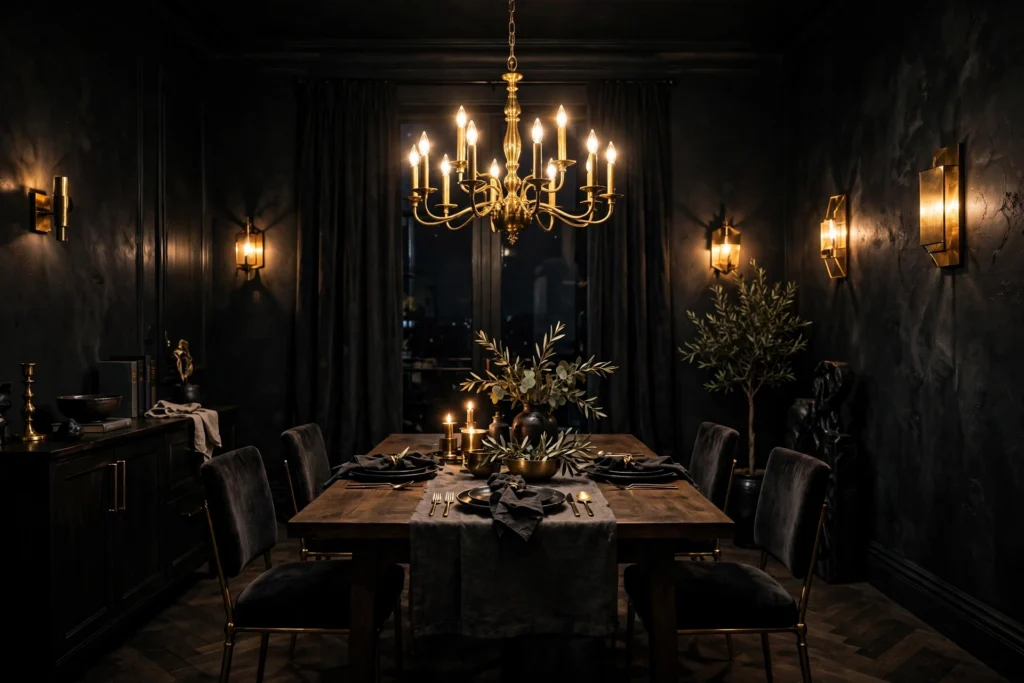

Moody dining room ideas prove that darkness can be delicious. While bright, airy dining rooms have their place, there is nothing quite like settling into a room wrapped in deep color, low light, and rich texture — dinner instantly feels like an event, conversation drops to a delicious murmur, and the outside world disappears. A moody dining room does not just host meals; it stages them.
The secret to moody dining room ideas that feel dramatic rather than dreary is balance: deep walls need warm light, heavy textures need breathing room, and dark palettes need at least one gleaming accent to catch the eye. The fifteen ideas below show how to layer color, light, and texture for a dining room with genuine atmosphere — whether you go full dark academia or just flirt with a charcoal accent wall.
1. Charcoal Walls with Gleaming Brass Accents
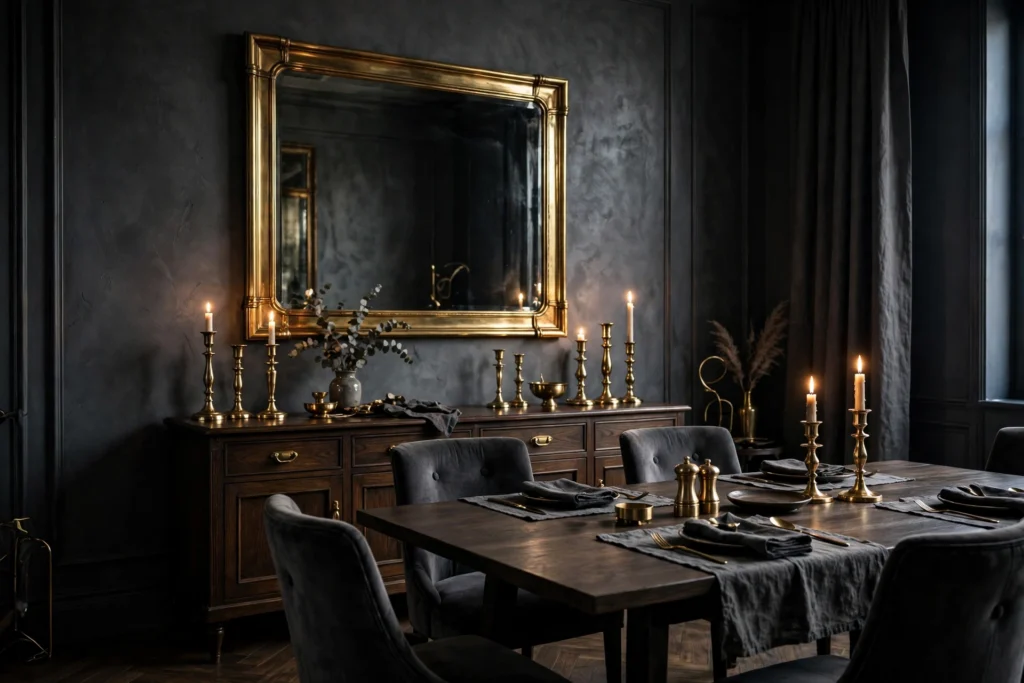
Charcoal gray walls are the gateway to moody dining rooms — deep enough to feel dramatic, neutral enough to live with daily. The trick is pairing them with something that glows: brass candlesticks, a gold-framed mirror, or brushed-brass cabinet hardware catch every bit of light and stop the room from feeling flat. The contrast between matte dark walls and gleaming metal is what gives the space its jewelry-box feel.
Paint the ceiling the same charcoal for a fully enveloping cocoon, or keep it soft white to lift the room slightly. Either way, choose a matte or eggshell finish — glossy dark paint shows every imperfection. Add warmth underfoot with a vintage rug in rust or ochre tones, and the room will feel rich rather than cold, dramatic rather than dark.
2. Black Panel Moulding for Architectural Drama

If painting whole walls black feels like a leap, black panel moulding gives you drama with structure. Applied moulding boxes painted in the same near-black as the wall behind them create shadow lines and architectural depth that flat paint cannot match. The effect is tailored and traditional — think gentlemen’s club or historic library — rather than merely dark.
This treatment works especially well in dining rooms with decent ceiling height, since the vertical lines draw the eye up. Keep the trim crisp by using a satin finish on the moulding against matte walls; the subtle sheen difference adds dimension. Pair with a substantial wood table and leather chairs, and let the walls do the talking — you will need surprisingly little wall decor when the architecture carries the room.
3. Deep Green Walls with Velvet Dining Chairs
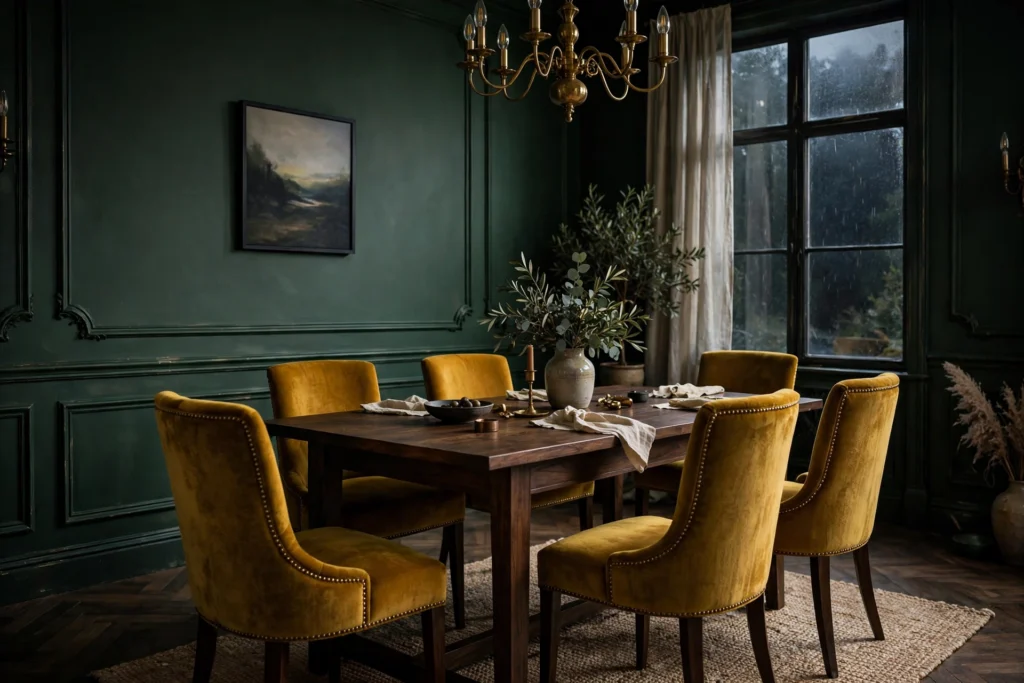
Deep green — forest, emerald, or inky hunter — is the moody color that still feels alive. Unlike black or charcoal, green shifts beautifully through the day, reading almost black at night and richly botanical in daylight. Velvet dining chairs in a complementary jewel tone (mustard, burnt orange, or deep plum) double down on the lushness and make every seat feel like the best one in the house.
Ground the palette with dark wood — walnut or stained oak — and warm metallics like aged brass or bronze. A large piece of landscape art or a moody still life ties the green walls to the room’s story. If full-room green intimidates you, try it on three walls with the fourth in warm white; the asymmetry actually heightens the drama by giving the eye somewhere to rest.
4. Oversized Statement Chandelier as Sculpture

In a moody dining room, the chandelier is not just lighting — it is sculpture. Go oversized and dramatic: a wrought-iron ring chandelier, a cluster of smoked-glass globes, or an antler-inspired fixture becomes the room’s exclamation point, especially when it catches candlelight and throws dancing shadows on dark walls. Scale up boldly — a fixture that feels slightly too big in daylight will feel exactly right at night.
Hang it low, twenty-eight to thirty-two inches above the table, so it enters the sightline and creates intimacy. Chandeliers have crowned dining tables for centuries, evolving from candle holders to the elaborate fixtures we know today — learn more about their history on Wikipedia’s chandelier page. Put it on a dimmer, non-negotiable: the ability to drop the light to a glow is what separates a moody dining room from a merely dim one.
5. Candlelight-First Ambience for Dinner Parties

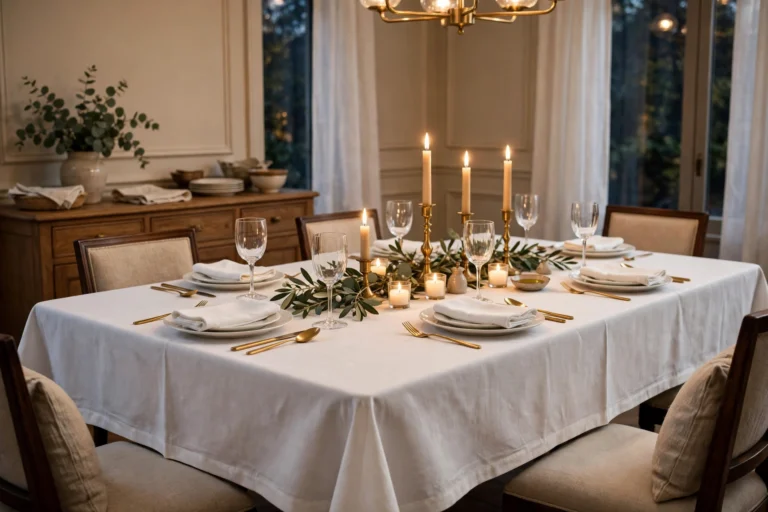
The simplest of all moody dining room ideas costs almost nothing: make candles your primary light source. A long table scattered with pillar candles, taper holders, and tea lights at varying heights creates a flickering landscape that no electric fixture can imitate. Faces look better, food looks better, and the whole evening slows to candlelight pace.
Build your candle collection gradually — thrift stores are goldmines for brass and glass holders. Mix heights deliberately: tall tapers at the back, medium pillars in the middle, and low votives near the front so nobody peers through a forest of flames. Keep overhead lights on a dimmer for the cooking and serving phases, then kill them entirely when everyone sits down. Battery-operated LED candles with realistic flicker are a smart backup for homes with kids or pets.
6. Dark Wood Table with Cognac Leather Seating

A dark walnut or ebonized table paired with cognac leather chairs is the moody dining room’s power couple. The leather’s warm amber tones glow against dark wood, and the material only gets better with age — every scratch and patina mark adds character. This combination feels masculine and rich without trying too hard, and it works in rooms from traditional to industrial.
Let the table be the hero by keeping the surrounding decor quiet: dark walls, a simple rug, and one strong art piece are enough. Leather chairs are also brilliantly practical for a dining room — spills wipe off, and they develop a lived-in softness that fabric cannot match. To see how wall styling completes this rich, layered look, explore our dining room wall decor ideas.
7. Moody Floral Wallpaper for Enveloping Pattern
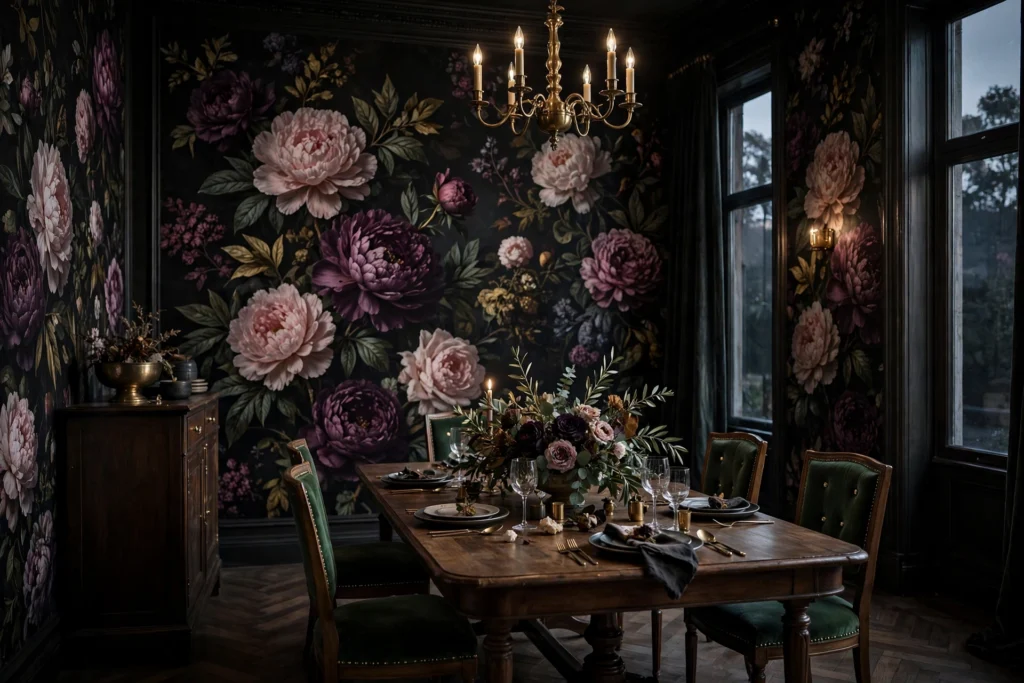
Dark floral wallpaper wraps a dining room in pattern the way a good novel wraps you in story. Look for large-scale botanicals on near-black or deep aubergine grounds — oversized blooms and trailing vines that feel romantic rather than fussy. This is maximalism done right: the pattern is so rich that you need almost nothing else on the walls.
Wallpaper all four walls for total immersion, or paper the wall behind a sideboard as a single dramatic panel. Keep furniture silhouettes simple so they do not compete with the pattern, and echo one of the wallpaper’s accent colors in your chairs or curtains. For more ways to use pattern for atmosphere, browse our dining room wallpaper ideas. Good lighting is essential here — picture lights or sconces keep the dark paper from disappearing at night.
8. Low-Hanging Pendant Cluster Over the Table

A cluster of low-hanging pendants replaces one predictable chandelier with a constellation of light. Group three to seven pendants — smoked glass, black metal, or seeded glass globes — at staggered heights over the dining table so the light pools exactly where the food is. The varying heights create visual rhythm and make the ceiling feel lower and more intimate, which is precisely the moody goal.
Choose warm bulbs (2700K or lower) and frosted or seeded glass to avoid harsh glare at eye level. The cluster works beautifully over round tables, where a single linear fixture would feel wrong, and it gives you flexibility: raise a pendant or two when you need task light, drop them all low for dinner-party drama. Black cords disappearing into a dark ceiling complete the floating effect.
9. Smoked Glass and Antique Mirrors

Smoked glass and antique mirrors are a moody dining room’s secret weapons for light management. A smoked-glass pendant or a set of gray-tinted hurricanes softens light to a flattering amber haze, while an antique mirror — with its foxed, mottled surface — reflects candlelight without the harsh clarity of a new mirror. Together they multiply your light sources while keeping everything soft.
Hang one large antique mirror opposite your candles or chandelier to double the glow, or group smaller mismatched mirrors gallery-style for a collected feel. Smoked glassware on the table — water glasses, decanters, bud vases — extends the theme to place settings. These reflective surfaces are especially valuable in windowless or north-facing dining rooms, where every photon of light needs to work twice as hard.
10. Oxblood and Plum Upholstery
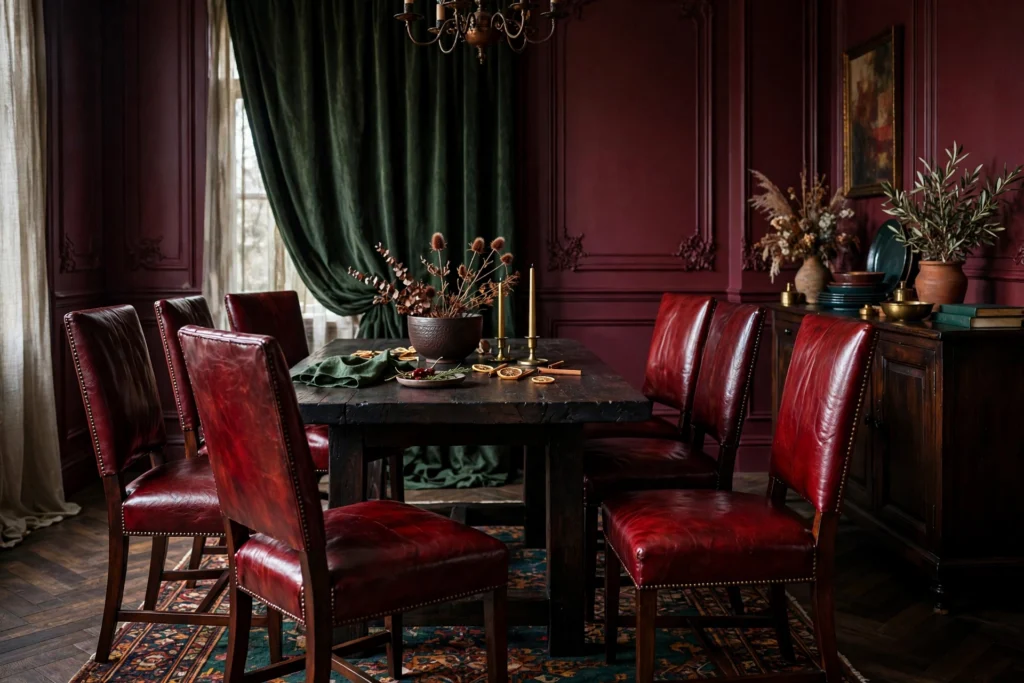
Oxblood red and deep plum are the moody dining room’s most seductive upholstery colors — rich, wine-dark, and endlessly flattering in low light. Fully upholstered dining chairs in oxblood leather or plum velvet turn seating into the room’s luxury statement, and the deep tones hide the sins of enthusiastic dinner parties far better than pale fabrics.
Use these colors with confidence but not everywhere: upholstered chairs plus dark walls is plenty; add a neutral rug to give the eye a rest. Brass or black metal chair legs keep the look grounded and contemporary. If committing to eight plum chairs feels bold, start with a pair of upholstered host chairs at the table ends — they read as intentional accents and you can expand the set later.
11. Gallery Wall in Uniform Dark Frames

A gallery wall in uniform black or espresso frames brings curated drama to a moody dining room. The consistent framing unifies wildly different art — moody landscapes, botanical prints, abstract studies, family photos in sepia — into one cohesive statement. Against dark walls, the frames nearly disappear and the art seems to float, lit like a private museum.
Plan the layout on the floor first, keeping two to three inches between frames for a tailored look. Mix sizes but keep one dominant piece as the anchor. Small picture lights above the arrangement, or a pair of sconces flanking it, make the gallery glow after dark. This is one of the most personal moody dining room ideas — the art you choose tells your story, and the dark frames make it all look deliberate.
12. Modern Moody Minimalism with Sculptural Light

Moody does not have to mean traditional — a modern minimalist dining room in dark tones feels like a chic private dining club. Think matte black walls, a live-edge or blackened-steel table, ghost-simple chairs, and one jaw-dropping sculptural light fixture doing all the decorative work. Restraint is the whole point: every object earns its place, and the darkness itself becomes the luxury.
The key to modern moody is material contrast rather than color: rough against smooth, matte against gleam. A travertine table against black walls, or a polished concrete floor under a wool rug, creates tension that keeps minimalism from feeling sterile. For a deeper dive into pared-back dining style, see our modern dining room design ideas. Keep clutter ruthlessly at bay — minimalism only works when surfaces stay clear.
13. Painted Ceiling in a Deep, Daring Tone

Painting the ceiling a deep tone — ink navy, espresso, or even black — is the moody move most people overlook. The ceiling is the dining room’s fifth wall, and a dark one makes the room feel like an intimate tent, especially under a glowing chandelier. It also hides ceiling imperfections and makes crown moulding pop in sharp relief if you paint the trim a contrasting shade.
This works best with ceilings of nine feet or more, though a dark ceiling in a smaller room simply feels cocooning rather than cramped — commit fully rather than apologizing for it. Extend the color slightly down the top of the walls for a seamless wrap, or cut a crisp line at the picture rail for architectural precision. Either way, guests will look up — which means your light fixture needs to be worth the attention.
14. Fireplace Glow as the Only Light Source
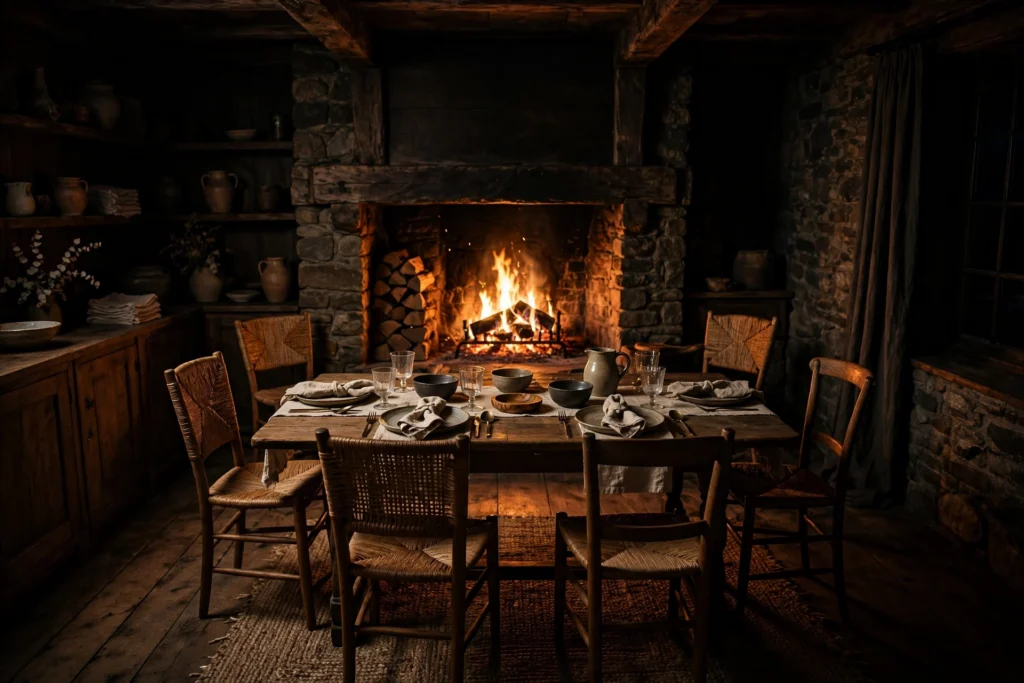
If your dining room has a fireplace, try the ultimate moody experiment: firelight only. On a winter evening, let the hearth be the room’s sole illumination — no overheads, no lamps, just flames and candles. The flickering light carves faces and food out of darkness in a way that feels ancient and primal, and dinner becomes an occasion burned into memory.
This works best with wood-burning or realistic gas fireplaces that produce genuine moving flame; a modest electric insert can contribute if it is the flickering-flame type. Arrange seating to face the fire so everyone shares the view, and keep a basket of throws nearby — the slight chill beyond the fire’s warmth is part of the experience. Even without a fireplace, a cluster of large pillar candles in the hearth of an unused firebox approximates the effect beautifully.
15. Layered Textures: Velvet, Linen, and Worn Wood
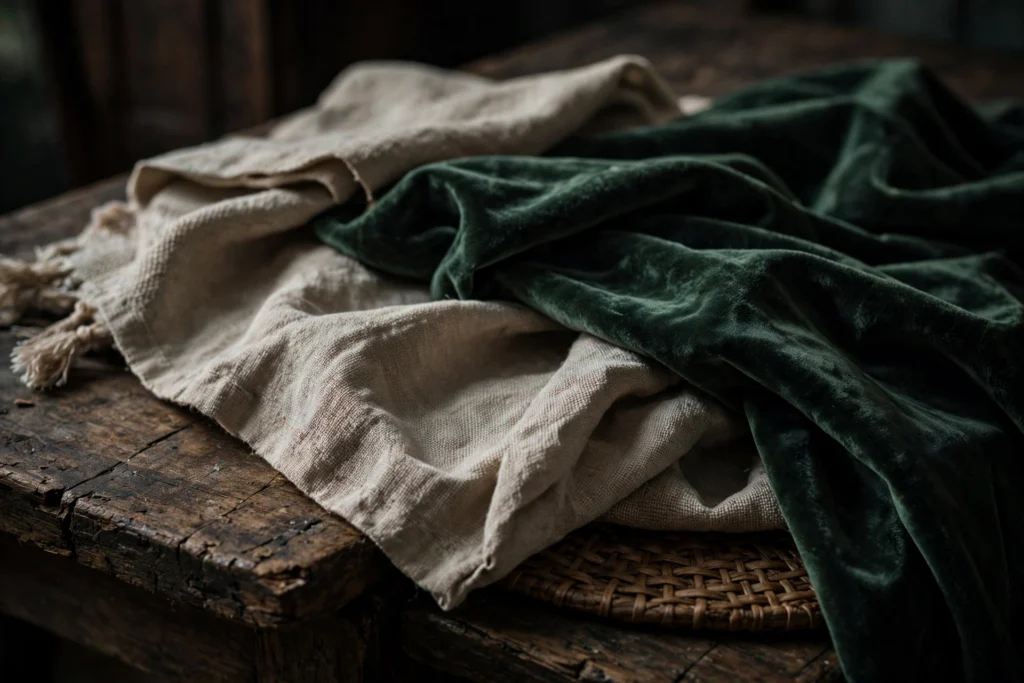
When color goes dark, texture has to do the heavy lifting — and the winning combination is velvet, linen, and worn wood. Velvet chairs catch light in shifting folds, nubby linen curtains filter it softly, and a worn wood table grounds everything with honest grain. Each material reads differently in low light, so the room stays visually interesting even in a near-monochrome palette.
Layer deliberately: a velvet bench cushion on a wood settle, linen napkins against dark stoneware, a wool rug under a glass-topped table. The rule is contrast — smooth against rough, soft against hard, matte against sheen. The dining room has hosted family meals for centuries across every culture; read about its enduring role on Wikipedia’s dining room page. In a moody room, texture is what guests actually feel, so choose materials you want to touch.
Frequently Asked Questions
What colors make a dining room moody?
The classic moody palette centers on deep, saturated tones: charcoal, near-black, ink navy, forest green, oxblood, espresso, and aubergine. These colors absorb light and create intimacy. For the most successful result, pick one dominant dark tone for walls and support it with warm metallics (brass, bronze), natural wood, and at least one lighter element — a pale rug or cream curtains — to keep the room from feeling like a cave.
How do you keep a dark dining room from feeling small?
Layer your lighting: overhead fixtures, sconces, candles, and even LED strips work together so no corner goes fully black. Add reflective surfaces — mirrors, glass, metallics — to bounce light around. Keep the ceiling lighter than the walls if you are nervous, use a rug with some pattern to define the floor, and avoid overcrowding: fewer, larger furniture pieces make a dark room feel grand rather than cramped.
What lighting works best in a moody dining room?
Warm, dimmable, and layered. Every fixture should be on a dimmer, bulbs should be 2700K or warmer, and you want at least three light sources: a statement overhead (chandelier or pendants), wall-level light (sconces or picture lights), and table-level glow (candles). The goal is pools of warm light in a dark field — bright enough to see your food and each other, dim enough that the room keeps its mystery.
Can a moody dining room work with natural wood tones?
Absolutely — natural wood is one of the best partners for dark walls. Medium and dark woods (walnut, stained oak, mahogany) melt into a moody palette, while even light oak works as a deliberate contrast that keeps the room from going flat. Wood’s grain adds organic texture that dark paint lacks, so a wood table is often the single piece that makes a moody dining room feel warm instead of cold.
What table shape suits a moody dining room?
Round tables are the moody dining room’s best friend: they pull chairs close, keep everyone in candlelight range, and soften all those dark, angular walls. A round pedestal table also improves flow in smaller dark rooms. That said, a long rectangular farmhouse table suits the great-hall version of moody — banquet-style, dramatic, made for crowds. Choose based on how you actually gather, then light it warmly.
Keep Exploring
A moody dining room is a love letter to the evening — to long dinners, low light, and conversations that outlast the candles. Whether you commit to ink-dark walls or simply dim the chandelier and light the tapers, atmosphere is the most affordable luxury in decorating. Pick one idea, pour something red, and let the room do the rest.