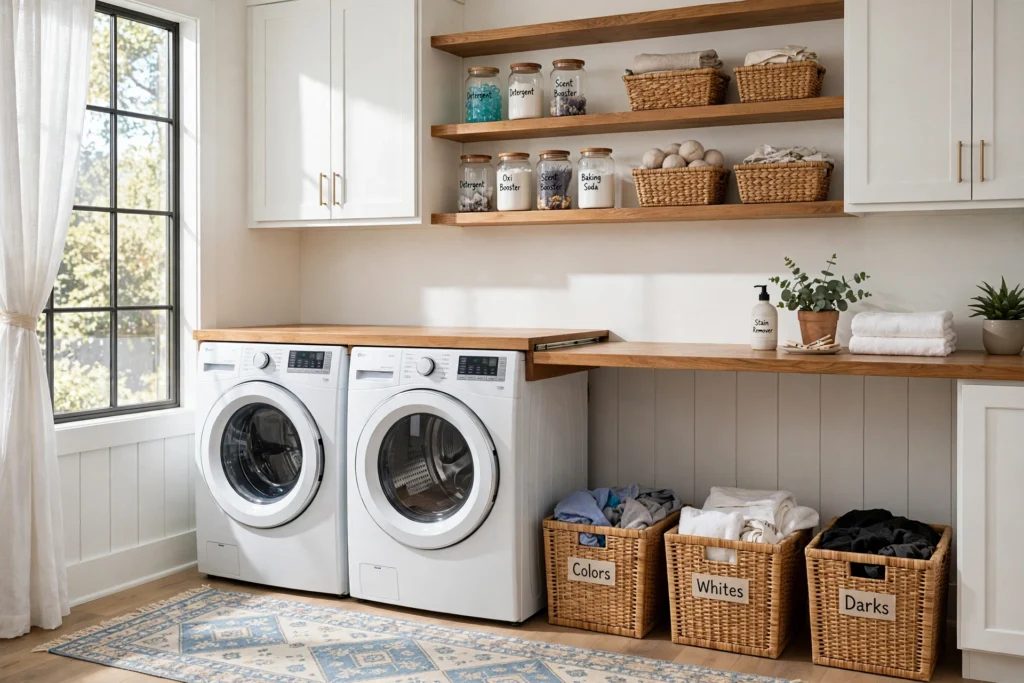

A well-organized laundry room changes the chore entirely. When every detergent has a home, every load has a clear path from hamper to hanger, and the floor is actually visible, laundry stops feeling like a battle and starts feeling like a routine you can handle on autopilot.
The good news is that laundry room organization ideas don’t require a renovation or a big budget. Most of the biggest wins are about systems: where things land, how they flow, and what earns its space. Here are fifteen practical ideas to turn your laundry area into a tidy, efficient space that practically runs itself.
1. Set Up a Three-Bin Sorting Station
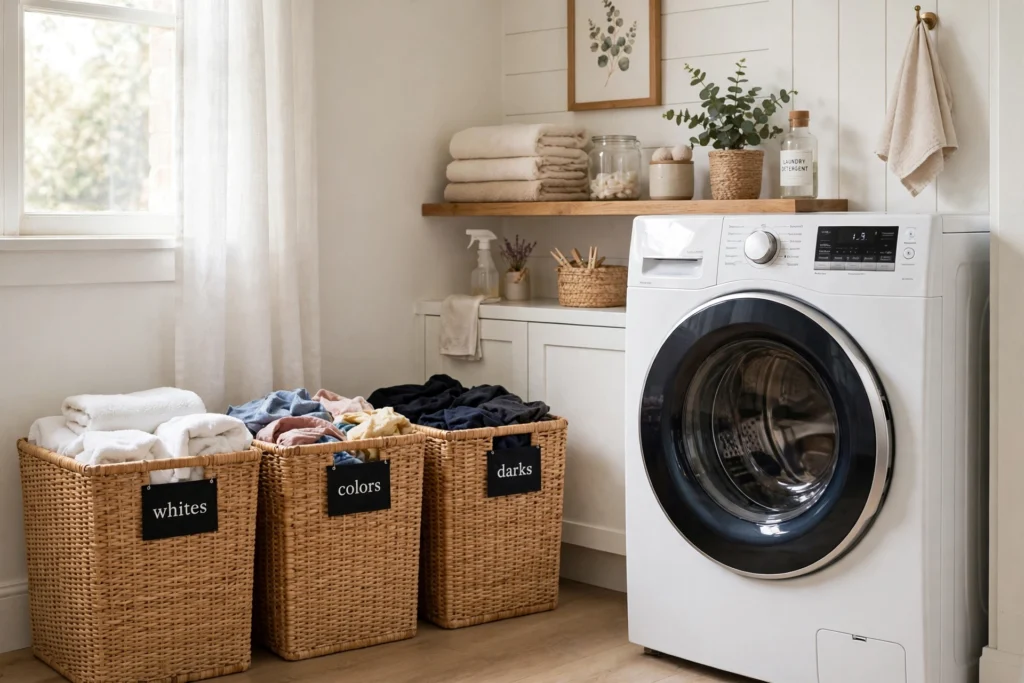
Sorting is where laundry chaos starts, so give it a proper system. Set up three bins — whites, colors, and darks — plus a small fourth for delicates, and make them visible and easy to toss into. The moment dirty clothes have a designated landing spot, the floor stops collecting stray socks.
Label each bin clearly and position them where clothes actually come off — near the bedroom door or inside the laundry room entrance. If you’re tight on space, stackable sorters or a single rolling cart with three compartments does the same job. Apartment Therapy’s roundup of 22 laundry room organization ideas puts a sorting station at the top of every efficient laundry room, and for good reason: when sorting is effortless, everything downstream runs smoother.
2. Mount a Wall-Mounted Drying Rack

Freestanding drying racks eat an entire room the moment they open. A wall-mounted rack that folds flat against the wall gives you full air-drying capacity for delicates, swimwear, and hand-wash items — with zero permanent footprint. Flip it down when you need it, fold it away when you don’t.
Install it near your folding area at a comfortable reaching height, and choose one rated for a full wet load so it doesn’t sag. Accordion-style wooden racks look handsome enough to stay visible, while retractable line-style racks disappear almost completely. Either way, the laundry room keeps its floor clear for the folding and sorting that actually need the space.
3. Decant Detergents into Matching Containers

Nothing makes a laundry room look chaotic faster than a jumble of mismatched plastic jugs with torn labels. Decant detergent, pods, scent beads, and stain remover into matching glass jars or uniform dispensers with labels. The visual calm is instant — and you’ll always know at a glance when something is running low.
Keep it practical: choose containers that pour cleanly and seal tight against moisture, and transfer only what you’ll use in a month or two to keep products fresh. A row of labeled jars on one shelf turns the most cluttered corner of the room into a display worth looking at, which is the secret trick of every organized space — make the system itself beautiful and you’ll maintain it.
4. Install Open Shelves Over the Machines
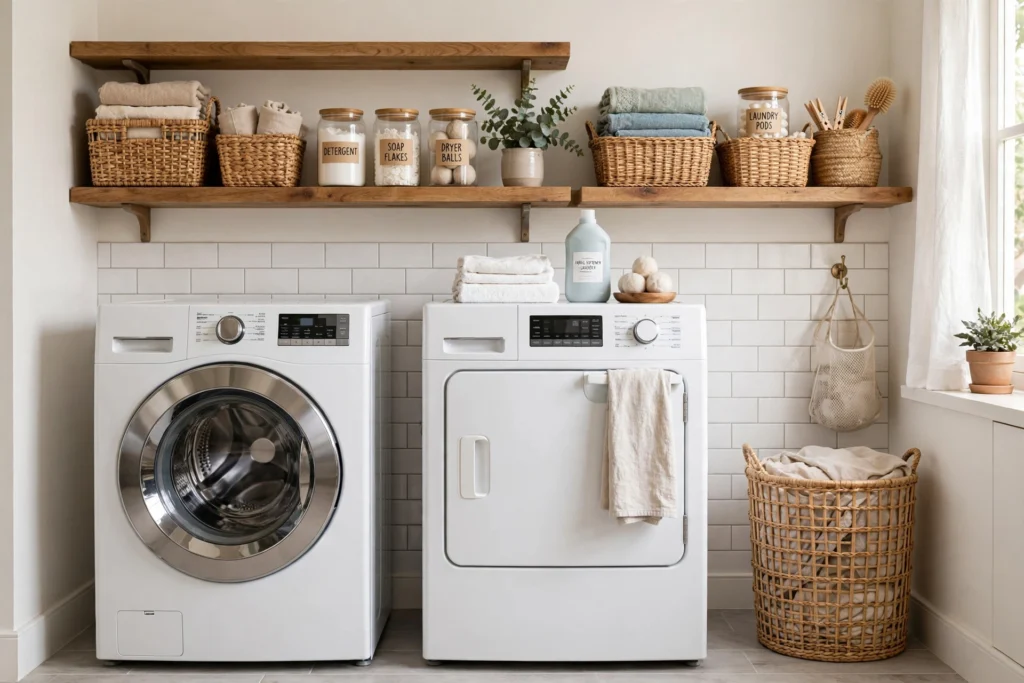
The wall above your washer and dryer is prime storage real estate going to waste in most laundry rooms. Two sturdy open shelves hold detergent, dryer sheets, stain treatments, and baskets of supplies within arm’s reach of where you actually use them. Open shelving keeps everything visible so nothing gets forgotten behind a cabinet door.
Style them with intention: corral small items into woven baskets or uniform bins, and leave breathing room between groupings so the shelf reads as organized rather than crowded. In a narrow room, a single long shelf works; in a galley layout, run it the full length of the wall. For more ways to make compact rooms work harder, our 15 Small Laundry Room Design Ideas That Work Hard and Look Good shows how vertical storage transforms tight footprints.
5. Add a Folding Counter Over Side-by-Side Machines
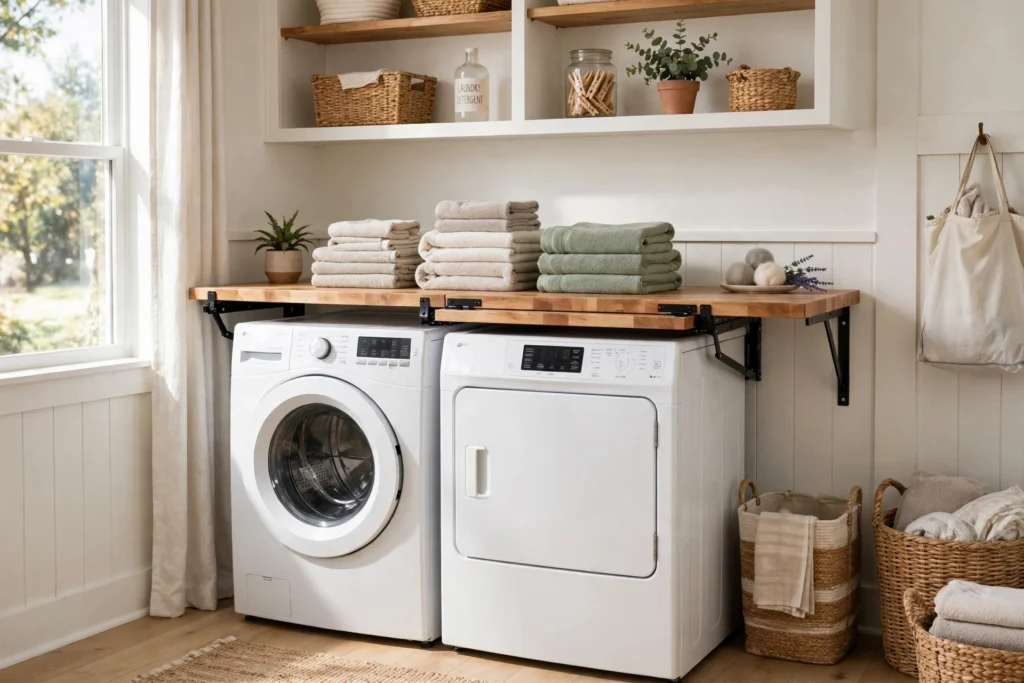
If your machines sit side by side, a slab of butcher block or sealed plywood across the top creates an instant folding station — the most-used surface in any laundry room. It turns dead appliance tops, which otherwise collect clutter and scatter it during the spin cycle, into a proper workspace.
Leave a small gap at the back for cords and venting, seal the wood against moisture, and don’t permanently attach anything you’ll need to remove for machine service. A hinged or lift-off top gives you maintenance access. Once you have a real folding surface, clothes stop piling up in laundry baskets for days — folding becomes a five-minute finish to each load instead of a dreaded weekend project.
6. Use a Rolling Cart for the Dead Gap
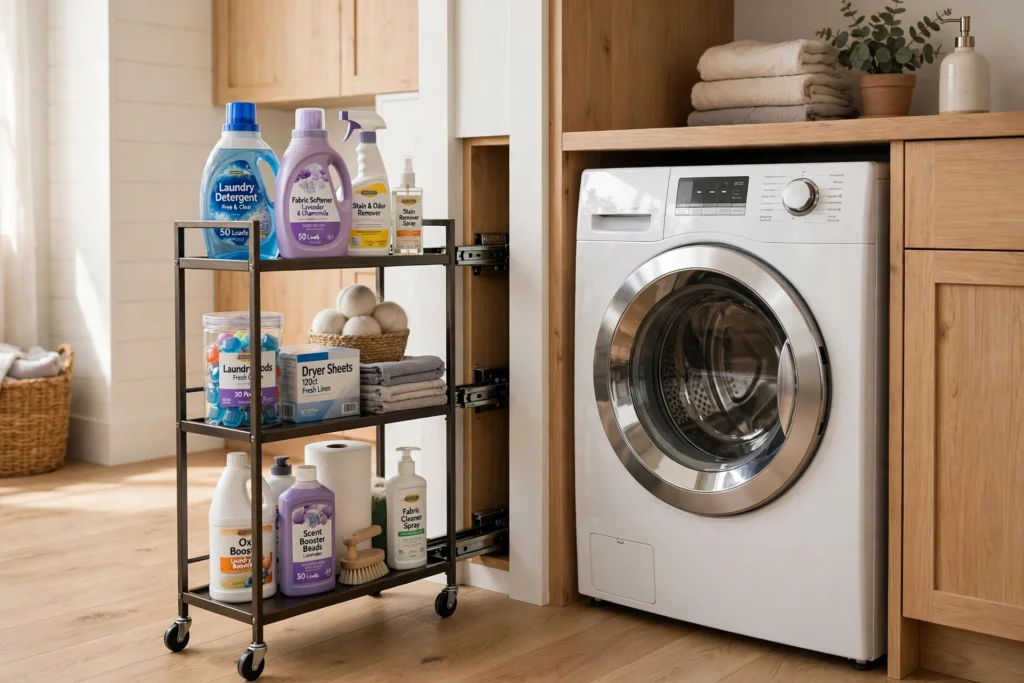
That narrow gap between or beside your machines is wasted space in most laundry rooms. A slim rolling cart — six to eight inches wide — slides right in and holds a full supply of detergent, stain removers, dryer sheets, and clothespins stored vertically where you can see everything at once.
Choose a cart with multiple tiers and smooth-rolling casters, and it pulls out in one motion when you need something from the back. It’s one of the cheapest organization upgrades you can buy, requires zero tools, and works for renters too. Pair it with a small caddy on top for the daily-use items and the cart becomes your laundry room’s mobile supply station.
7. Hang a Lost-Sock Station
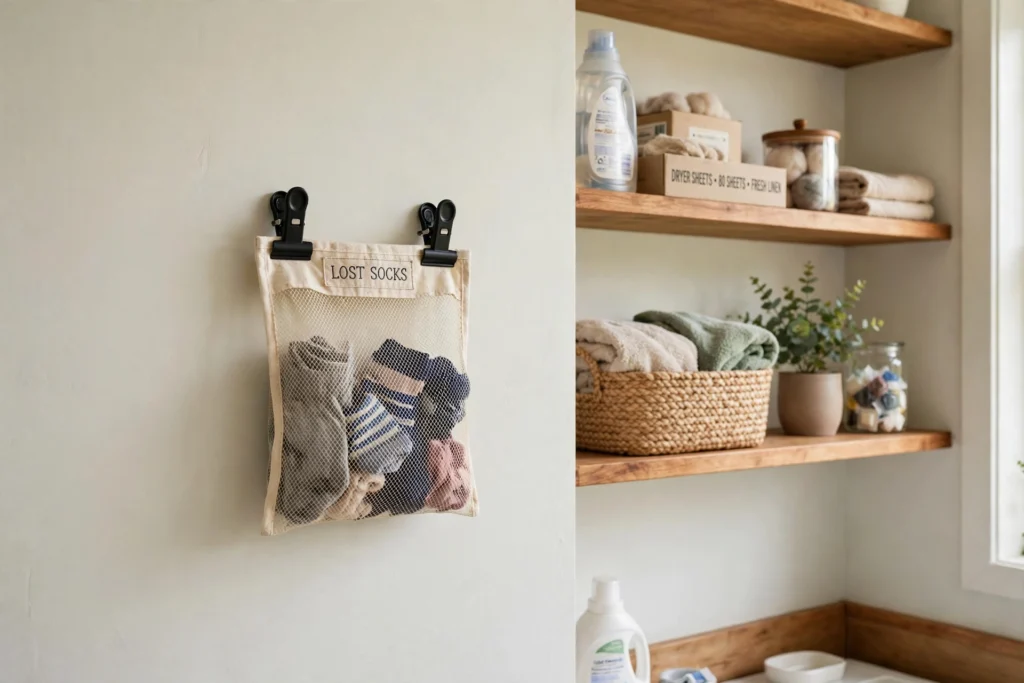
Orphan socks are the eternal mystery of laundry day, so stop letting them vanish. Mount a small mesh bag, a lidded bin, or a row of magnetic clips on a board near the folding counter and designate it the official lost-sock station. Every lone sock goes there the moment it’s discovered — no more, “I’ll find its match later.”
Check the station once a month; most pairs turn up within a load or two. The system works because it’s visible and specific — a sock in the bin is a sock with a future, while a sock on top of the dryer is gone forever. It’s a small detail, but organized laundry rooms are built from dozens of small details like this one.
8. Create a Stain-Treatment Command Post
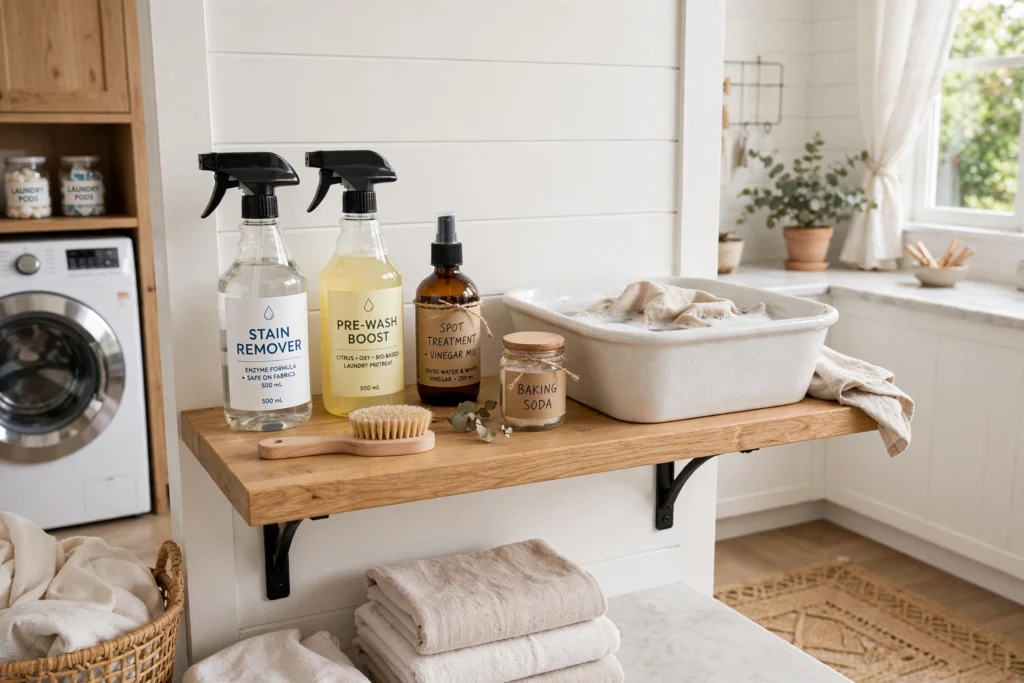
Stains are time-sensitive, so your stain-fighting supplies shouldn’t live three rooms away. Dedicate one spot — a shelf, a caddy, or a section of your folding counter — as the stain-treatment station: stain remover spray, a bar of stain soap, an old soft-bristle brush, and a small dishpan for soaking.
Keep a simple chart of common stain treatments taped inside a cabinet door so anyone in the household can act fast. The Spruce’s collection of laundry room ideas is full of similar dedicated-zone thinking — the rooms that work best are the ones where every task has a home. When the tools are within arm’s reach, a stain gets treated the moment it comes out of the hamper instead of after it’s set.
9. Install a Pull-Out Ironing Board
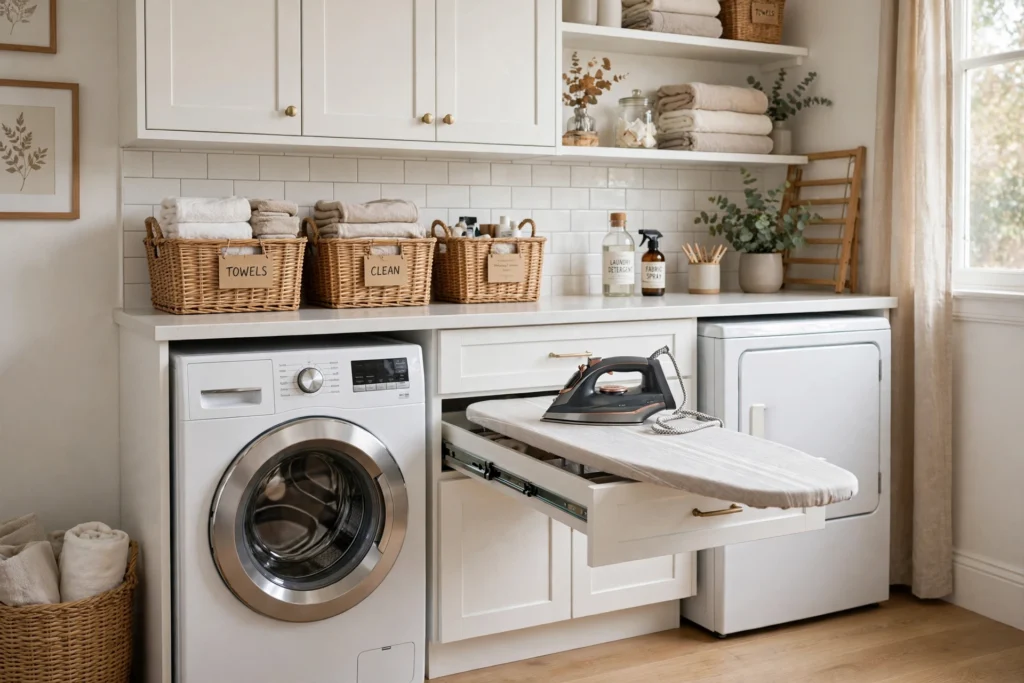
A freestanding ironing board is a space hog that spends nearly its whole life leaning in a corner. A pull-out or fold-down board built into a drawer or mounted on the wall disappears completely when closed, then extends to full ironing height in seconds.
Position it near an outlet and give it a clear swing radius. Many pull-out models include compartments for the iron, spray starch, and a lint roller, so the entire pressing station tucks into what was previously dead space. You’ll actually iron things when setup takes five seconds — and the laundry room never has to look at a leaning board again.
10. Label Everything With a Label Maker
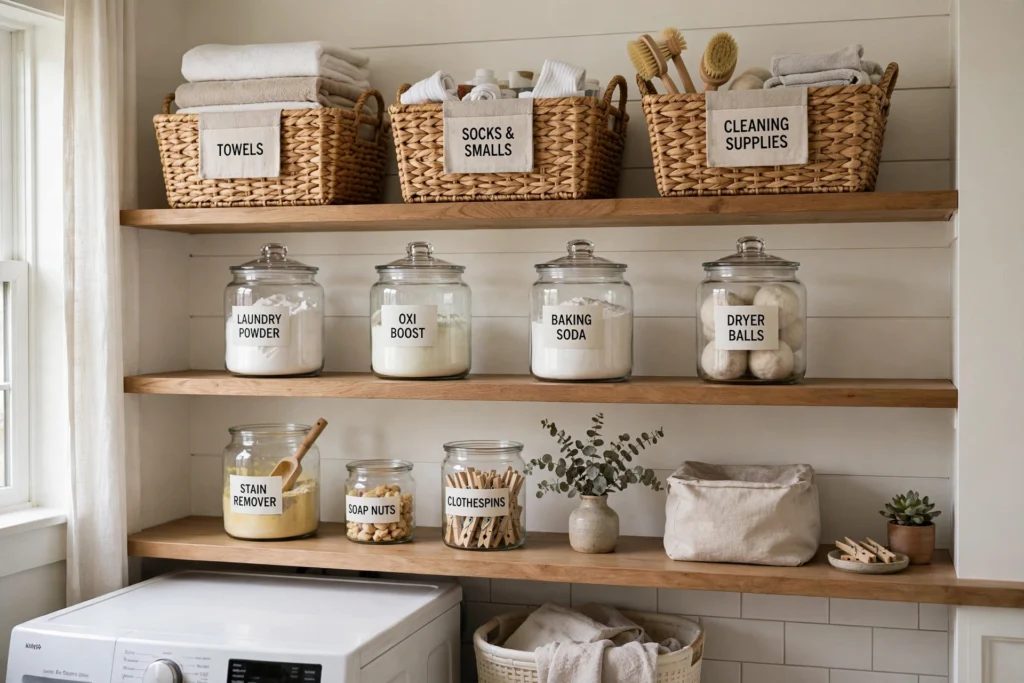
Labels are the difference between a tidy week and a tidy year. A label maker turns baskets, jars, bins, and shelf edges into a self-maintaining system that survives kids, guests, and tired 10 p.m. laundry sessions. Label the detergent jars, the sort bins, the cleaning-supply caddy, even the shelves themselves.
The rule is simple: if a container doesn’t have a label, it becomes a junk drawer. Start with the five most-used spots — detergent, stain treatment, clothespins and clips, cleaning rags, and the lost-sock station — and expand from there. Labels also stop well-meaning family members from putting things back in the wrong place, which is half the battle in any shared space.
11. Go Magnetic on the Machine Sides
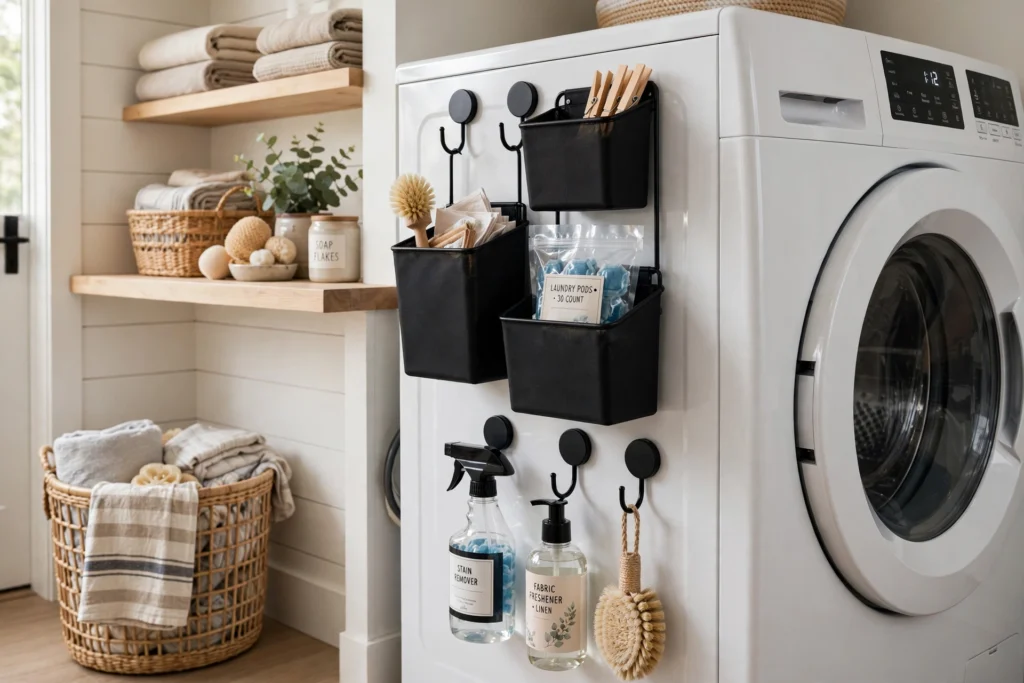
The sides of your washer and dryer are acres of untapped vertical real estate. Magnetic bins, hooks, paper-towel holders, and slim spice-style containers stick right to the metal and keep stain pens, dryer sheets, lint rollers, and clothespins exactly where you reach for them — no wall space or drilling required.
This is a perfect renter-friendly win and it costs almost nothing. Keep the magnets rated for real weight (full detergent bottles are heavy), and cluster items by task: everything for the wash on one machine, everything for drying on the other. When supplies live on the machines themselves, the walk across the room to grab something mid-load disappears entirely.
12. Add a Hanging Rod for Air-Dry Items
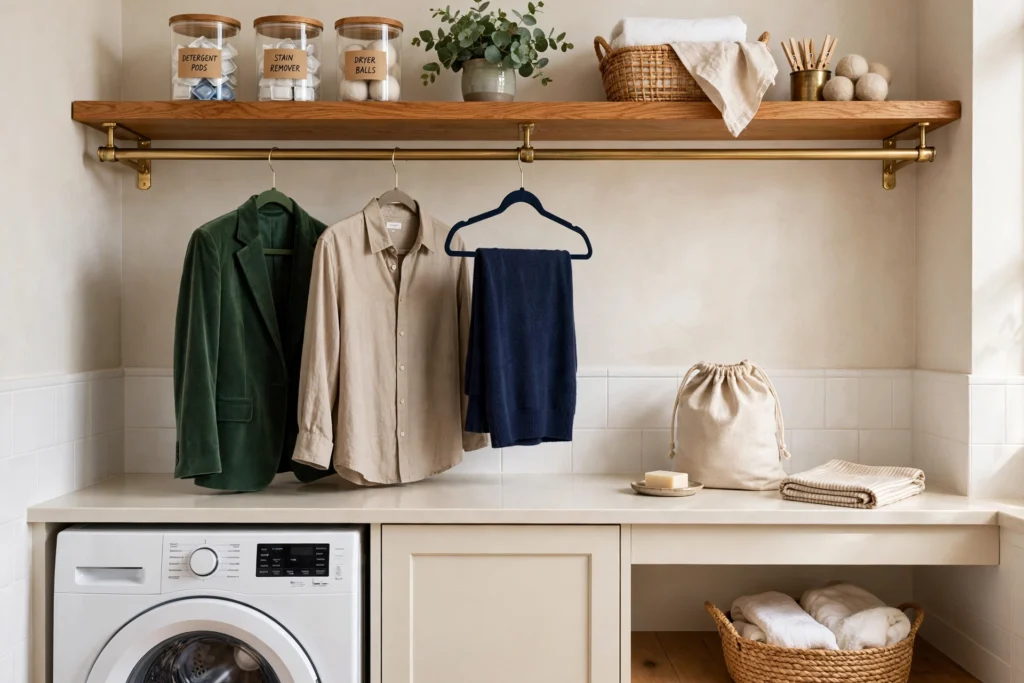
Not everything belongs in the dryer, and delicates draped over the machines end up wrinkled and forgotten. Mount a sturdy rod under a shelf or between two walls, at a height that keeps hangers clear of the appliances, and give air-dry items a permanent home.
Brass or matte-black rods double as a design detail when empty. Keep a stack of slim velvet hangers nearby so garments go straight from rod to closet. A hanging rod paired with your folding counter creates a complete wash-dry-fold workflow in a few square feet — the kind of organized flow that makes a small laundry room feel twice its size.
13. Corral Cleaning Supplies in One Caddy
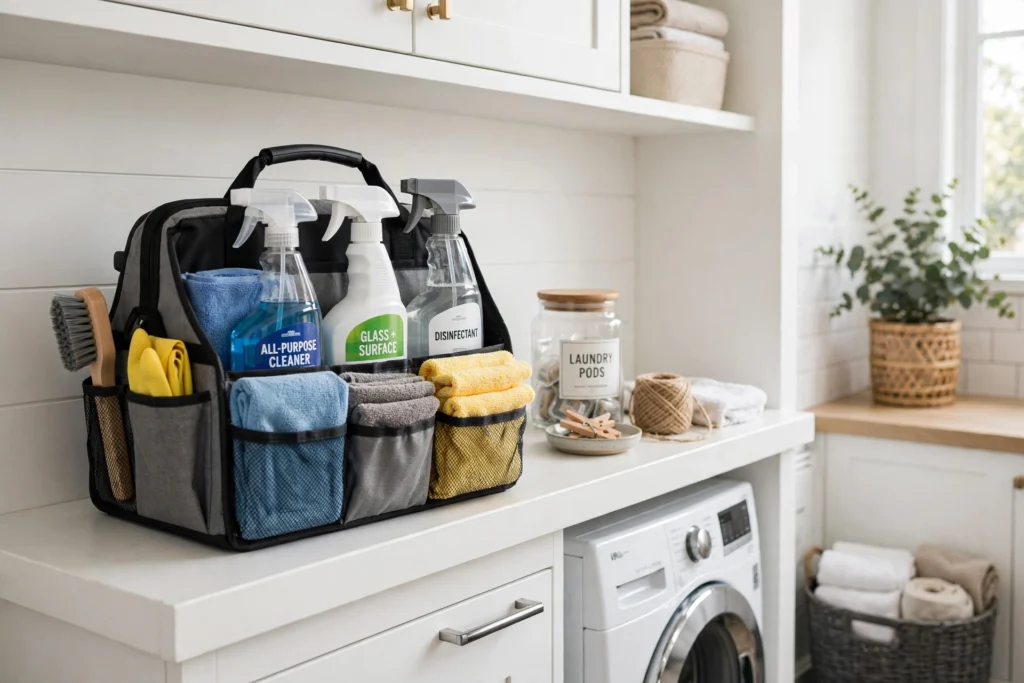
Laundry rooms accumulate cleaning supplies from all over the house — the duster, the glass cleaner, the bathroom spray that migrated. Corral everything into one portable caddy with a handle, and keep it on a shelf or in a cabinet in the laundry room. When it’s cleaning time, grab the caddy and go; when you’re done, it all comes back to one spot.
Audit the caddy seasonally and toss anything dried out, expired, or duplicated. One all-purpose cleaner beats four half-used specialty bottles. A single organized caddy also stops you from buying duplicates — you’ll see what you have every time you open the laundry room, which is exactly the point of the system.
14. Use the Back of the Door
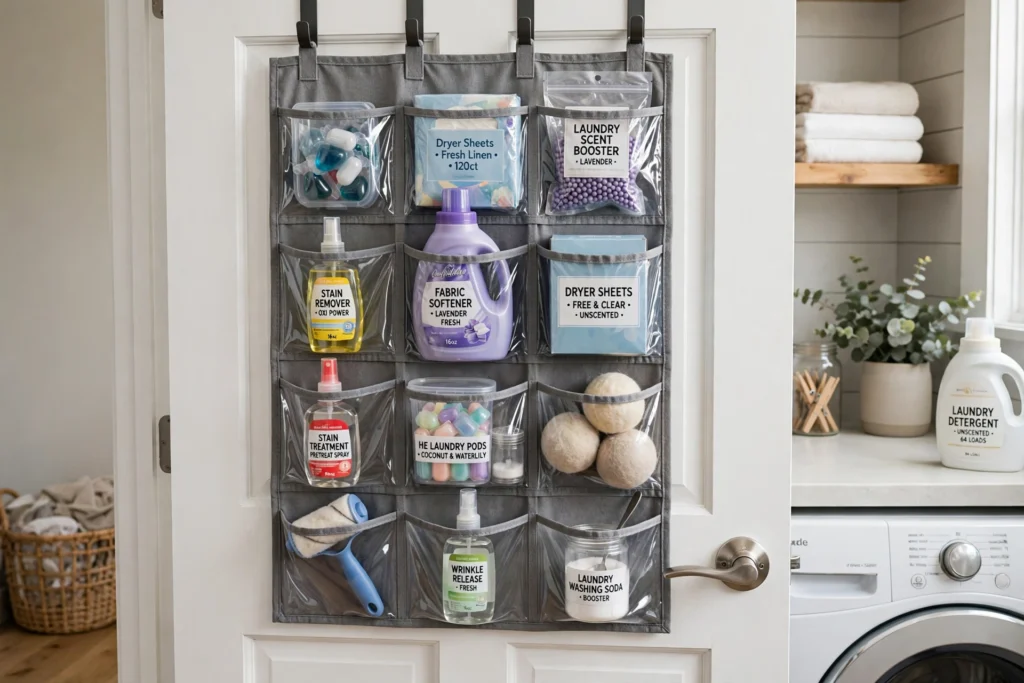
The back of the laundry room door is storage space you’re already heating and lighting — put it to work. An over-the-door organizer with clear pockets holds stain sticks, sewing kits, dryer balls, and all the small items that otherwise vanish into drawers. A slim over-the-door rack can carry the ironing board, the broom, or a fold-flat drying rack.
Keep the door system light and rattle-free so it doesn’t swing annoyingly with every wash cycle. For renters, over-the-door solutions are gold: zero holes in the wall, fully reversible, and they add the equivalent of an extra shelf of storage to even the tiniest laundry closet.
15. Build a Weekly Laundry Rhythm
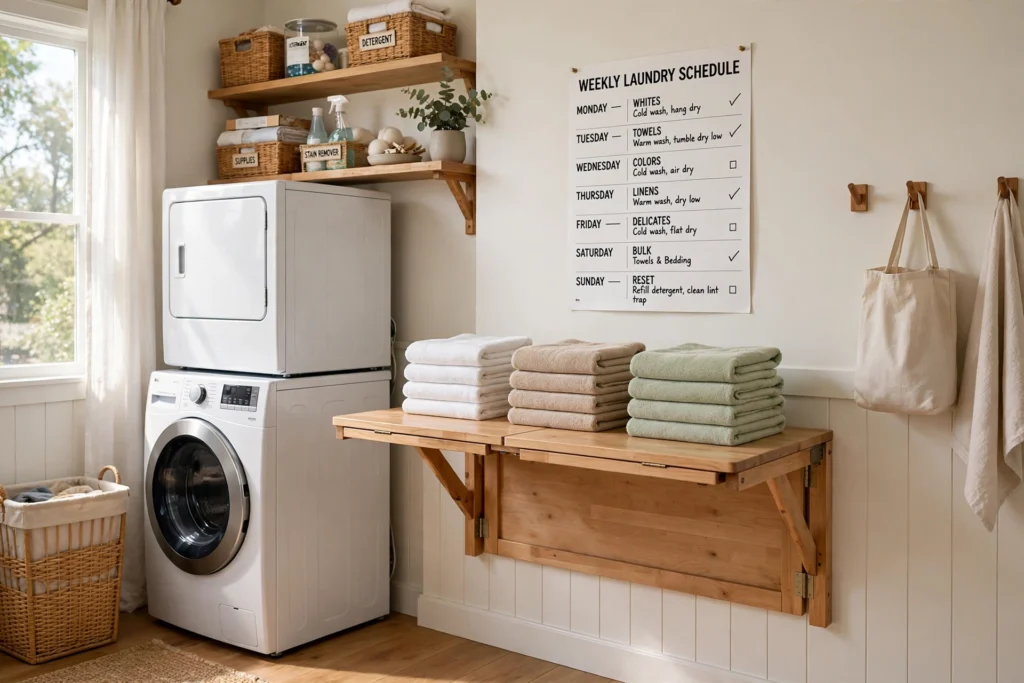
The most organized laundry room in the world still fails without a rhythm. Build a simple weekly schedule and post it inside a cabinet door: sheets on Sunday, towels on Wednesday, delicates on Friday — whatever fits your household. Assign each person a hamper and a day, and laundry becomes a background process instead of a weekend avalanche.
Pair the rhythm with a nightly two-minute reset: clear the folding counter, return supplies to their homes, start tomorrow’s first load if the machines are free. For more small-space thinking that keeps routines running, our 15 Mudroom Design Ideas That Make Every Entryway Work Harder applies the same everything-has-a-home philosophy to the busiest corner of the house. Systems beat motivation every time — and a posted schedule is a system you don’t have to remember.
Frequently Asked Questions
How do I organize a very small laundry room?
Think vertically and eliminate single-use items. Wall-mounted drying racks, shelves over the machines, magnetic storage on the appliance sides, and an over-the-door organizer add the equivalent of several extra shelves without touching the floor. A slim rolling cart fills the dead gap between machines, and decanting supplies into stackable containers keeps every inch working.
What is the best way to sort laundry?
Set up a labeled three-bin station — whites, colors, darks — plus a small bag for delicates, placed where clothes actually come off. Sorting at the source means you never re-sort at the machine. Keep the bins visible and easy to toss into; a system nobody uses is just furniture.
How do I keep my laundry room from getting cluttered again?
Give every item one labeled home and do a nightly two-minute reset: clear the folding counter, return supplies to their labeled spots, and toss the lost socks in their station. Audit quarterly — expired products, dried-out markers, duplicate supplies — and remove what crept in. Maintenance is the system, not an extra step.
Should I decant laundry detergent?
Yes, if you value a calm, functional space. Matching labeled containers make supplies easy to find, show you at a glance what’s running low, and stop the visual chaos of mismatched jugs. Keep it practical: airtight containers for powders, easy-pour dispensers for liquids, and only decant a month or two of product at a time to keep it fresh.
What cleaning supplies belong in the laundry room?
Keep it lean: one all-purpose cleaner, glass cleaner, a stain remover, dryer sheets or balls, lint rollers, and a small tool kit for quick fixes. Store them in one portable caddy so you can grab and go. Anything you haven’t used in three months probably belongs somewhere else — or in the trash.
Keep Exploring
An organized laundry room pays you back every single week — in found socks, unstained shirts, and ten minutes saved on every load. Start with the sorting station and the folding counter, add the labeled systems one at a time, and let the rhythm build.
For more ways to make small hardworking spaces earn their keep, explore our 15 Closet Office Design Ideas for a Smart Small Space Workspace — the same vertical thinking and zone-by-zone logic, applied to a whole different room. And remember: the tidiest rooms aren’t the biggest ones, they’re the ones with the best systems.







[…] run low. Group by task: stain treatment, drying, ironing. For more organization systems, see our 15 laundry room organization ideas for a tidy, efficient […]
[…] style with storage, because in a small utility space every pretty thing should also earn its keep. Laundry room organization ideas for a tidy efficient space go deeper on systems that keep it all […]