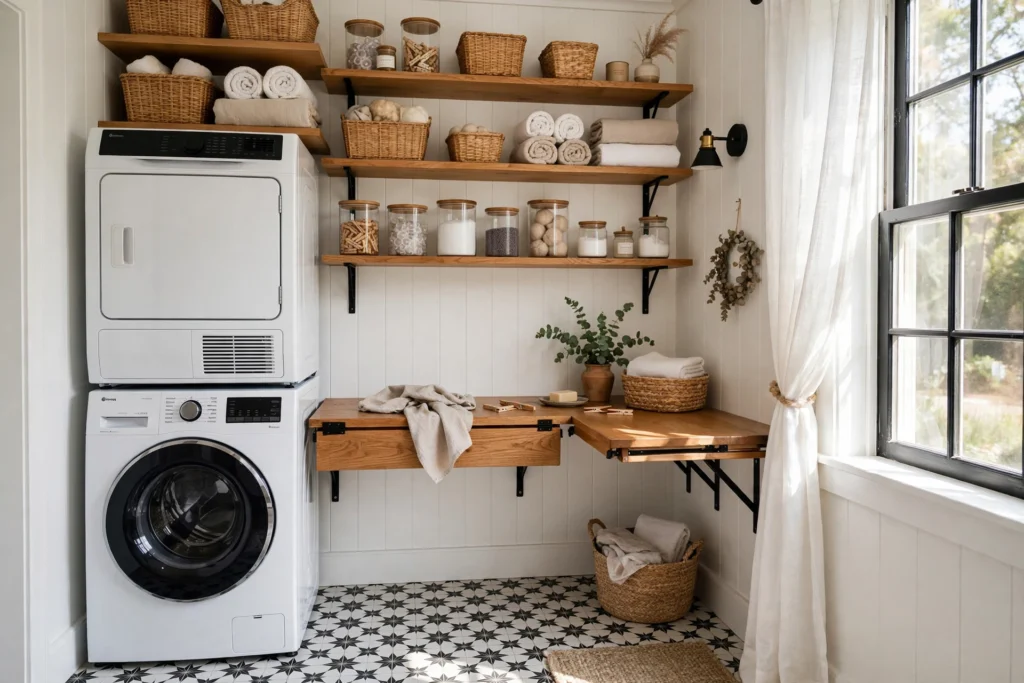

The laundry room is one of the hardest-working rooms in your home and usually one of the smallest. It has to sort, wash, dry, fold, and store — all in a footprint that often fits inside a closet. The good news is that small laundry rooms respond brilliantly to smart design: every inch you reclaim feels like a bonus.
These small laundry room design ideas prove that a tight footprint can still work hard and look good. From stacked machines and hidden drying racks to wallpaper that makes you smile, here are fifteen ways to turn your laundry corner into a space you actually enjoy using.
1. Stack the Washer and Dryer
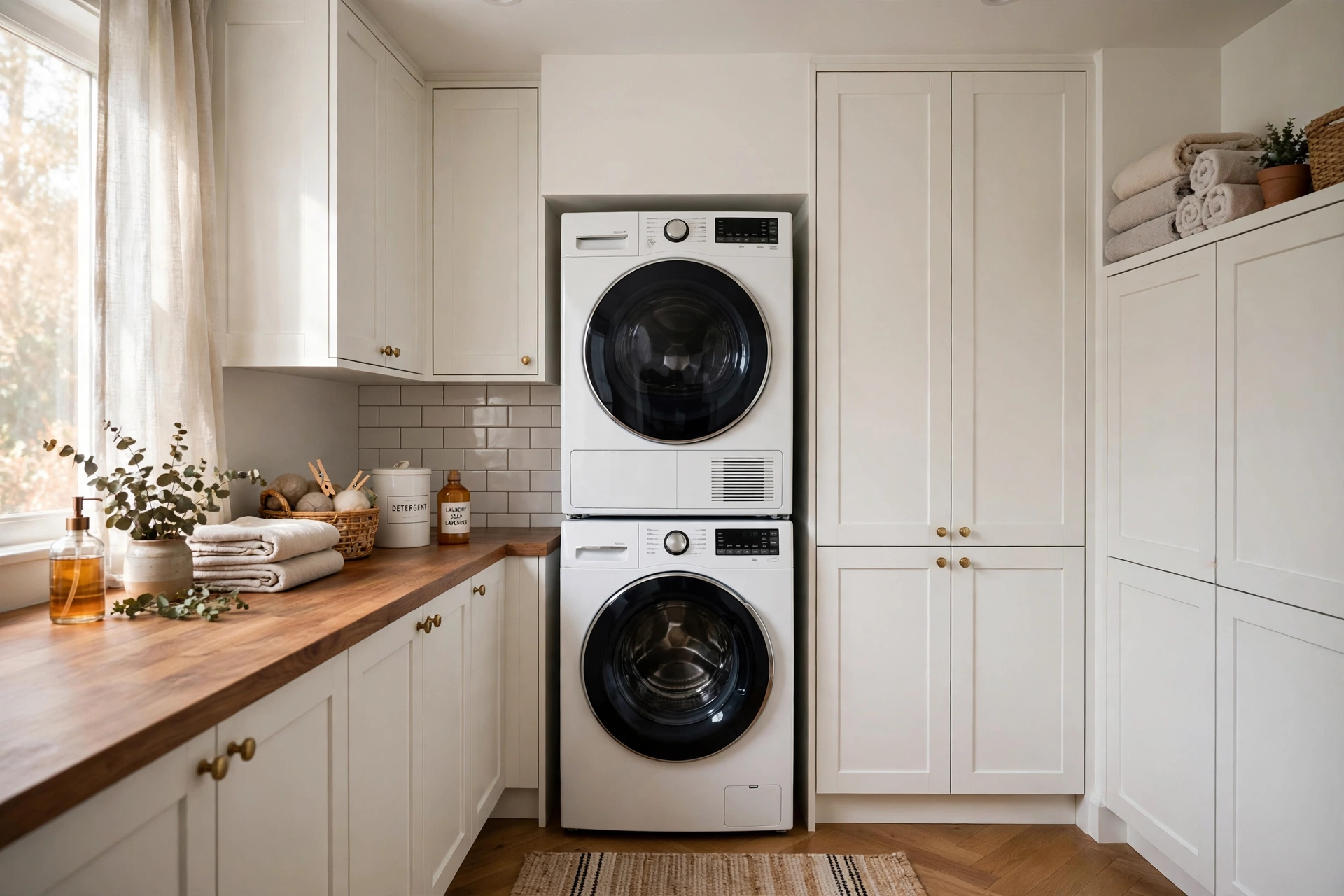
Among all the small laundry room design ideas on this list, stacking the machines is the single biggest space win. A front-load washer and dryer stacked vertically occupies the footprint of one machine instead of two, freeing up roughly a square yard of floor space in a room where every inch counts.
Use a manufacturer stacking kit — never balance a dryer on a washer without one — and make sure the setup is properly vented and level. Stacking also makes moving wet clothes between machines easier, since you transfer straight down instead of across the room. If you already own a side-by-side pair, check whether your models have a compatible kit before buying new machines.
2. Cap Side-by-Side Machines with a Folding Counter
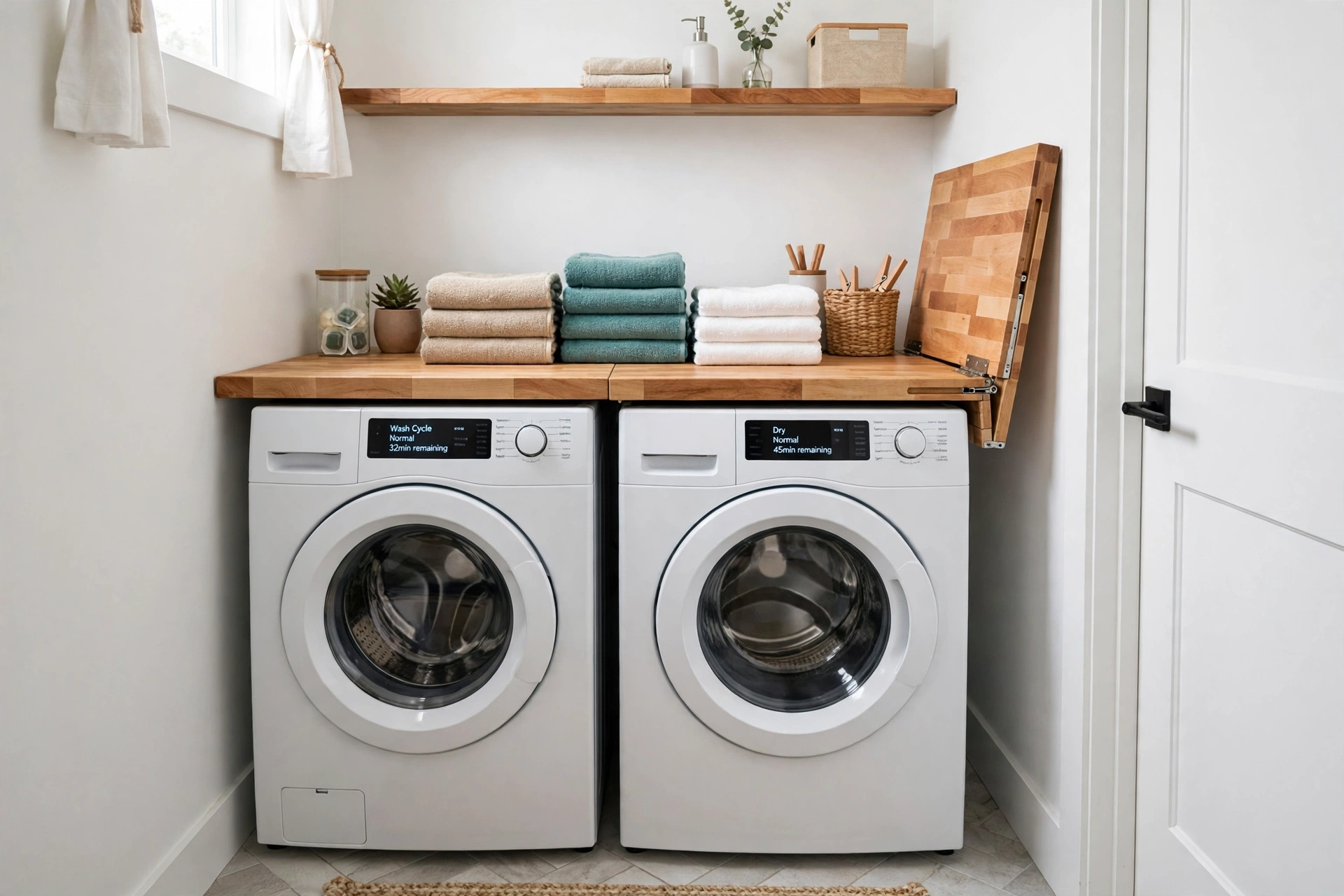
If stacking isn’t an option, the next best move is a slab of butcher block or plywood over side-by-side machines to create an instant folding counter. It turns dead appliance tops — which otherwise collect clutter and scatter it during the spin cycle — into your room’s most-used work surface.
Keep it practical: leave a small gap at the wall for cords and venting, finish the wood with a water-resistant sealant, and don’t permanently attach anything you’ll need to remove for machine service. A removable or hinged top gives you maintenance access without a demolition job. For folding technique and beyond, it’s one of the cheapest upgrades with the biggest daily payoff.
3. Install a Pull-Out or Fold-Down Drying Rack
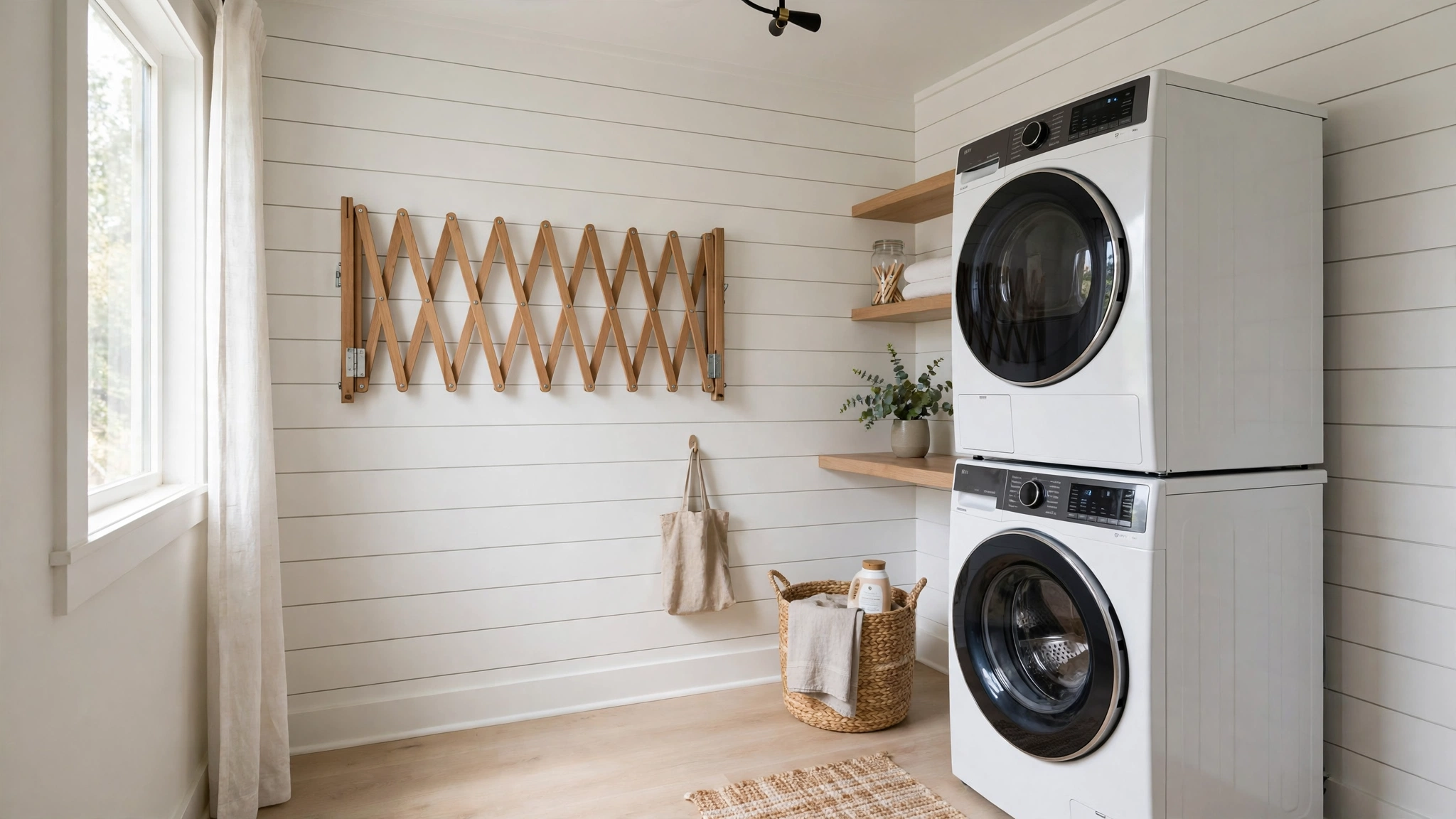
Freestanding drying racks eat an entire room’s floor space the moment they open. A wall-mounted rack that folds flat when not in use gives you full air-drying capacity with zero permanent footprint — perfect for delicates, swimwear, and anything that can’t take the dryer.
Install it at a comfortable reaching height near your folding area, and choose one rated for a full wet load — cheap racks sag and drag sleeves across the floor. Accordion-style wooden racks double as handsome wall decor when folded, so even your drying solution earns its design keep. It is one of the small laundry room design ideas with the highest return for the lowest cost.
4. Take Cabinets All the Way to the Ceiling
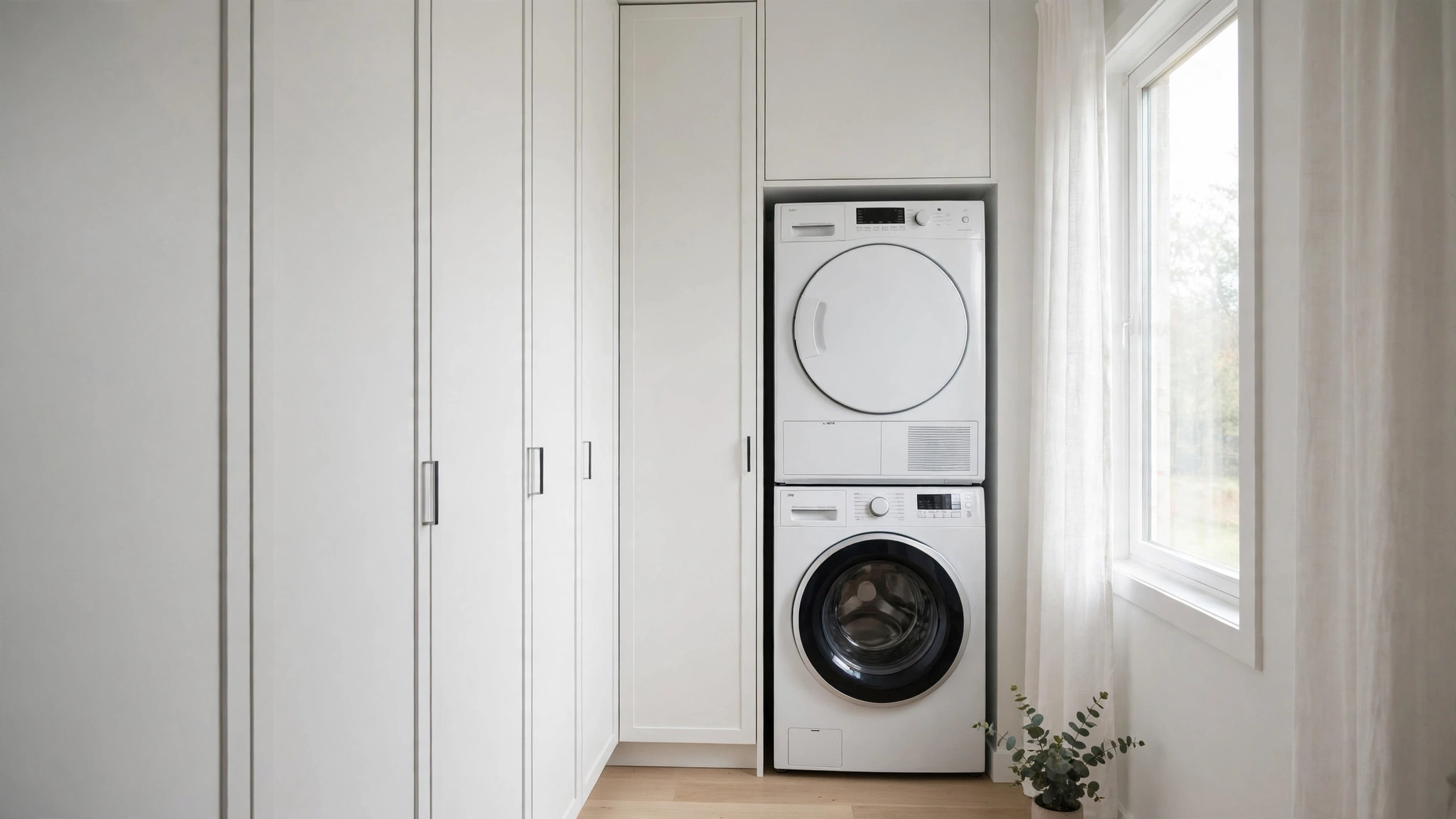
Upper cabinets are the workhorse of small laundry storage, and stopping them a foot short of the ceiling wastes the best storage real estate in the room. Floor-to-ceiling cabinets keep detergent, stain removers, and spare supplies behind closed doors so the room looks calm even when your supplies aren’t.
Keep a slim step stool tucked in a corner or behind the door so top shelves stay reachable, and reserve them for bulk refills and out-of-season items. If full custom cabinets are beyond budget, stock wall cabinets from a home-improvement store painted to match your walls look just as intentional for a fraction of the price.
5. Style Open Shelves with Baskets and Jars
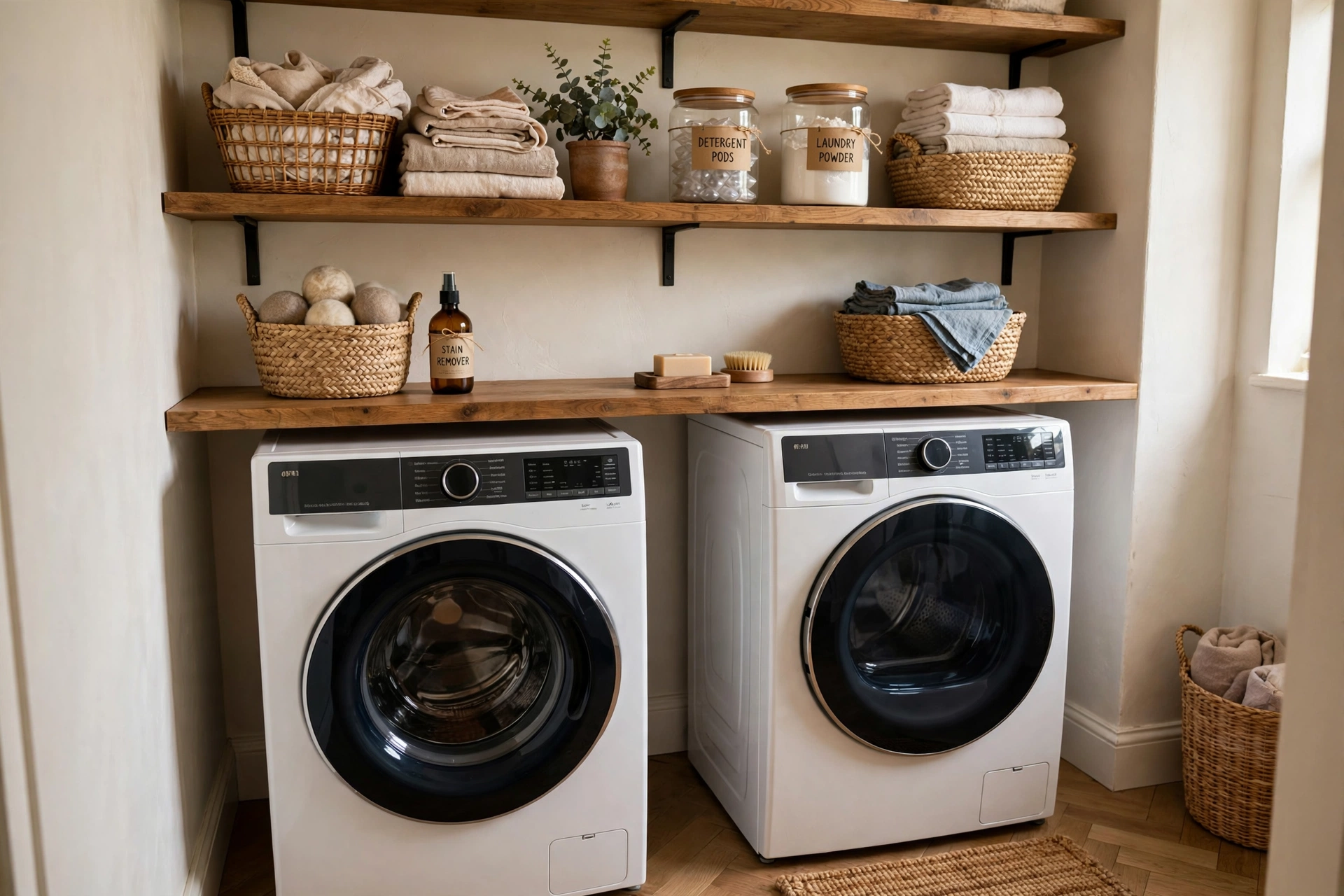
Open shelving feels lighter than cabinets in a tight room and puts everyday supplies within easy reach. The trick is keeping it intentional rather than cluttered: decant detergent and pods into matching glass jars, corral small items into woven baskets, and leave some breathing room between groupings.
Two chunky wood shelves over the machines are the classic move, but a single shelf running along one wall works in even the narrowest galley layout. Label baskets for each household member’s lost socks and dryer finds — it stops the shelf from becoming a junk drawer in disguise. Apartment Therapy’s laundry room organization guide is packed with more small-space storage tricks like this one.
6. Add a Compact Utility Sink
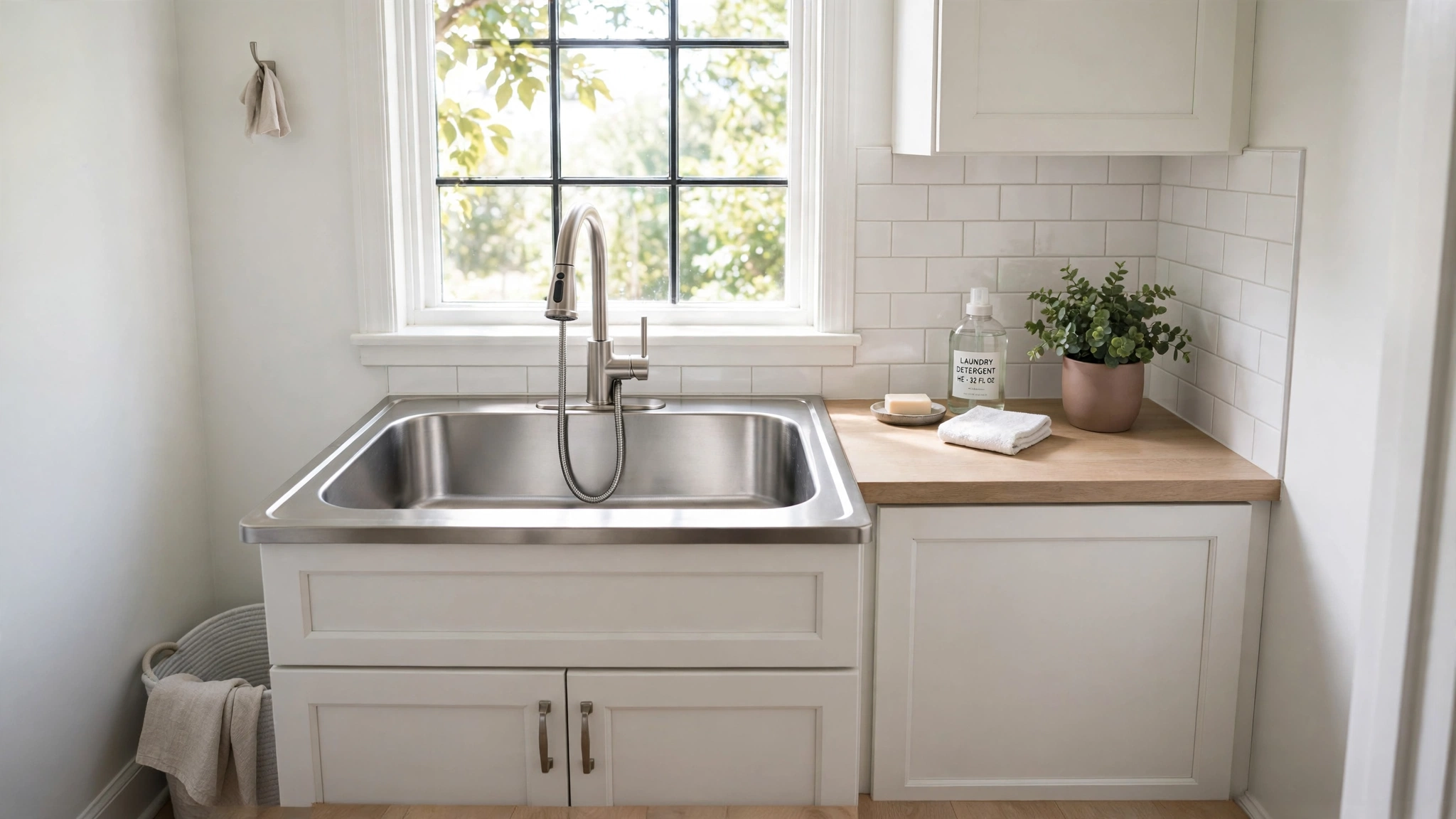
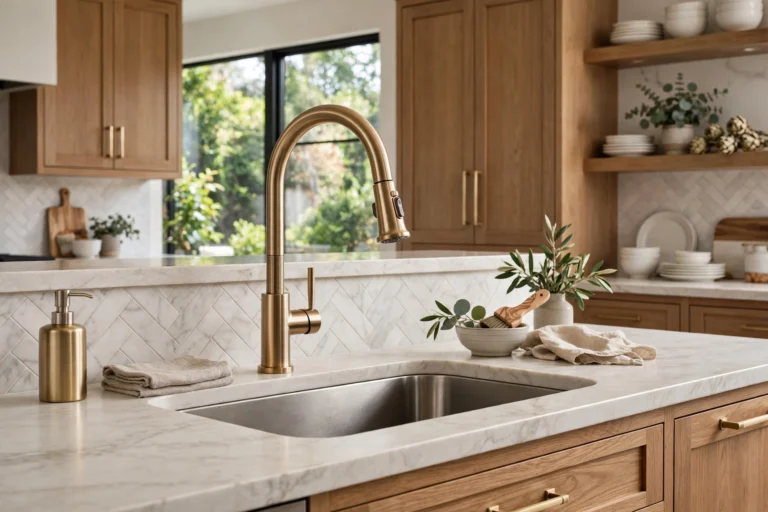
A utility sink changes what a laundry room can do: hand-wash delicates, pre-treat stains before they set, rinse muddy shoes, and water plants without traipsing through the house. You don’t need a full-size basin — a compact stainless or composite sink fits into surprisingly narrow runs of counter.
If plumbing allows, position the sink under a window so hand-washing gets natural light and a pleasant view. A pull-down faucet makes rinsing tall items easy, and a cutting-board-style cover over the basin gives you back counter space when the sink isn’t in use. It’s the feature that makes a laundry room feel like a proper workroom rather than a machine closet.
7. Hang a Bold Wallpaper Accent Wall
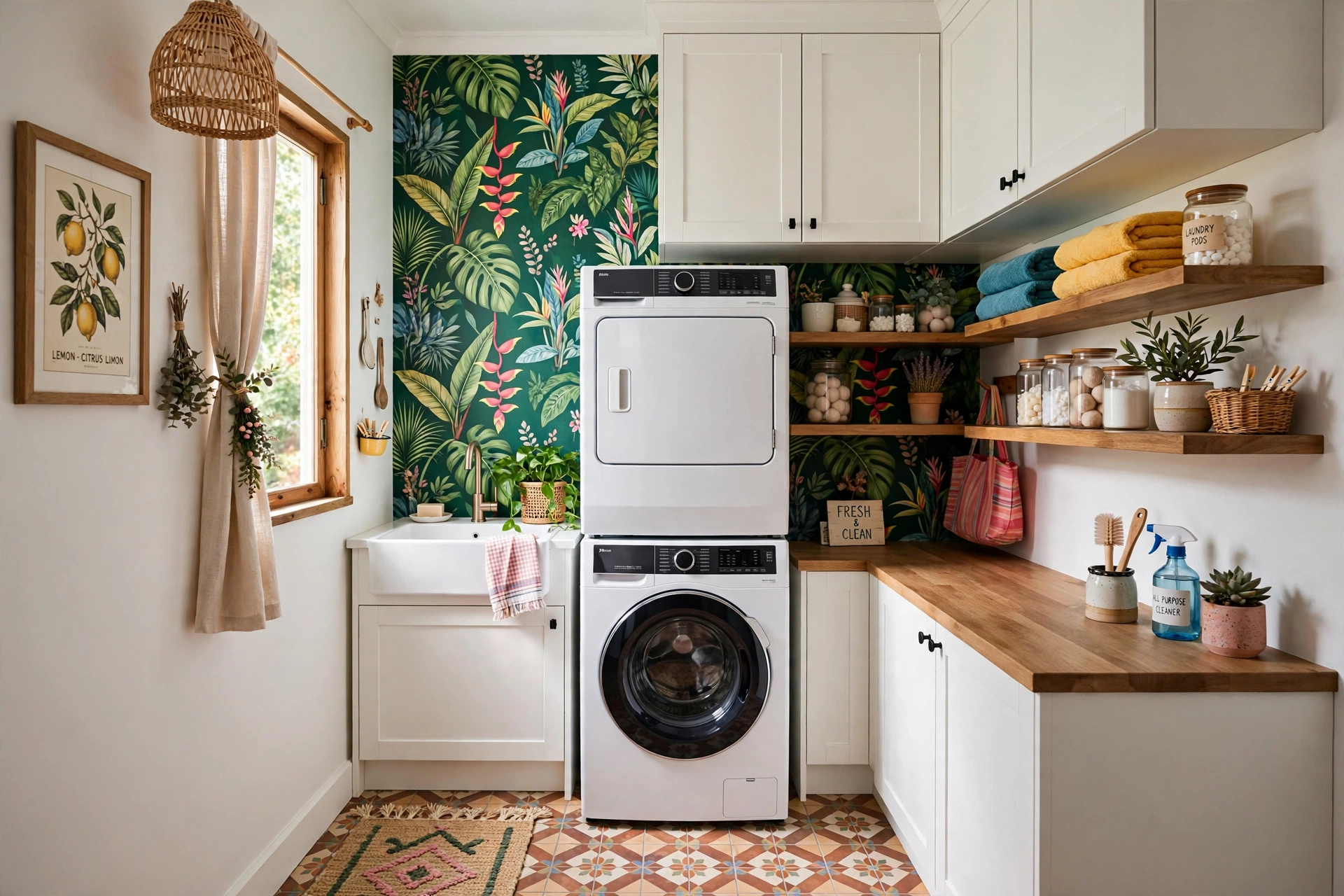
Small rooms are the perfect place to go big with pattern — you need so little paper that a single statement roll transforms the space for the cost of a pizza night. A bold botanical, a graphic stripe, or a cheeky laundry-themed print gives the room a personality that makes the chore feel lighter.
Peel-and-stick wallpaper is the renter-friendly move here, and it handles laundry-room humidity far better than it used to. Cover one accent wall for maximum impact with minimal commitment, or go all-in on a tiny closet laundry where pattern feels cozy rather than loud. The Spruce’s 57 laundry room ideas is full of bold-pattern inspiration if you need proof of how good it can look.
8. Build In a Fold-Down Ironing Board
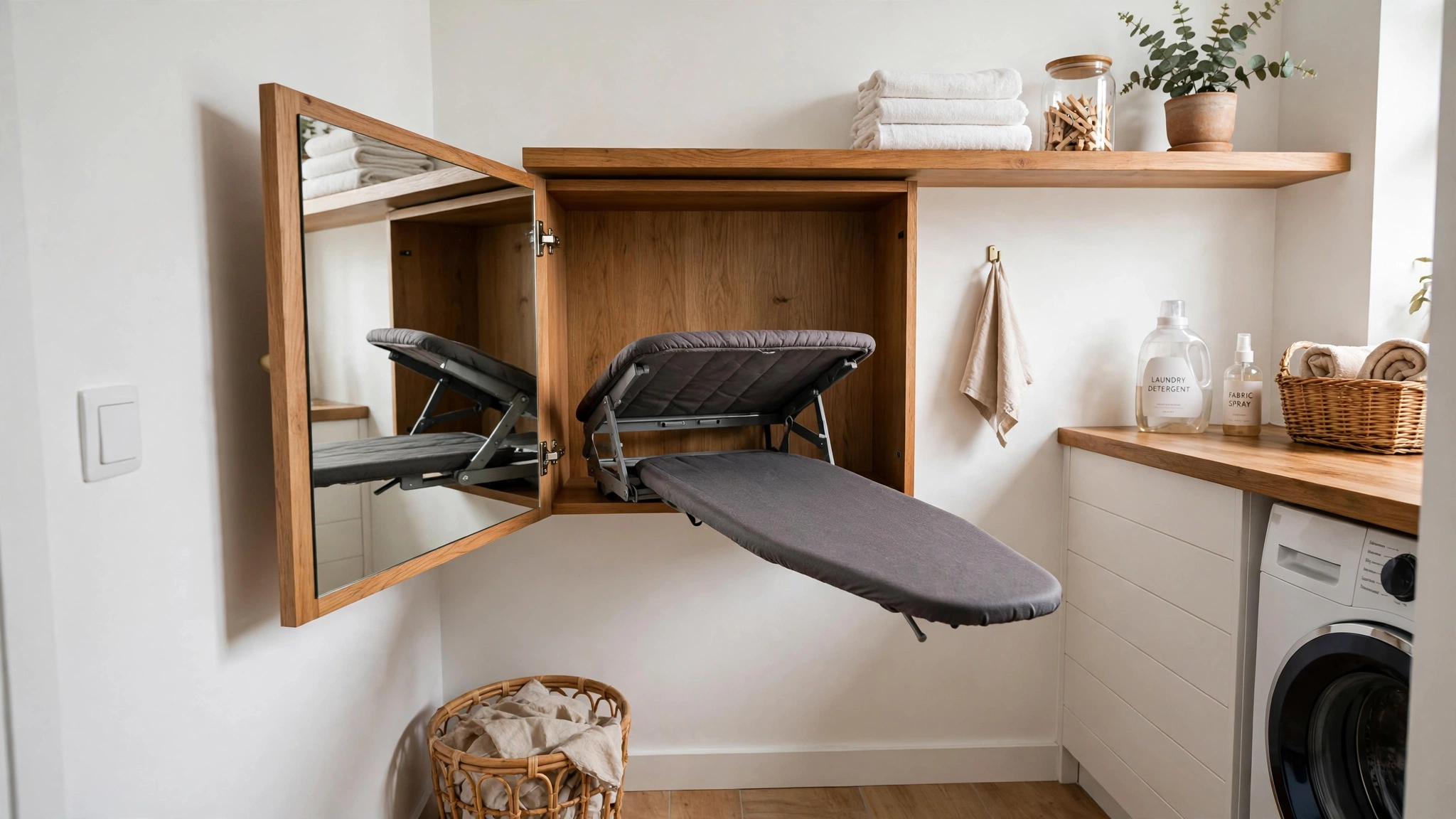
A freestanding ironing board is a space hog that spends 99 percent of its life leaning in a corner. A wall-mounted fold-down board disappears into a shallow cabinet or behind a mirrored door when closed, then flips down to full ironing height in seconds.
Mount it near an outlet at whatever wall has a clear swing radius — even a six-inch-deep cabinet can hide one. Many models include a built-in sleeve for the iron and small shelves for spray starch and supplies, so the whole pressing station tucks into what was previously dead wall space. You’ll actually iron things when the board takes two seconds to set up.
9. Put Up a Pegboard Storage Wall
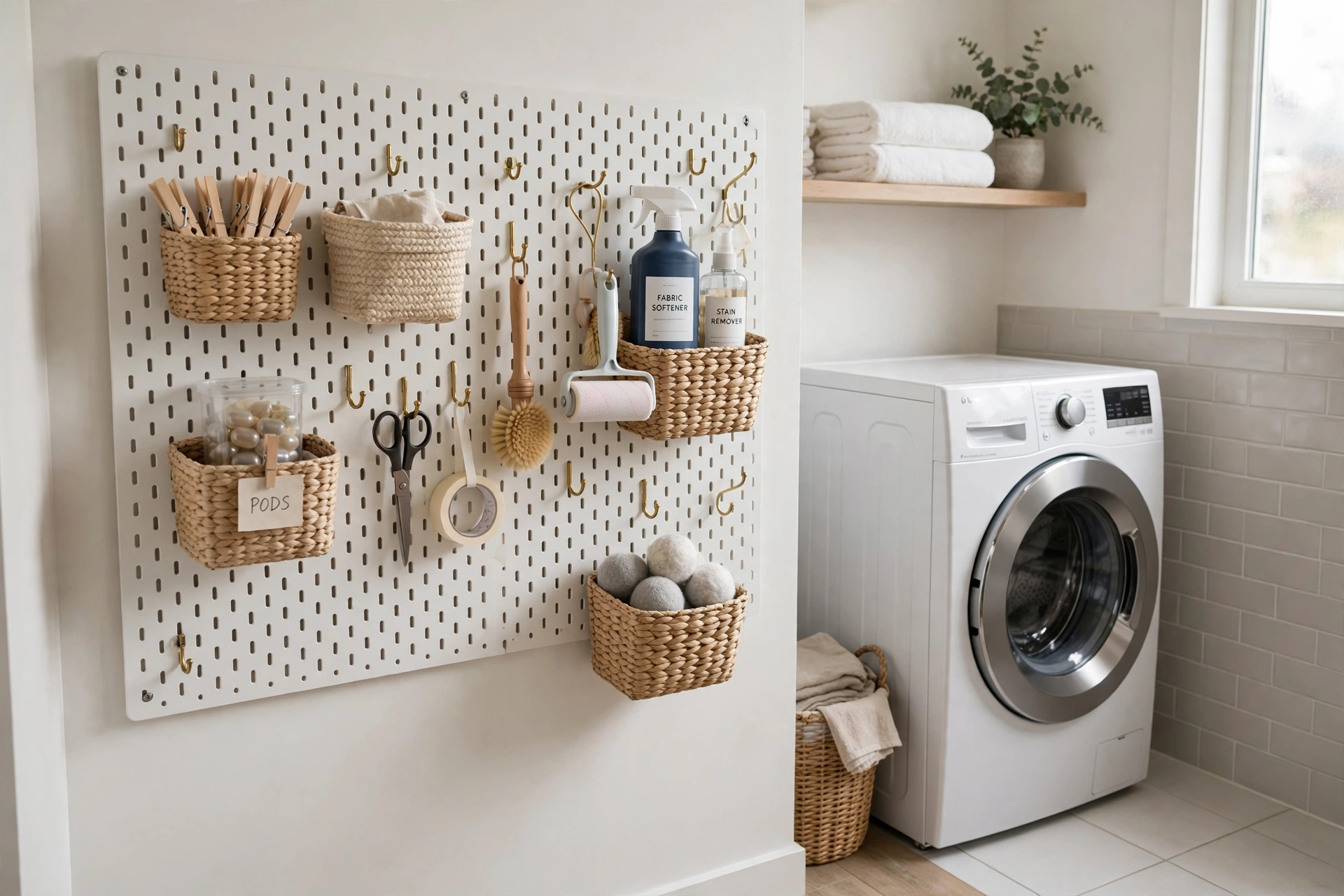
Pegboard is the most flexible wall storage ever invented: hooks, baskets, and shelves all reposition in seconds as your needs change. A full or half wall of pegboard beside the machines holds lint rollers, stain sticks, clothespins, and cleaning tools without a single drawer.
Paint the board the same color as your wall for a built-in look, or go bold with a contrasting color and matching frames for a deliberately designed feel. Mount it on furring strips so hooks have clearance behind the panel, and keep the heaviest items — full detergent bottles — on shelves rather than hooks. It is storage that evolves with your routine instead of fighting it.
10. Swap the Swing Door for a Sliding Barn Door
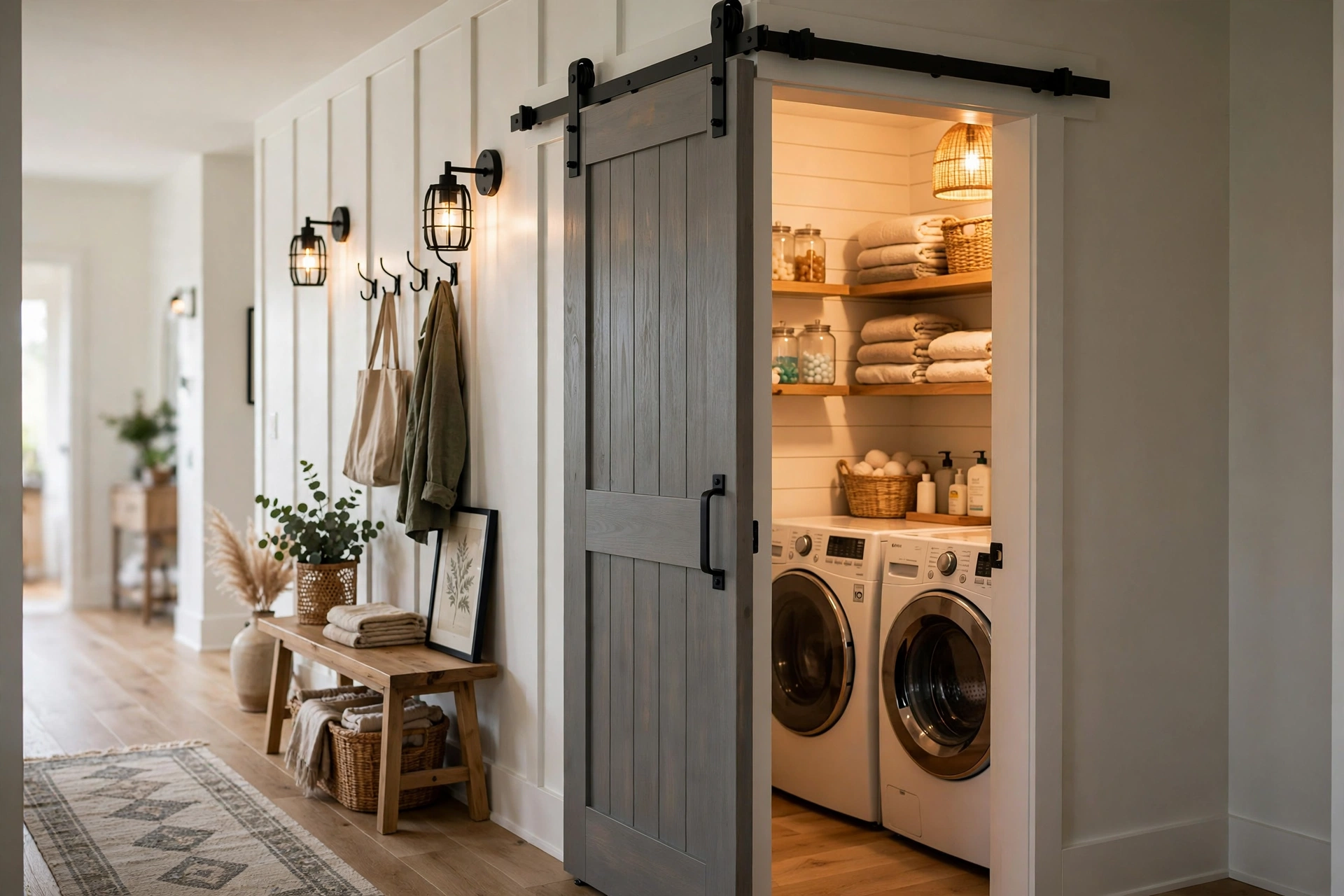
A standard swing door needs nearly ten square feet of clear floor space to open — in a tiny laundry room, that’s floor you could be using. A sliding barn door or pocket door glides along the wall instead, giving you back that entire sweep of usable floor.
Barn doors also bring style with them: the hardware is a design feature, and a painted or stained slab adds warmth to what might otherwise be a purely utilitarian opening. If you prefer something that disappears completely, a pocket door recesses into the wall — but barn-door hardware is a much easier weekend project. Either way, you gain usable room without moving a single wall.
11. Sort with Pull-Out Hampers
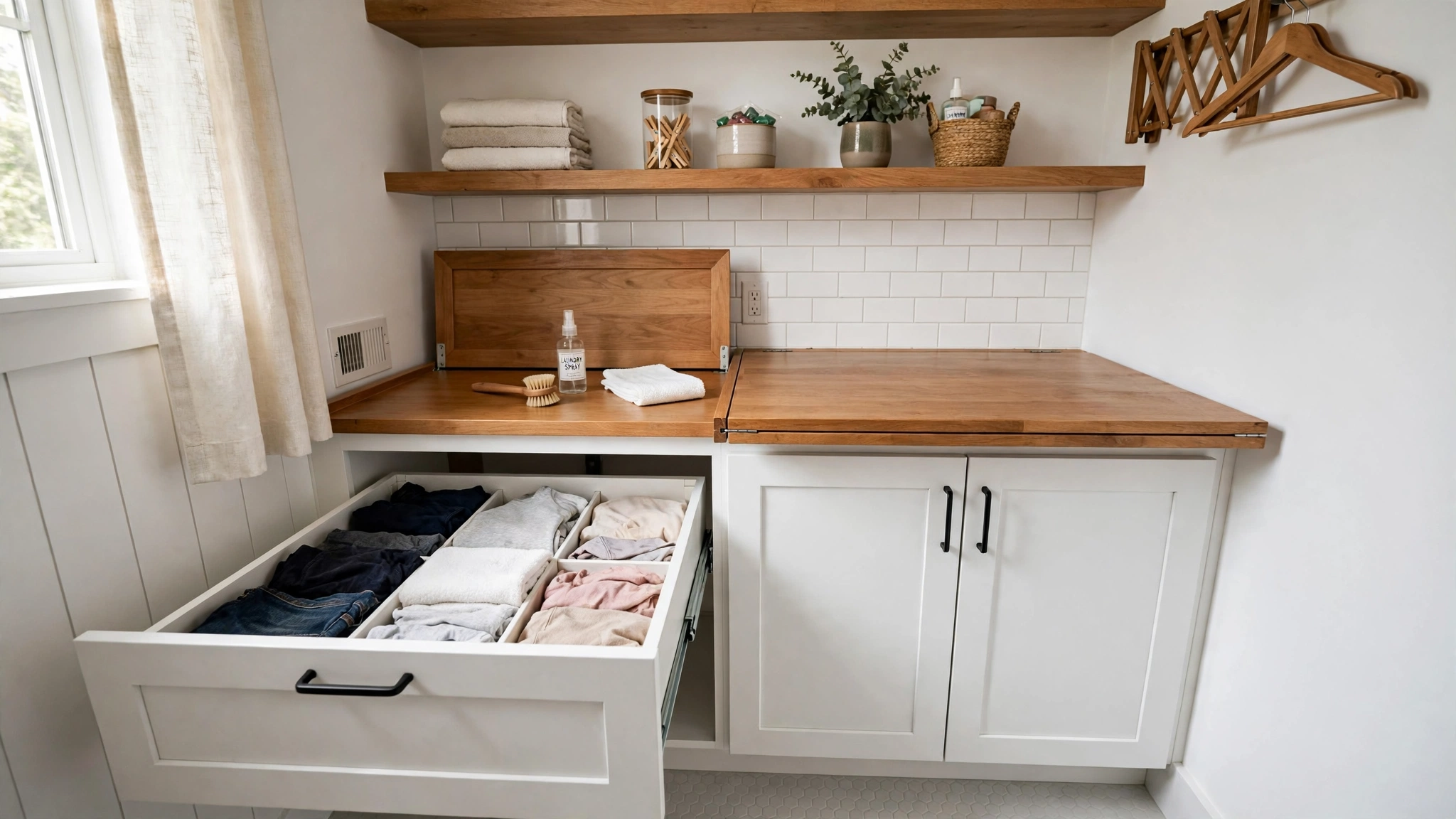
Sorting laundry is the step that creates floor clutter — three baskets sprawled across a small room make it feel like a laundromat. Pull-out hampers built into a base cabinet keep whites, darks, and delicates separated and out of sight until wash day.
Tilt-out or slide-out hampers fit into standard cabinet widths, and ventilated liners keep things from smelling between loads. If custom cabinetry isn’t in the budget, two slim stackable sorters on a low shelf under your folding counter achieve the same organized effect. The sorting system disappears, but your habit of sorting stays.
12. Add a Hanging Rod for Air-Drying
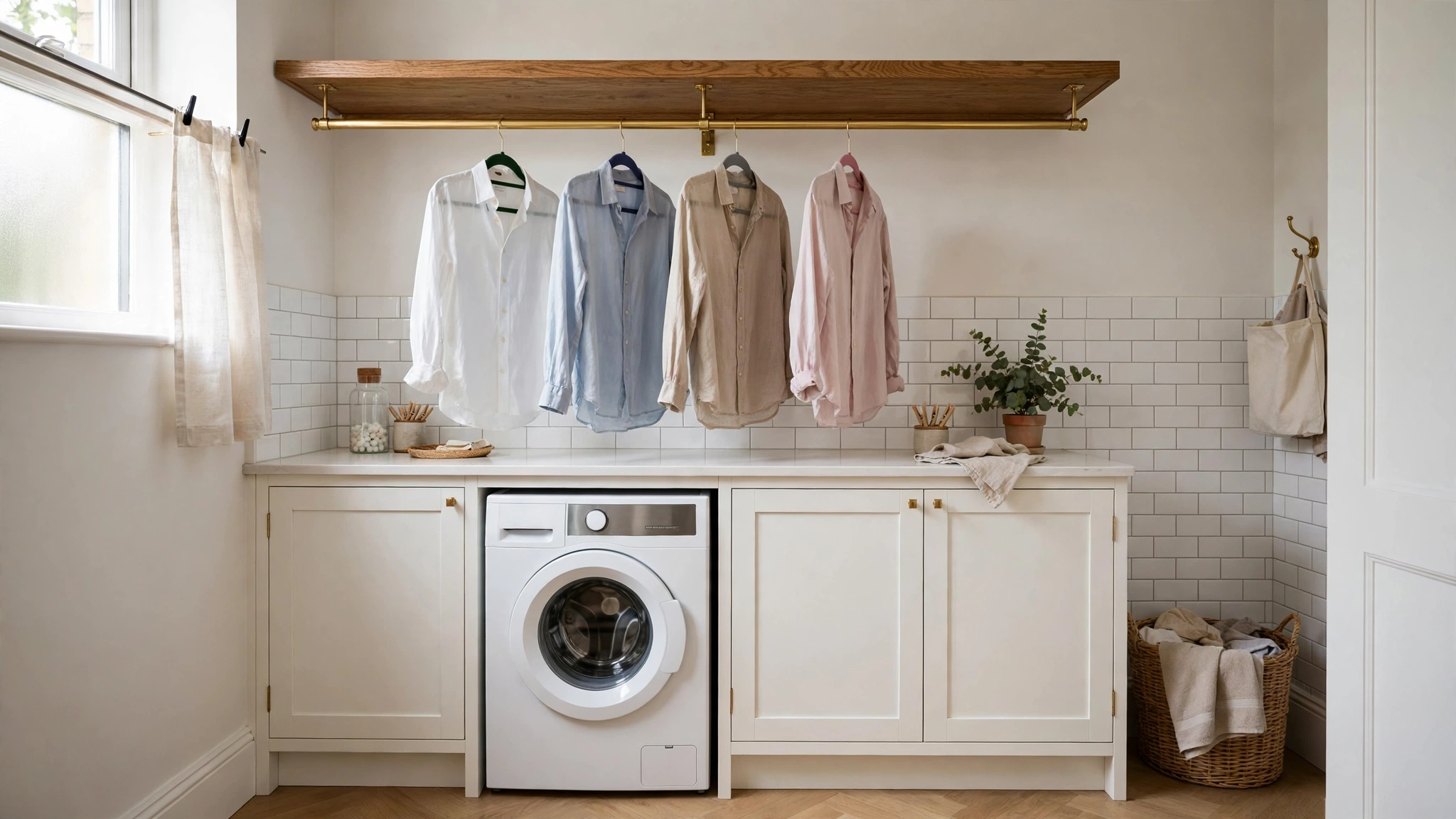
Not everything belongs in the dryer, and a dedicated hanging rod gives delicates a permanent home. Mount a sturdy rod under a shelf or between two walls at a height that keeps hangers clear of the machines — even a short rod holds a surprising number of garments.
Brass or matte-black rods look sharp against painted cabinetry and double as design detail when empty. Keep a stack of slim velvet hangers nearby so freshly dried shirts go straight from rod to closet. Pair the rod with your folding counter setup and you’ve built a complete wash-dry-fold workflow in a few square feet. For more renter-friendly small-space tricks, our apartment bathroom design ideas use the same vertical thinking in tight wet spaces.
13. Paint It a Color You Love
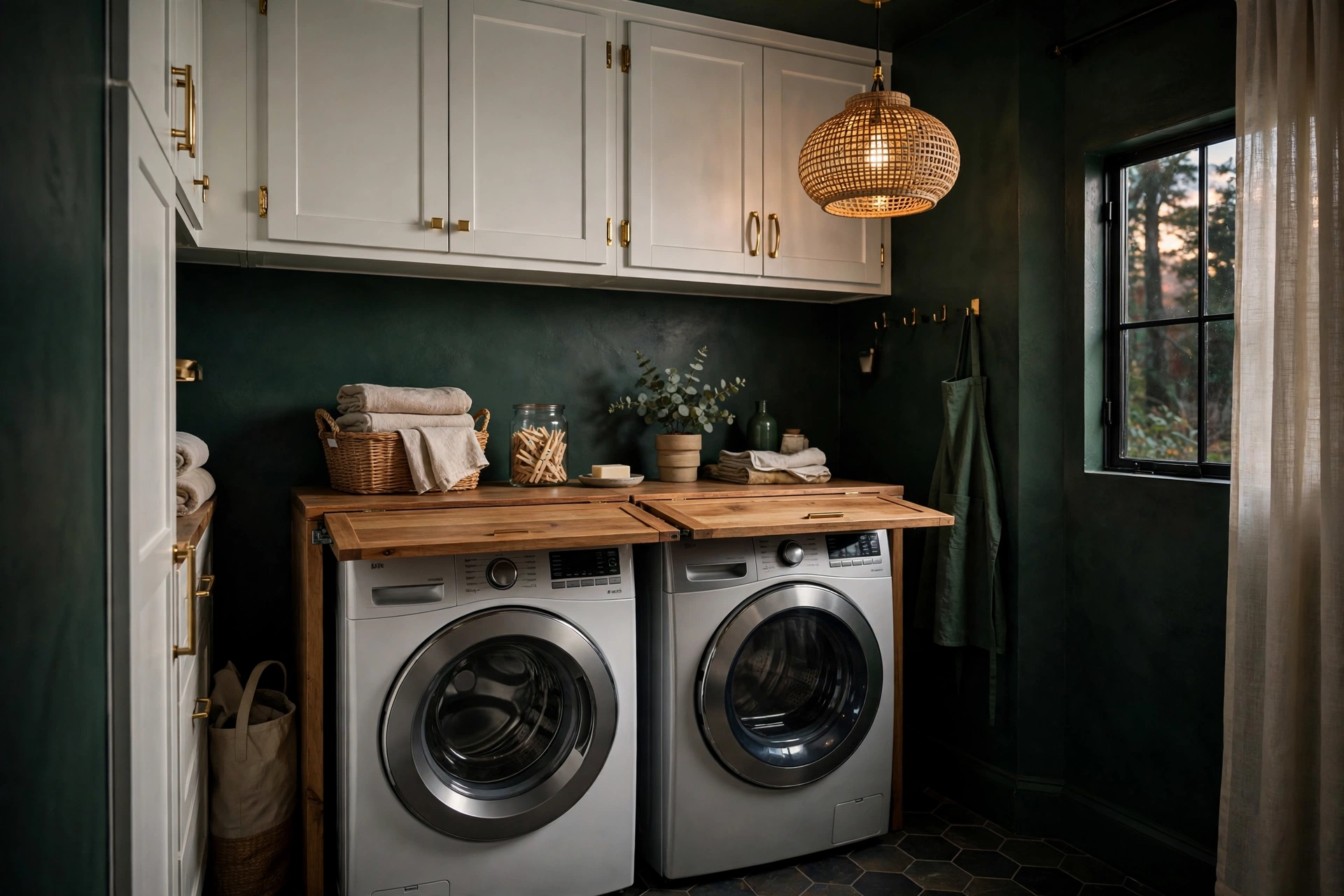
The laundry room is one of the safest places in your home to experiment with color. It’s small, it’s private, and if the shade doesn’t thrill you, repainting takes an afternoon. Moody forest green, cheerful butter yellow, or dusty blue — a confident color turns a forgettable utility space into a room with genuine character.
If bold walls feel risky, paint just the cabinets or a single accent wall and keep the rest crisp white. Semi-gloss or satin finishes handle laundry-room humidity better than flat paint, and they bounce light around a small space nicely. For a calmer, spa-like take on small wet-room color, see our small spa bathroom design ideas — the same soft tones work beautifully here.
14. Go Magnetic and Slim
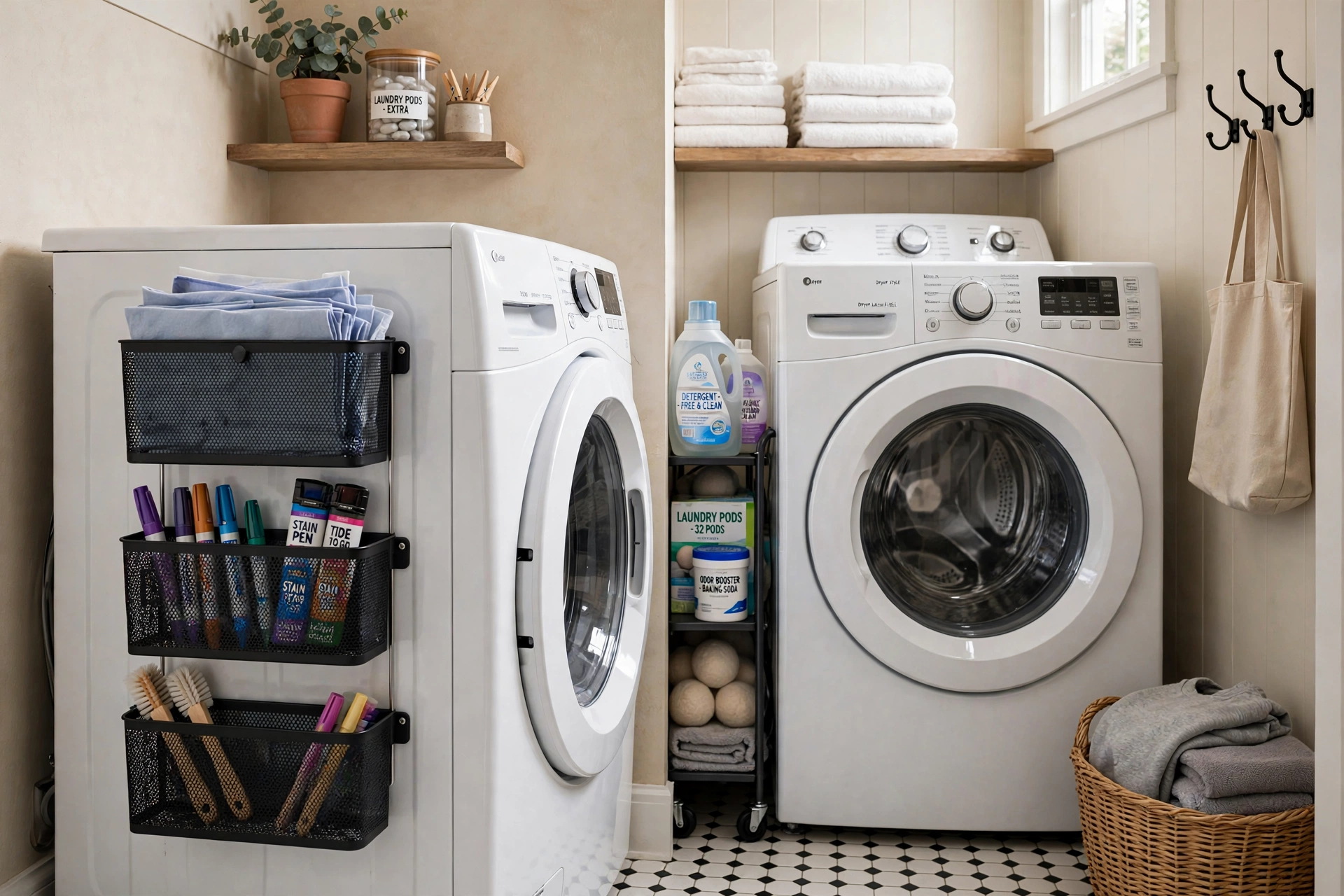
The sides of your washer and dryer are acres of untapped magnetic real estate. Magnetic bins, paper-towel holders, and spice-style containers stick right to the appliance sides and keep stain pens, dryer sheets, and clothespins exactly where you reach for them — no wall space required.
For the dead gap between machines, a slim rolling cart (six to eight inches wide) slides in and out with a full supply of detergent and supplies stored vertically. These no-drill solutions are perfect for renters and anyone who can’t mount shelves. It is the definition of using space you already have instead of wishing for space you don’t.
15. Make the Floor a Feature
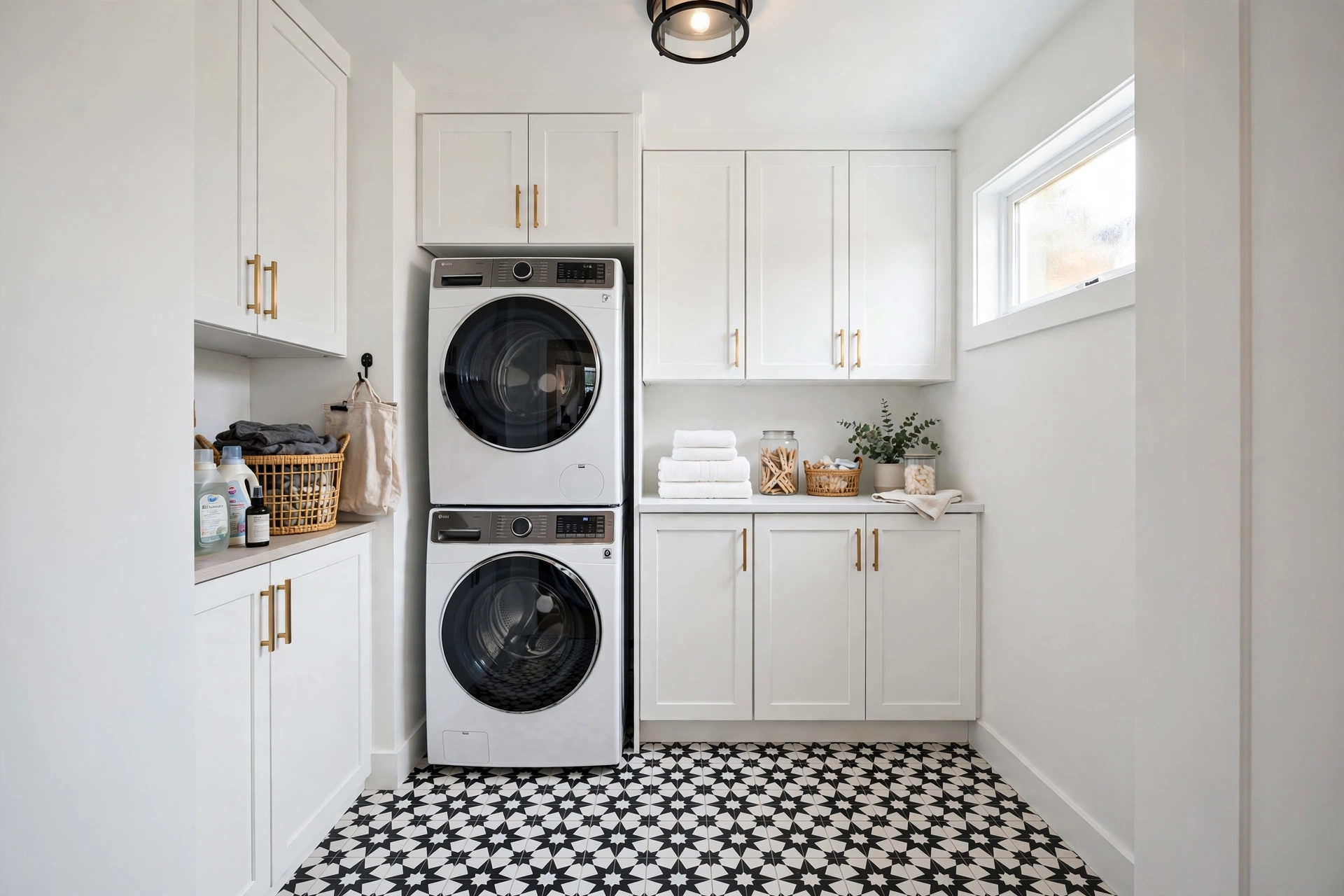
In a room this small, the floor is a major visual surface — so make it count. A bold patterned tile, a graphic peel-and-stick floor, or a low-pile washable runner turns the ground plane into the room’s design statement, drawing the eye away from the machines entirely.
Patterned tile also forgives the scuffs and lint that come with laundry duty, and washable rugs handle the occasional detergent drip without a crisis. Keep grout lines tight and sealed so they stay easy to clean. If you want to see how pattern carries tiny wet rooms, our 5×7 bathroom design ideas prove the same trick works in miniature bathrooms.
Frequently Asked Questions
How do you make a small laundry room functional?
Start with the workflow: sort, wash, dry, fold. Give each step a dedicated spot — pull-out hampers for sorting, stacked or capped machines for washing, a fold-down rack or hanging rod for drying, and a folding counter for finishing. Then add storage vertically with upper cabinets or open shelves, and keep supplies corralled in labeled baskets so the small footprint never feels chaotic.
Can you fit a utility sink in a small laundry room?
Usually, yes. Compact utility sinks are available in widths under 20 inches and can fit into a short run of counter or a narrow cabinet beside the machines. The main constraint is plumbing — if there’s an existing water line nearby, adding a sink is often straightforward. A sink cover that doubles as counter space when the basin isn’t in use makes it practical even in tight quarters.
What is the best paint color for a small laundry room?
There’s no single right answer, but small laundry rooms take color beautifully because the commitment is low. Light colors like warm white and soft blue make the room feel airy, while moody greens and navies add drama that makes the space feel intentional rather than leftover. Use satin or semi-gloss paint for humidity resistance, and consider that this is the one room where a bold choice costs almost nothing to try.
Should you stack your washer and dryer in a small laundry room?
If both machines are front-loaders and stacking kits are available for your models, stacking is the single most effective way to free floor space in a tiny laundry room. The trade-off is losing the countertop area over the machines and needing to reach the dryer’s controls and door at height. If anyone in your household can’t comfortably reach the top machine, keep them side-by-side and add a folding counter instead.
How do you add folding space to a tiny laundry room?
A slab of sealed wood over side-by-side machines is the classic answer, but small rooms have other options: a wall-mounted fold-down table that disappears when not in use, a sink cover that converts the basin into counter space, or even a sturdy rolling cart parked at folding height. Whatever you choose, aim for a surface roughly waist-high and at least 24 inches deep so folded laundry doesn’t slide off mid-task.
Keep Exploring
A great small laundry room is finished the moment every load has a clear path — from hamper to washer to dryer to folded stack — and the room looks good doing it. Start with the biggest win for your layout, whether that’s stacking the machines or claiming vertical storage, then layer in the personality touches at your own pace.
We hope these small laundry room design ideas have you looking at your own laundry corner with fresh eyes. For more ways to make small spaces work harder, explore our laundry decor ideas — and remember that the tiniest rooms often reward the boldest choices.







[…] layout, run it the full length of the wall. For more ways to make compact rooms work harder, our 15 Small Laundry Room Design Ideas That Work Hard and Look Good shows how vertical storage transforms tight […]
[…] door needs. Choose a track rated for the door’s weight. For more laundry inspiration, see our 15 small laundry room design ideas that work hard and look […]