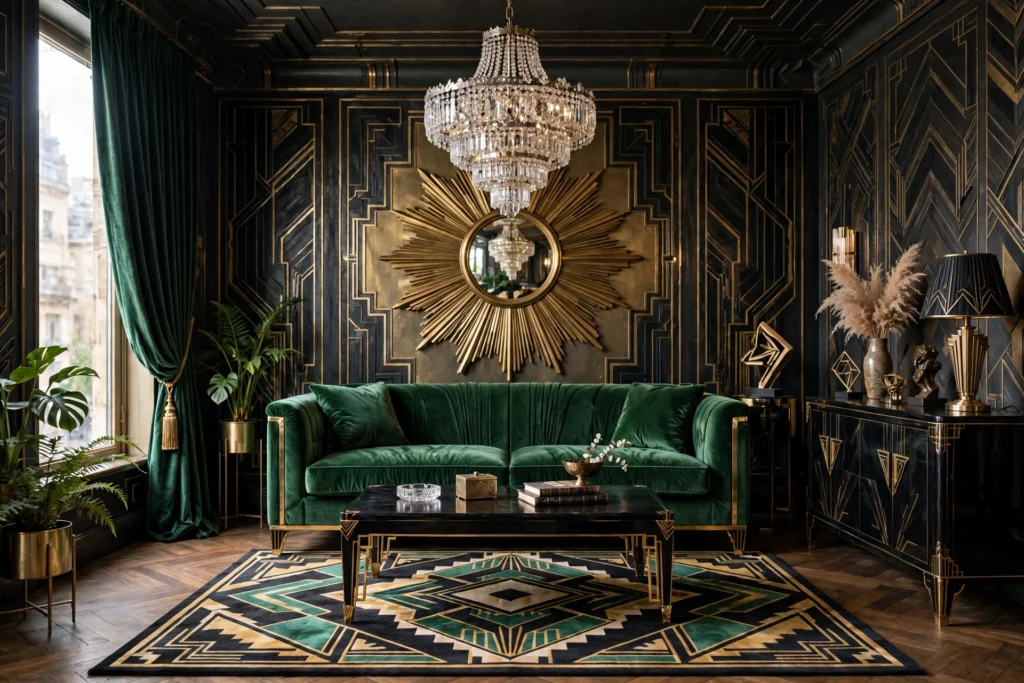

A century after it first dazzled the world, Art Deco still knows how to make an entrance. Born in the jazz age of the 1920s, it is the style of velvet and brass, of sunburst mirrors and cocktail hours — glamour with geometry, luxury with confidence. An Art Deco living room doesn’t whisper; it glows.
These art deco living room design ideas will help you channel that iconic era without turning your home into a movie set. The trick is balance: bold patterns and rich materials, curved silhouettes and metallic shine, all tempered with enough restraint that the room feels livable. Here are fifteen ideas to bring the glamour home.
1. Start With Bold Geometric Patterns
Geometry is the visual language of Art Deco — chevrons, fan motifs, sunbursts, zigzags, and stepped patterns that echo the era’s fascination with speed and modernity. Introduce it somewhere prominent: a geometric wallpaper on one wall, a bold area rug, or patterned upholstery on an accent chair. One strong geometric moment sets the entire tone of the room.
Keep the pattern confident but contained. A full room of competing geometrics gets dizzying; one hero pattern plus quieter supporting textures feels intentional. Black-and-gold or navy-and-brass combinations are the classic Deco pairings, but emerald, blush, or deep teal backgrounds work just as beautifully.
2. Choose a Velvet Channel-Tufted Sofa
No fabric says Art Deco like velvet, and no sofa silhouette says it like channel tufting — those vertical padded channels that run the length of the piece. A sofa in emerald green, sapphire blue, blush pink, or classic black velvet becomes the room’s undeniable star. The fabric catches light as you move around it, giving the whole room a living, luminous quality.
Curved profiles are the Deco ideal: a gently bowed back, rounded arms, a shape that invites lounging. Pair the velvet with tailored throw pillows in contrasting textures — silk, satin, or a subtle geometric print. A velvet sofa is an investment piece, so choose the color you’ll still love in a decade.
3. Hang a Sunburst Mirror
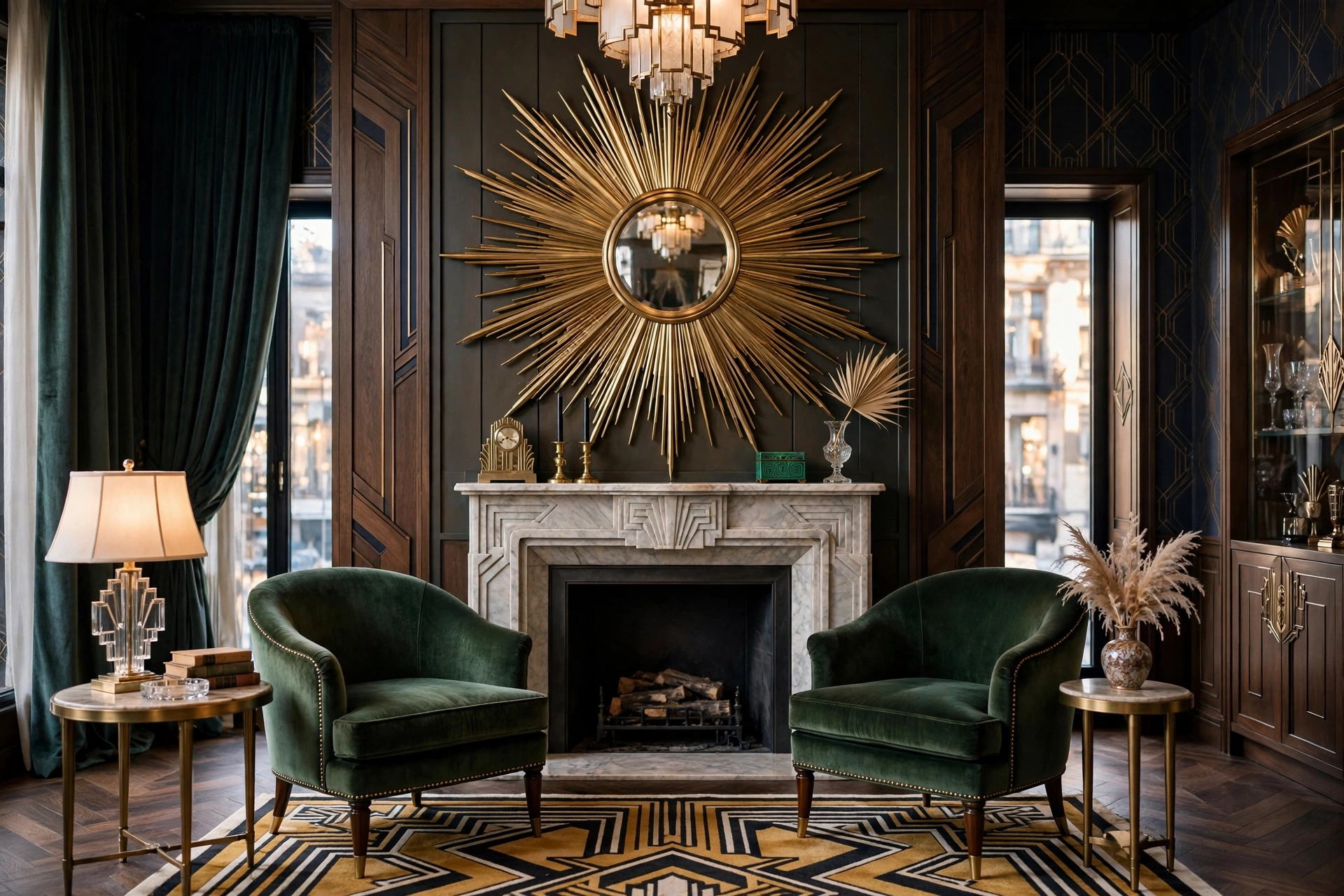
The sunburst mirror is Art Deco’s most iconic accessory, and one dramatic piece can carry a whole wall. Brass or gold rays radiating from a central round mirror catch light from every angle and add instant 1920s glamour. Hang it over the mantel, above a console, or as the centerpiece of a gallery wall.
Scale matters: go bigger than feels safe. A generous sunburst — 36 inches or more across — reads as art, while a small one reads as an afterthought. If the full sunburst feels like too much, a fan-motif or stepped geometric mirror delivers the same era nod in a quieter voice. Either way, the mirror doubles your light and your glamour at once.
4. Add Mirrored and Lacquered Furniture
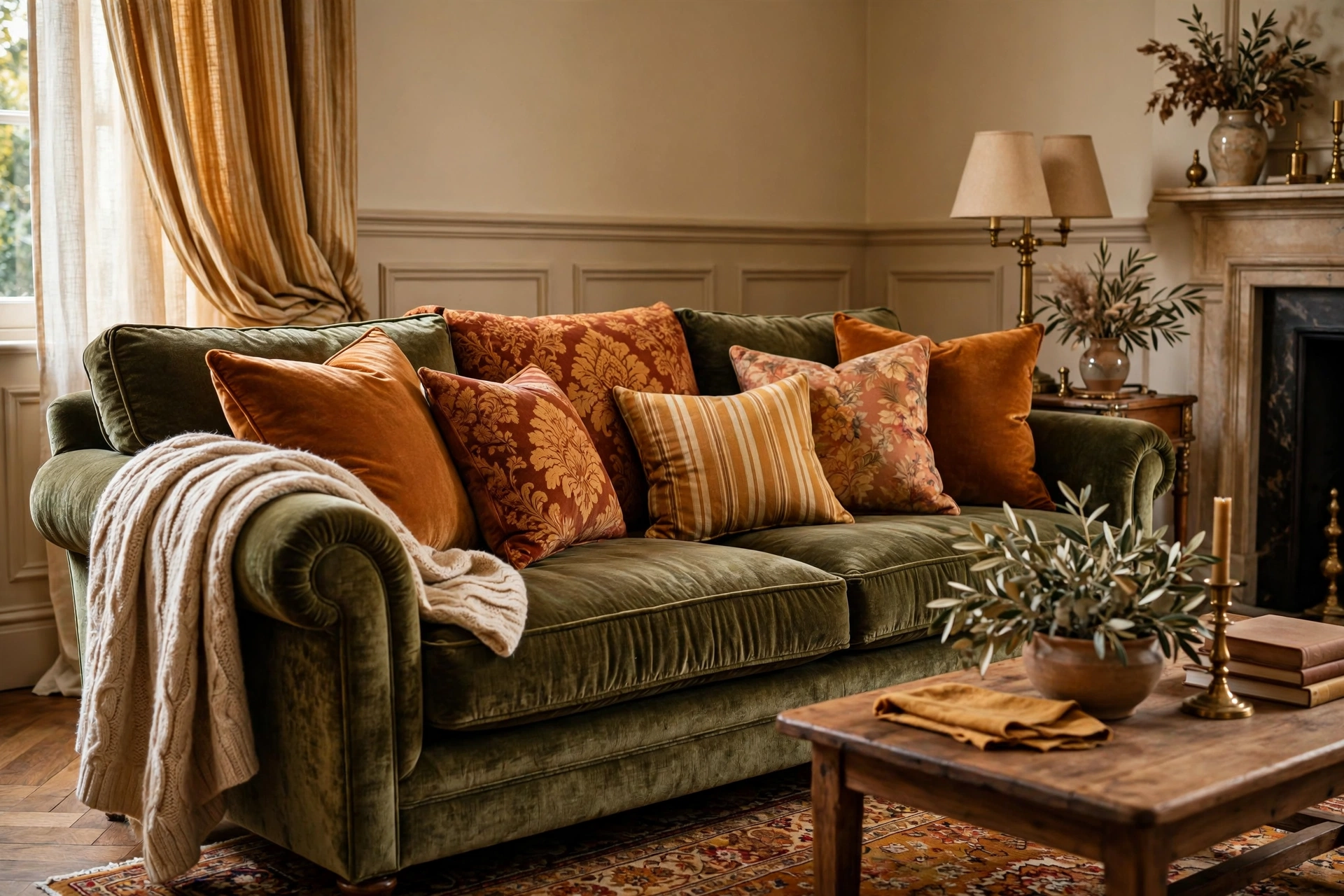
Art Deco loved surfaces that shine. Mirrored side tables, a lacquered coffee table in black or deep green, a mirrored console behind the sofa — these reflective pieces bounce light around the room and add the polished, nightclub-luxe feeling the era was famous for. They also make small rooms feel larger, since every mirrored surface visually doubles the space.
Use them strategically rather than everywhere: one mirrored coffee table or a pair of mirrored nightstands is plenty. Too many reflective surfaces turn a living room into a funhouse. Balance the shine with soft, light-absorbing textures nearby — velvet upholstery, a plush rug — so the room feels glamorous but still warm.
5. Go Deep With Jewel Tones
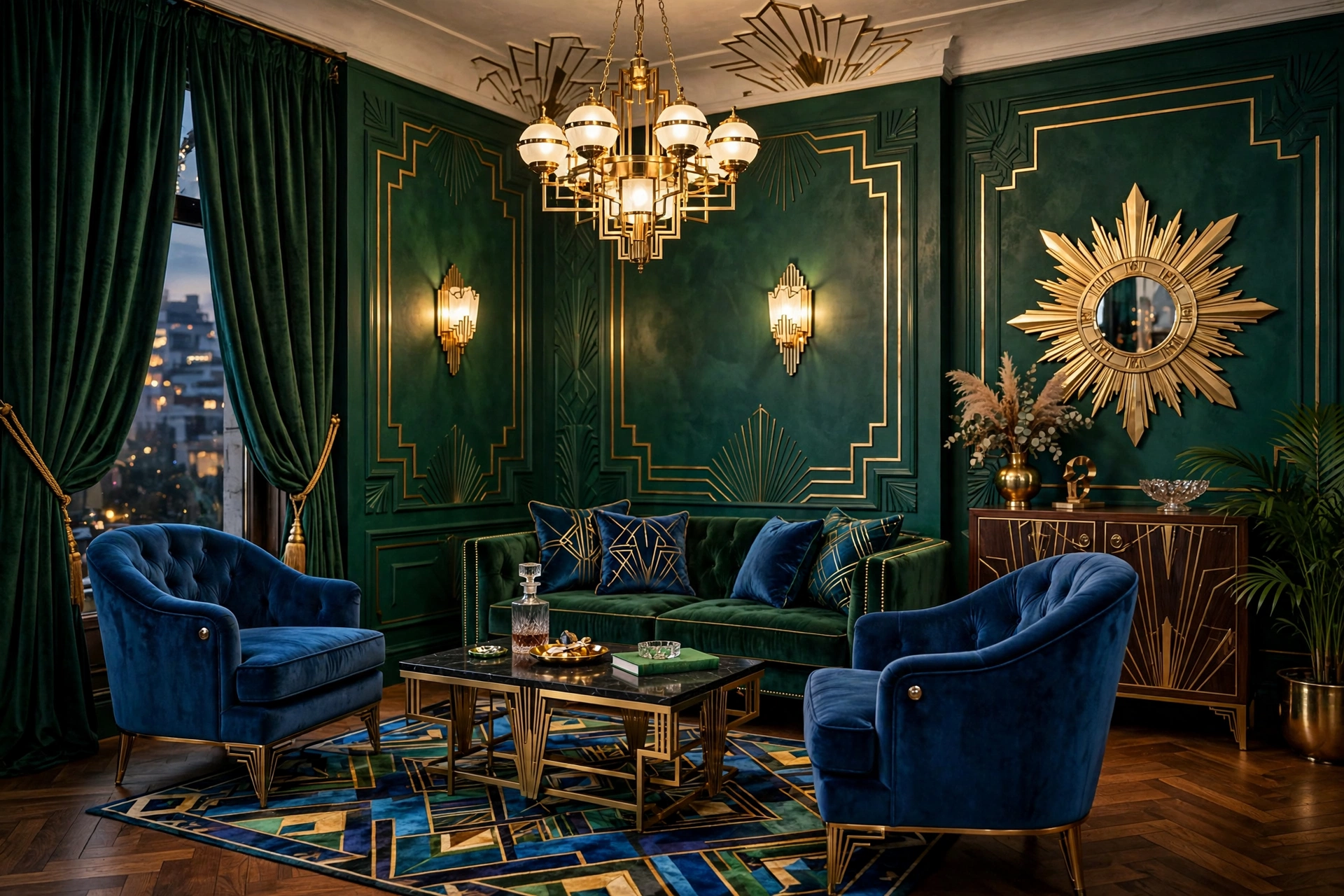
Art Deco’s color palette is unapologetically rich: emerald green, sapphire blue, ruby red, amethyst purple, and deep teal, set against black, cream, and gold. These saturated hues create the cocooned, after-dark glamour the style is famous for. Paint one wall — or all four, if you’re brave — in a deep jewel tone and watch the room transform.
If full saturation feels risky, bring jewel tones through upholstery and textiles instead: an emerald sofa against cream walls, sapphire drapes, ruby pillows. The contrast between deep color and metallic gold is what makes Deco sing. Homes and Gardens’ collection of art deco living room ideas shows designers using everything from deep teal paneling to emerald built-ins for maximum drama.
6. Install a Statement Chandelier
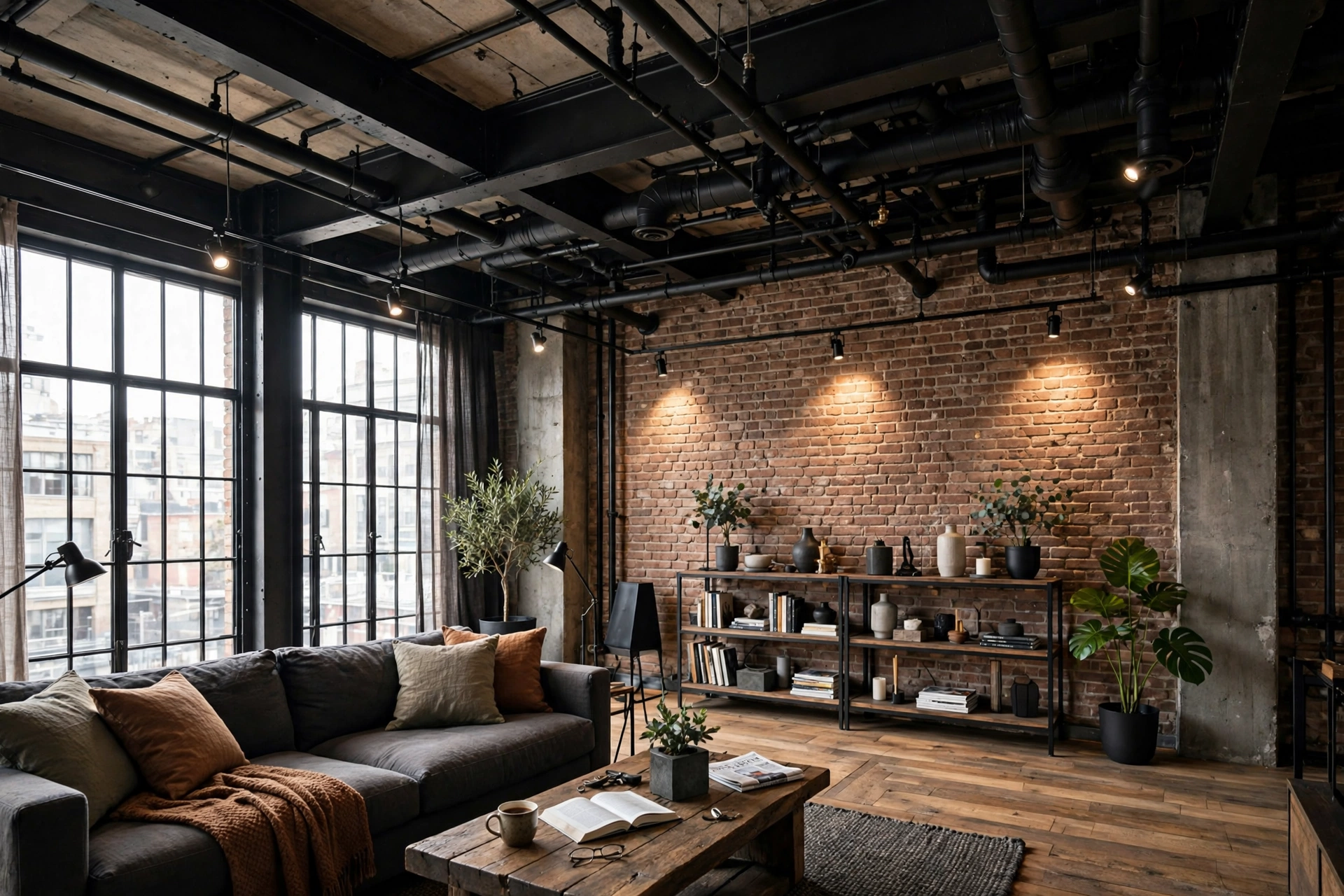
Lighting is jewelry in an Art Deco living room, and the chandelier is the crown jewel. Think tiered crystal, frosted glass globes, geometric brass frames, or a sputnik-style fixture with Deco bones. It should be the first thing guests notice when they walk in — scale it generously and hang it where it commands the room.
Flank it with supporting players: a pair of brass table lamps with geometric shades, wall sconces with frosted glass, a sculptural floor lamp in the reading corner. Keep every bulb warm — Deco glamour lives in golden light, not clinical white. Put the whole scheme on dimmers so the room can shift from cocktail bright to after-dinner moody.
7. Style a Glamorous Bar Cart
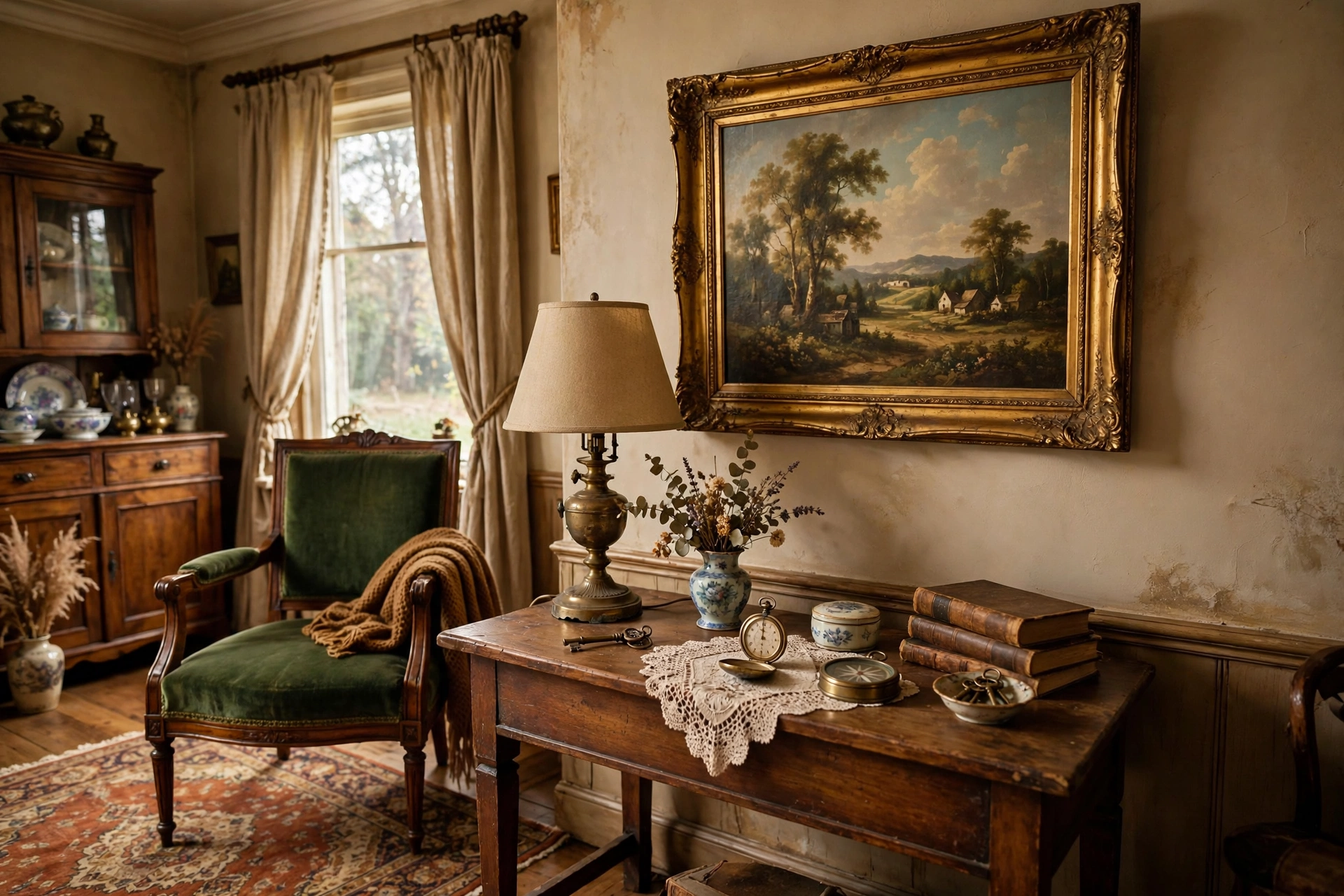
Nothing says 1920s quite like a well-stocked bar cart. Brass or mirrored, two or three tiers, styled with crystal decanters, vintage-style glassware, a cocktail shaker, and a small vase of flowers — the bar cart is both functional and the ultimate Deco styling moment. It practically demands a cocktail party.
Style it like a still life: group glassware by height, add one sculptural object, keep the top surface edited. Roll it beside the sofa for entertaining, or park it in a corner as a permanent vignette. Even if you rarely drink, a beautiful bar cart reads as pure glamour — it’s the accessory that tells guests this room knows how to have fun.
8. Mix Black Lacquer With Gold
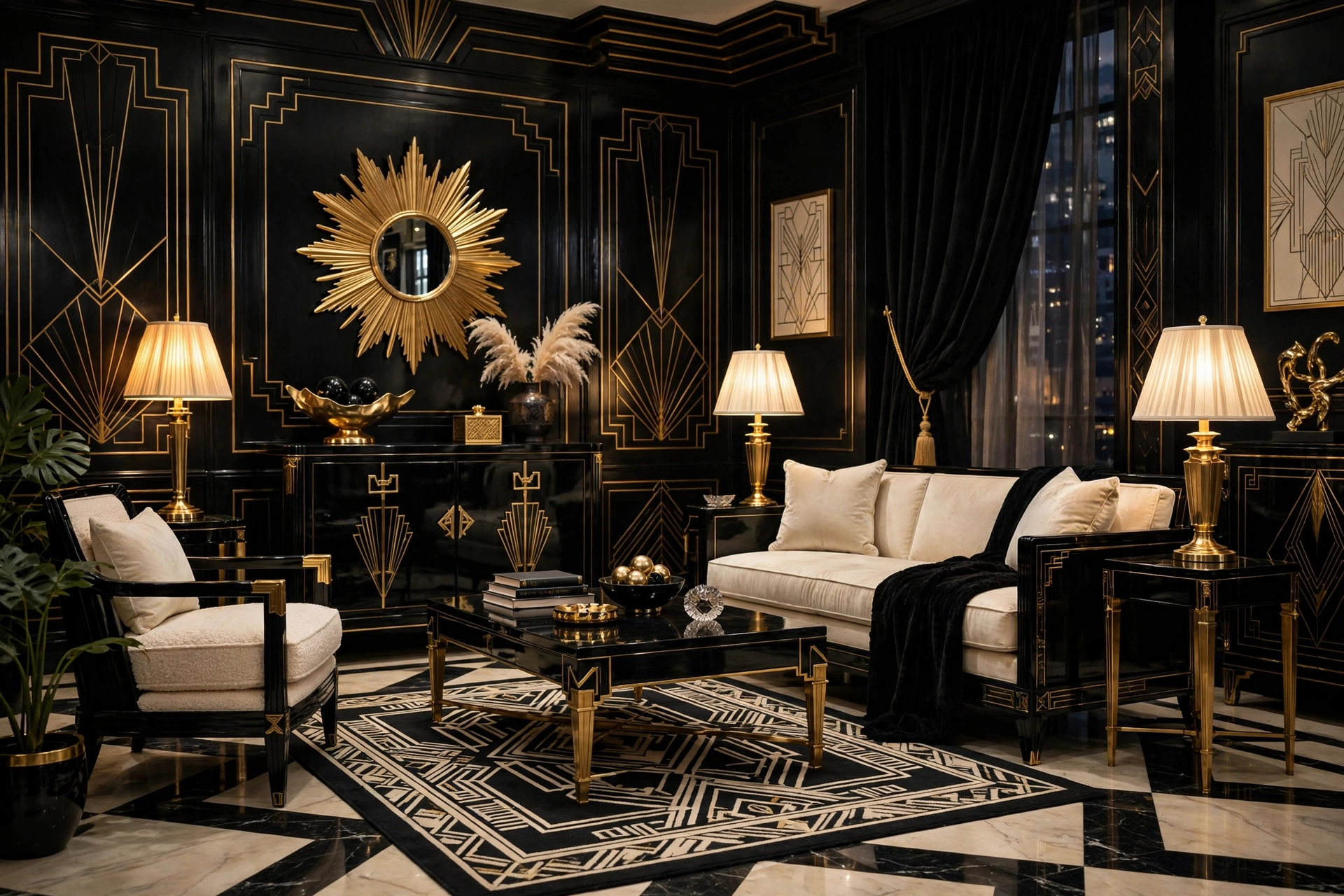
The black-and-gold combination is Art Deco’s signature pairing — dramatic, graphic, and endlessly chic. Black lacquered furniture (a coffee table, sideboard, or pair of side tables) against gold accents (brass lamps, gilt frames, gold hardware) creates the high-contrast glamour the era perfected. The black grounds the room; the gold makes it glow.
Balance is everything here. Too much black feels heavy; too much gold feels gaudy. Aim for roughly a 70-30 split — mostly black and neutrals with gold as the gleaming accent. A black lacquered coffee table with brass legs, or black side tables topped with brass lamps, nails the ratio in a single vignette.
9. Choose Curved, Sculptural Furniture
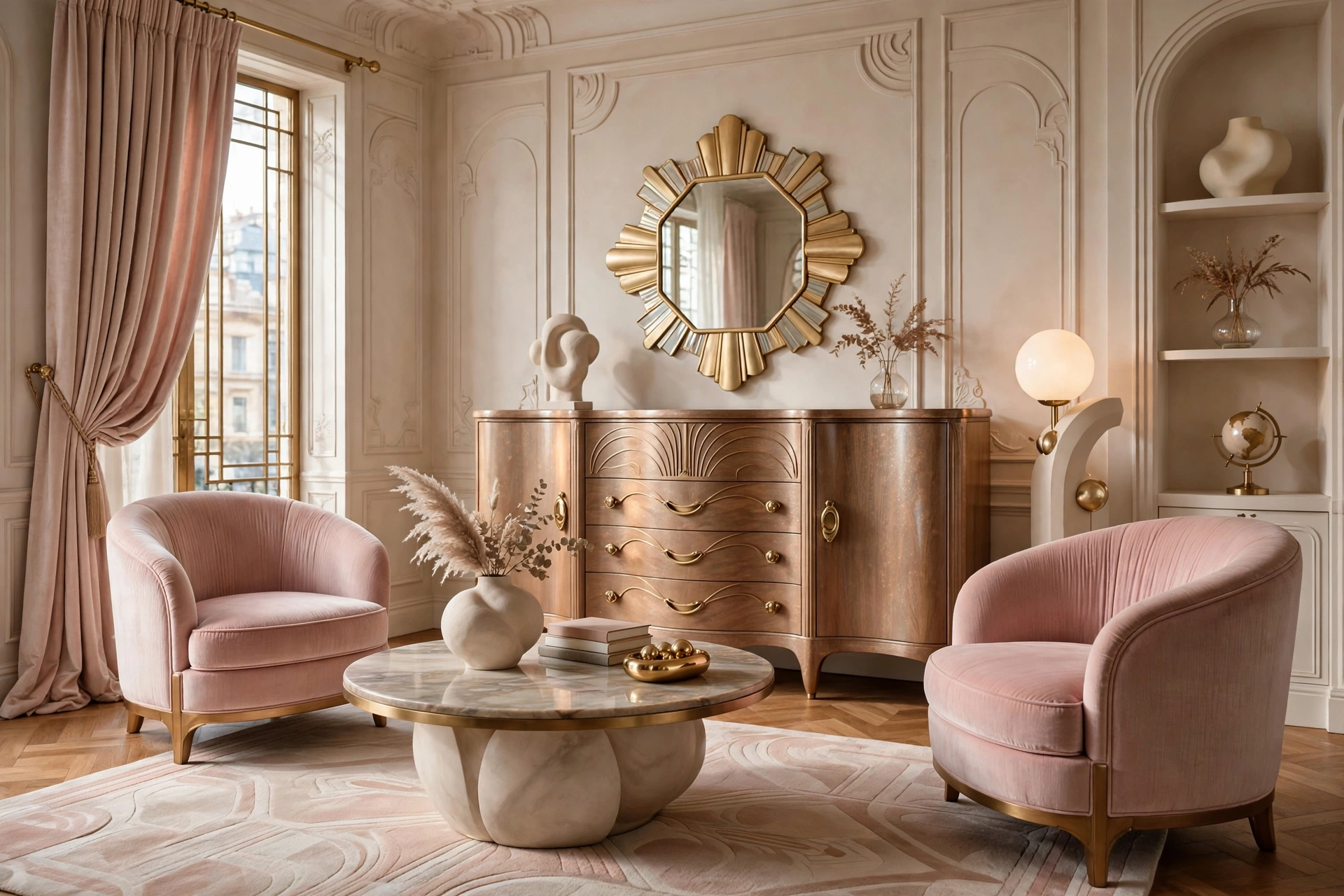
Art Deco furniture celebrates the curve: barrel-back chairs, serpentine-front cabinets, waterfall-edge tables, rounded sofas. These sculptural silhouettes soften the geometry of the room’s patterns and add the sensuous, streamlined feeling the era borrowed from ocean liners and automobiles. One or two curved pieces change the whole energy of a seating arrangement.
A pair of barrel chairs flanking the fireplace, a curved velvet loveseat, a round coffee table instead of a rectangular one — each curve is a counterpoint to the room’s straight lines. Our mid-century modern living room design ideas share this love of sculptural silhouettes, if you want to see how curves work in a different retro vocabulary.
10. Add Marble and Luxe Stone Details
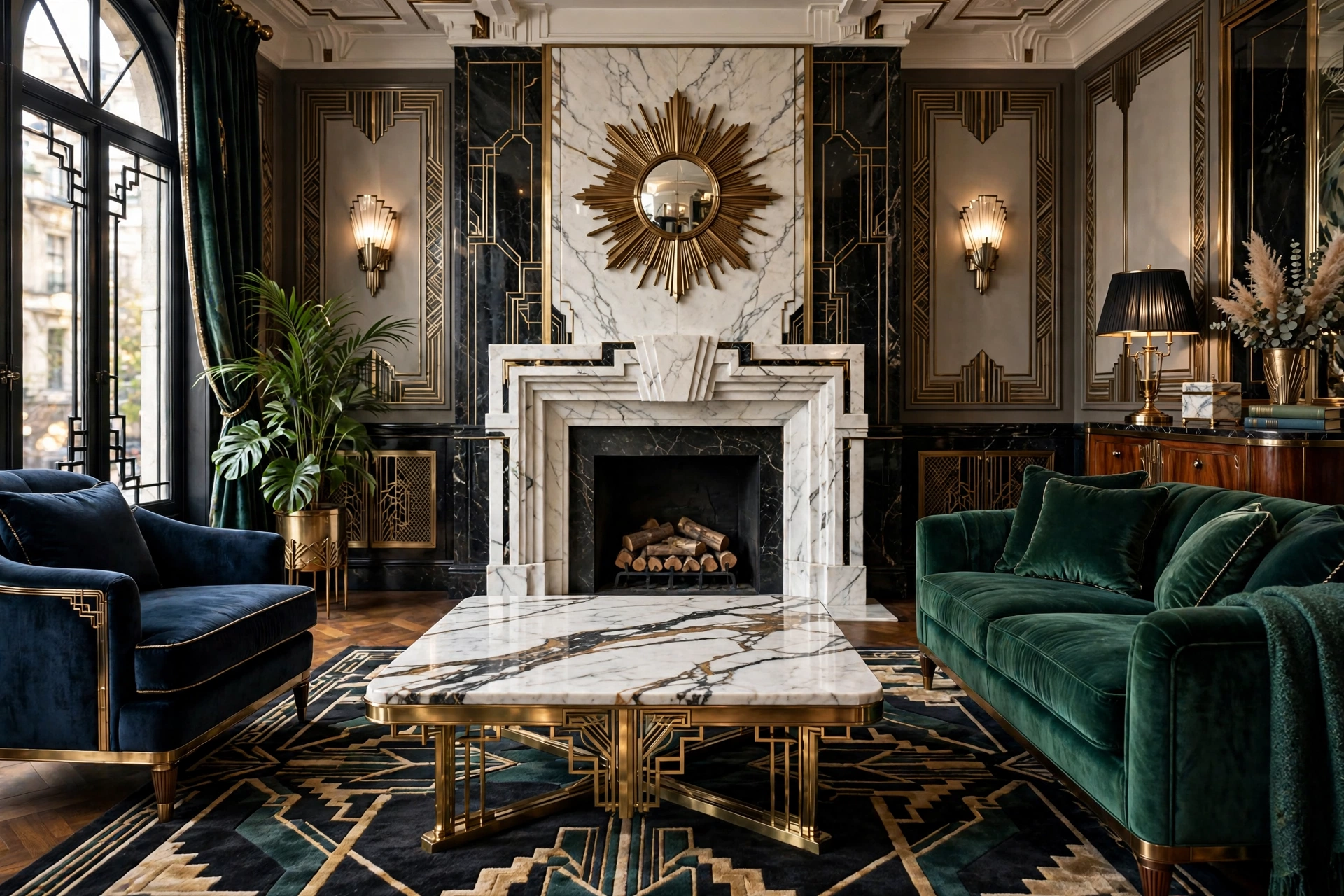
Art Deco was obsessed with luxurious materials, and marble sits at the top of the list. A marble coffee table, marble-topped side tables, a marble fireplace surround, or even marble-patterned wallpaper brings the cool, polished stone the era adored. White marble with dramatic veining is the classic choice; black marble is the bolder one.
You don’t need slabs of the real thing everywhere — one marble-topped piece plus marble-look accessories (a tray, bookends, small objets) delivers the effect. Pair marble with brass for the ultimate Deco material combination: cool stone against warm metal is a contrast the 1920s perfected and that still looks fresh today.
11. Lay a Bold Geometric Rug
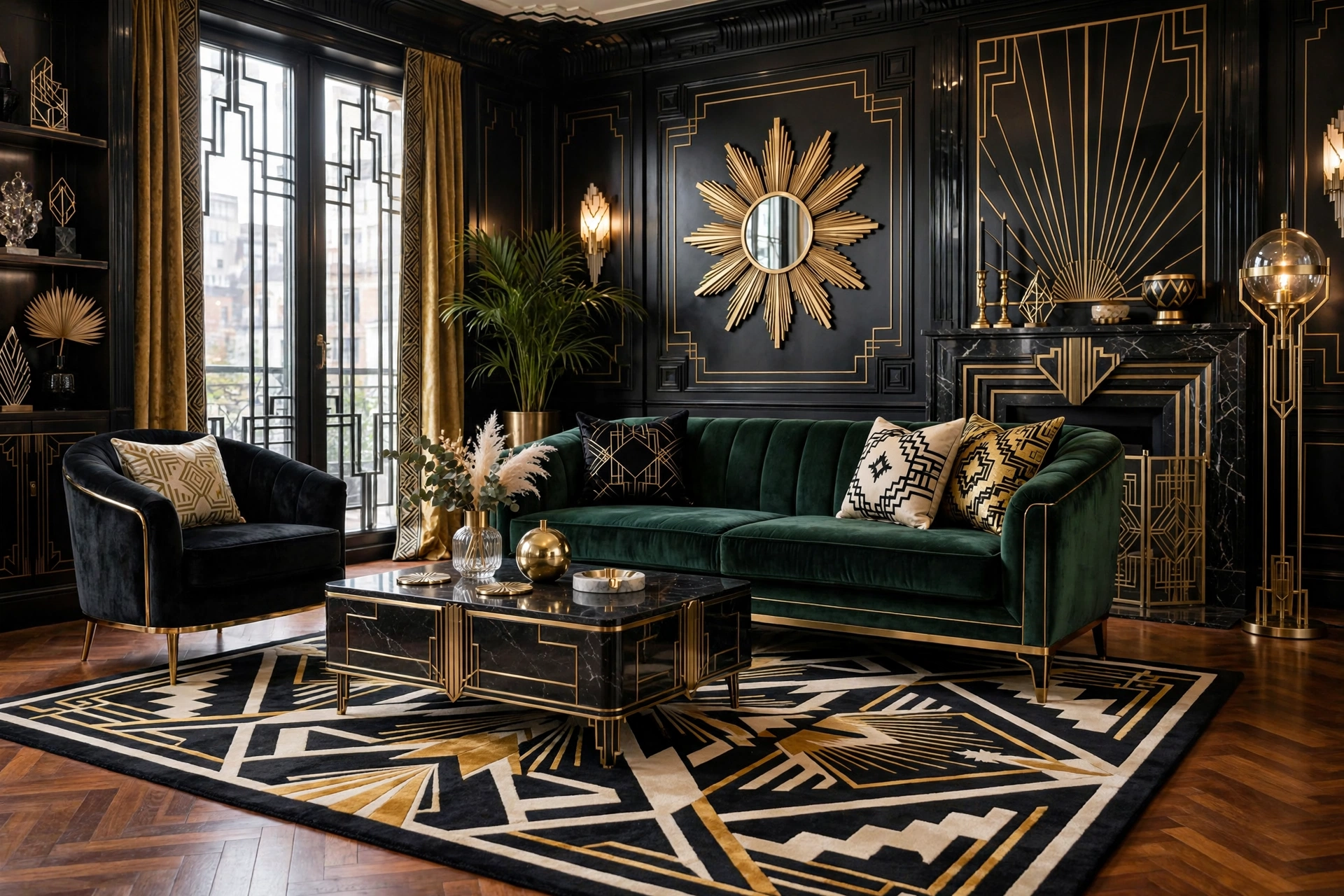
The rug is where Art Deco’s love of pattern hits the floor. A bold geometric — chevron, Greek key, fan motif, or stepped diamond pattern — in black, cream, and gold (or jewel tones) anchors the seating area and sets the graphic tone for everything above it. Size it generously so all front legs of the seating rest on it.
If the walls already carry a strong pattern, choose a rug that echoes rather than competes: pick up one color from the wallpaper in a simpler geometric. And don’t fear a vintage rug — a genuine 1920s or 1930s piece brings authenticity no reproduction can match, and Deco-era rugs surface regularly at estate sales and auctions.
12. Bring in a Lacquered Sideboard or Cabinet
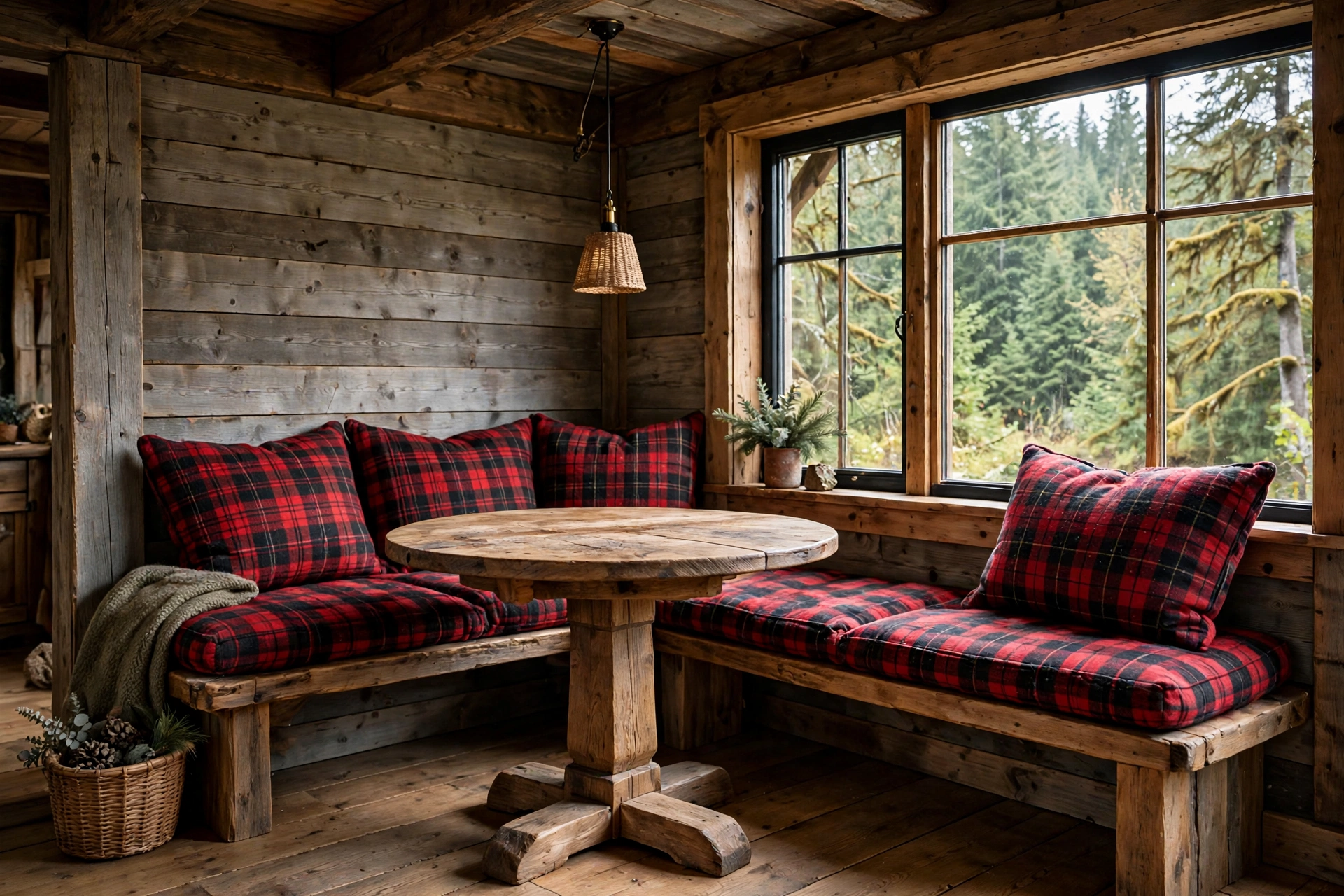
Every glamorous living room needs storage that looks like sculpture, and the lacquered sideboard is Art Deco’s answer. High-gloss black, deep green, or navy, with brass hardware and maybe mirrored or inlaid details — it stores the practical stuff while looking like it belongs in a Paris salon. Style the top with a mirror or art above, a pair of lamps or sculptural objects, and one beautiful tray.
The high-gloss finish is doing the visual work here, so keep the styling simple and let the piece shine — literally. Wipe it down regularly; lacquer shows dust and fingerprints, but that’s the price of glamour. One great sideboard beats three ordinary storage pieces in a Deco room.
13. Layer Sculptural Lighting
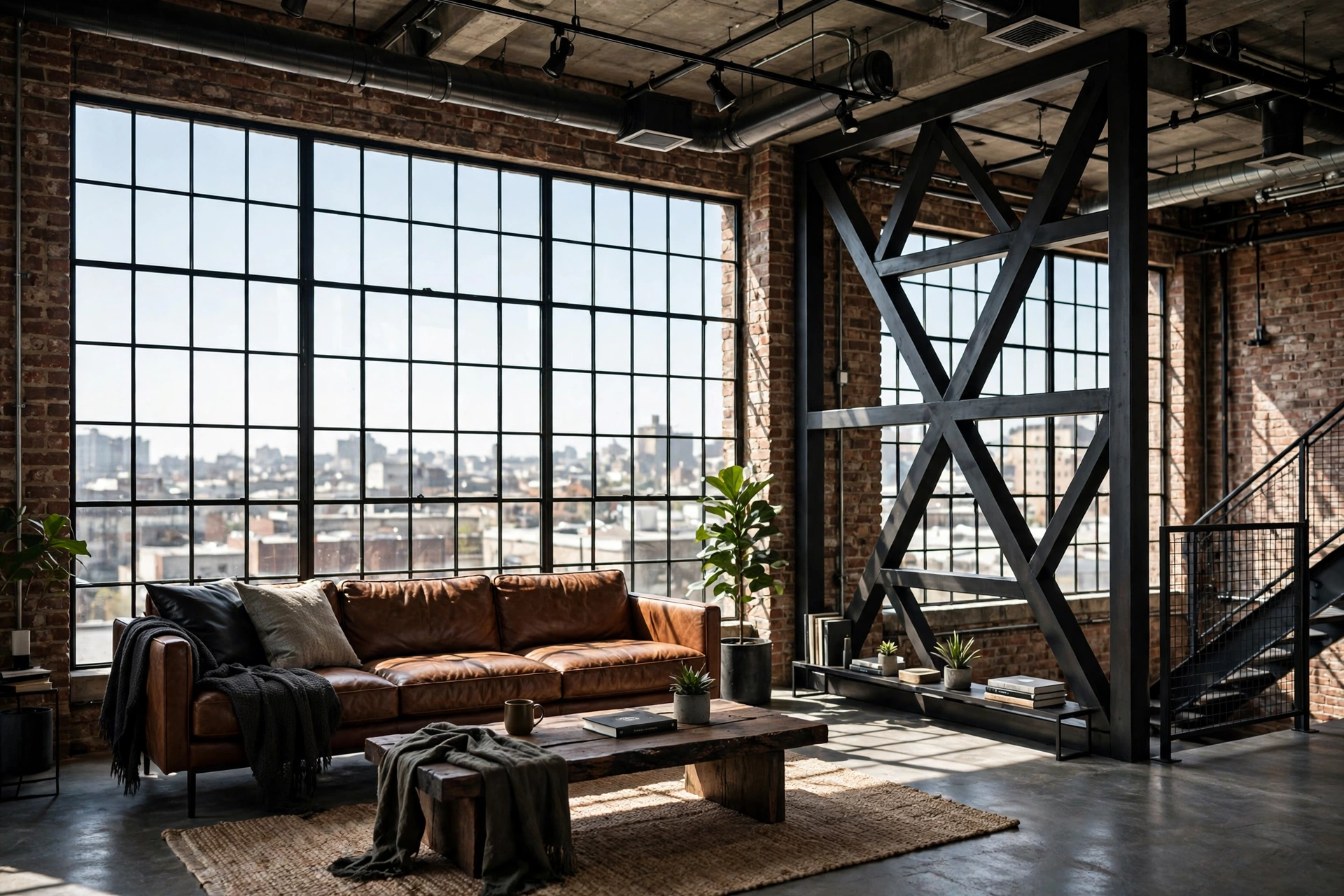
Beyond the chandelier, Art Deco rooms layer light through sculptural fixtures: frosted-glass globe sconces, geometric brass table lamps, a tiered floor lamp, backlit shelving. Each fixture should be beautiful enough to admire when it’s off — Deco lighting is decor first, illumination second. Symmetry helps: pairs of matching sconces or lamps reinforce the era’s love of order.
The Spruce’s guide to interior design styles describes Art Deco’s hallmarks — geometric shapes, stylized curves, atmospheric lighting, luxe materials like marble and velvet — as the defining vocabulary. Aim for three layers minimum: ambient from the ceiling, task light by the seating, and accent light washing the walls or art.
14. Add Animal Print and Rich Texture
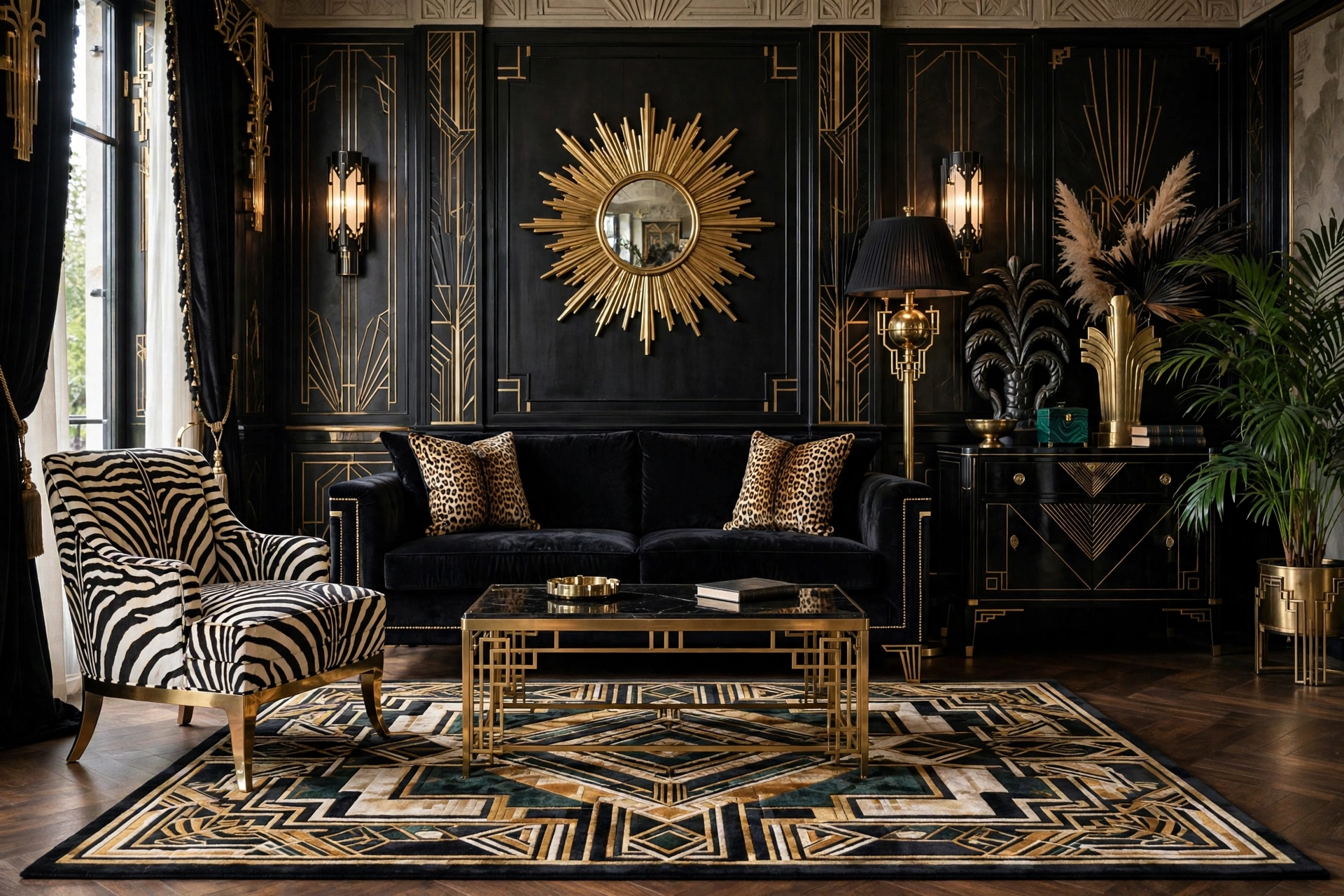
Art Deco had a wild side — zebra, leopard, and other exotic prints were the era’s shorthand for luxury and adventure. A zebra-print accent chair, leopard-print pillows, or a faux-fur throw adds the untamed contrast that keeps a glamorous room from feeling too polished. Used sparingly, animal print is the exclamation point in a Deco sentence.
Treat it as an accent, never the main event: one chair or a pair of pillows is enough. Pair it with the room’s metallics — leopard against brass is a combination that never fails. The texture matters as much as the pattern; a nubby faux fur or a sleek hide-look fabric adds the tactile richness Deco demands.
15. Finish With Gatsby-Era Glamour
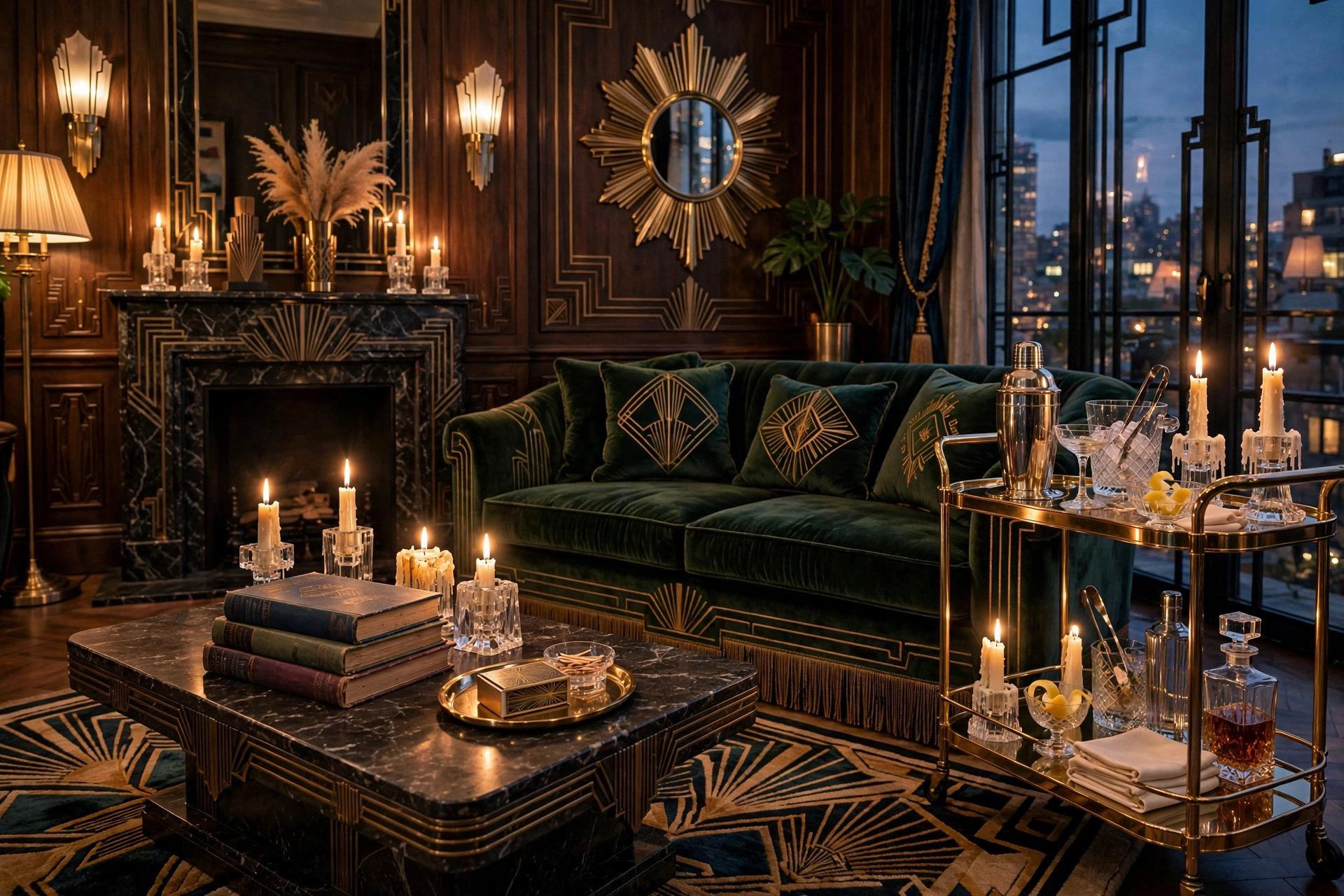
The final layer is pure atmosphere: a cocktail shaker on the bar cart, jazz on the speaker, candles in crystal holders, a stack of 1920s art books on the coffee table. These are the details that make an Art Deco living room feel like an invitation rather than a museum — glamour you can actually live in.
Keep the styling edited and intentional. Deco is maximalist by nature, but every object should earn its place. For a darker, moodier take on glamorous living spaces, our moody living room design ideas explore the dramatic end of the spectrum — and if you prefer your glamour with cleaner lines, our modern living room design ideas show how to keep luxury feeling current.
Frequently Asked Questions
What are the key elements of Art Deco living room design?
Geometric patterns, rich jewel tones, luxurious materials (velvet, marble, brass, mirrored surfaces), curved sculptural furniture, symmetrical layouts, and statement lighting. The overall feeling should be glamorous and confident — 1920s luxury filtered through modern livability.
How do I add Art Deco style without it looking like a theme?
Pick two or three Deco signatures — say, a sunburst mirror, a velvet sofa, and brass lighting — and keep everything else quiet and contemporary. Restraint is what separates inspired-by from costume. One era’s furniture mixed with modern art and neutral walls reads as curated, not themed.
What colors work best in an Art Deco living room?
Jewel tones (emerald, sapphire, ruby, amethyst) with black, cream, and metallic gold or brass. This is the classic Deco palette. For a softer version, use blush pink, champagne, and warm neutrals with brass accents — still glamorous, less dramatic.
Can Art Deco work in a small living room?
Yes — in fact, small rooms suit Deco’s jewel-box quality beautifully. Use mirrors to double the light and space, choose a bold wallpaper on one wall, keep furniture scaled to the room, and let one statement piece (a great mirror, a velvet loveseat) do the heavy lifting.
Is Art Deco the same as Hollywood Regency?
They’re close cousins. Hollywood Regency is essentially Art Deco’s glamorous American offspring — bolder, more maximalist, with mirrored furniture, lacquer, and high contrast. Think of Hollywood Regency as Art Deco turned up to eleven.
Keep Exploring
An Art Deco living room is a celebration — of craft, of glamour, of the idea that your home should dazzle a little. Start with the geometry and the velvet, add the brass and the light, and let the room develop its own after-dark personality.
For more living room inspiration across every style, explore our living room decor ideas — because the best rooms are the ones with a point of view.





[…] It works best on walls with natural light, which brings out the variation. One caution: true limewash is not wipeable like latex, so skip it behind the snack table if you have small children. For a dressier take on old-world texture, see our 15 art deco living room design ideas full of glamour. […]