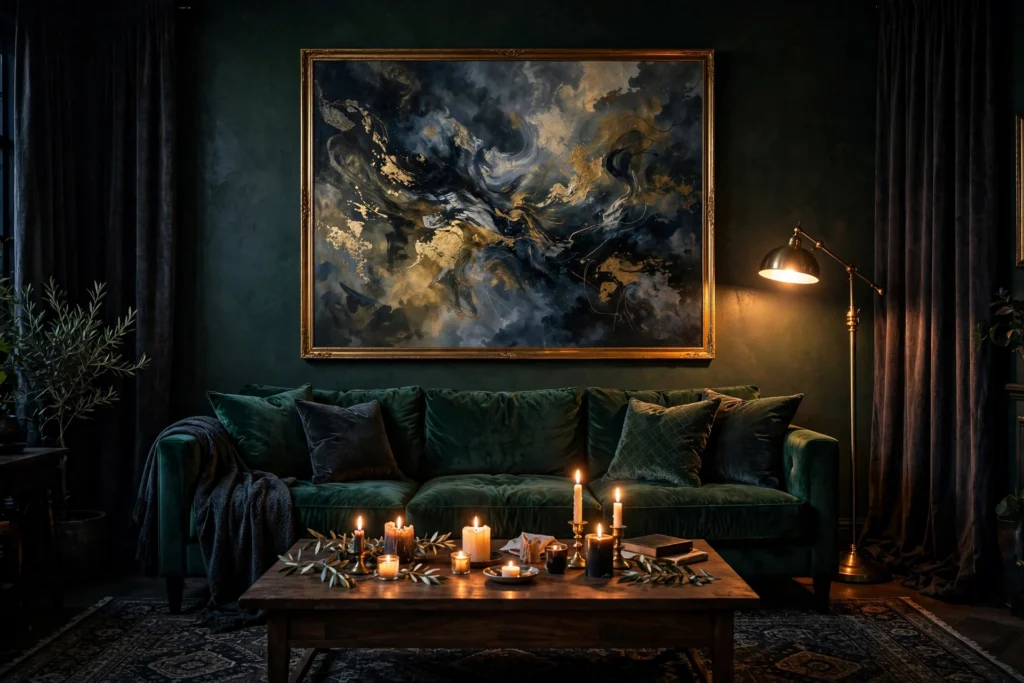

There’s a special kind of comfort in a room that pulls the evening in rather than pushing it away. A moody living room isn’t dark for the sake of being dark — it’s layered, textured, and glowing in all the right places. Think deep forest green walls softened by lamplight, a velvet sofa that practically begs you to sink in, and brass details catching candlelight across the room. Done well, moody design feels like a warm exhale at the end of the day.
The secret is balance: darkness needs contrast to shine. Every shadow in these ideas is paired with something warm — a pool of amber lamplight, a nubby wool throw, a gilded frame, the flicker of a real flame. Below are fifteen moody living room design ideas that show exactly how to build that drama without the gloom, so your living room feels like a film set you’re lucky enough to live in.
1. Paint the Walls a Deep, Enveloping Green
Nothing says moody quite like walls in a rich, desaturated green — think forest, hunter, or a blackened olive with gray undertones. These colors recede in lamplight and make everything in front of them glow: art looks richer, brass looks warmer, and your sofa suddenly becomes the star. Test three shades on the wall and watch them at night under your lamps before committing, because a green that looks muddy at noon can look like pure velvet by evening.
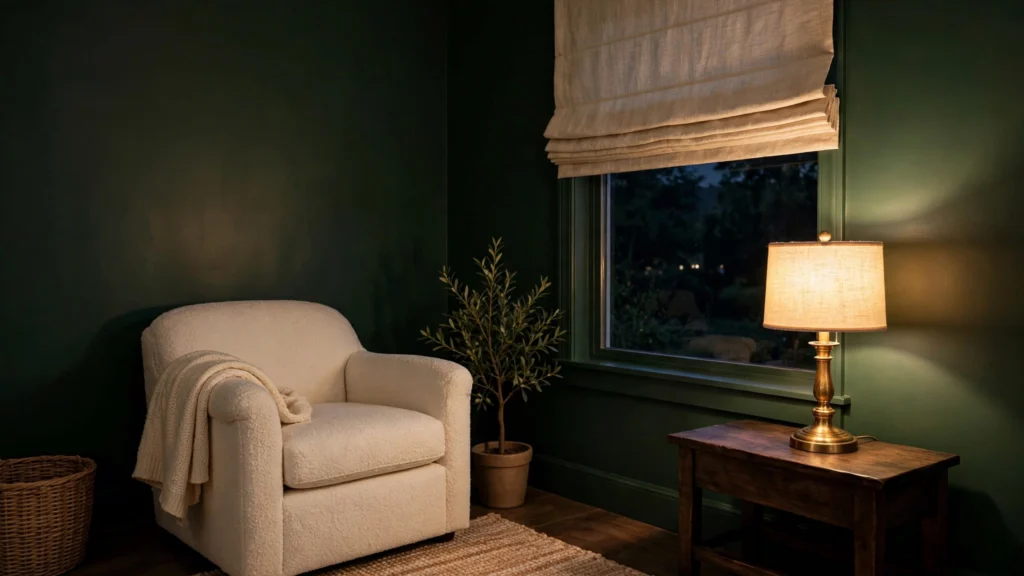
To keep the room from feeling like a cave, pair the green with one strong light-toned element — a cream boucle armchair, a pale oak side table, or a linen roman shade. The contrast is what makes the dark feel intentional rather than accidental. Finish with a matte or eggshell paint finish rather than flat; it catches lamplight in a soft sheen that keeps the walls alive instead of swallowing them.
2. Choose Velvet Upholstery That Drinks the Light
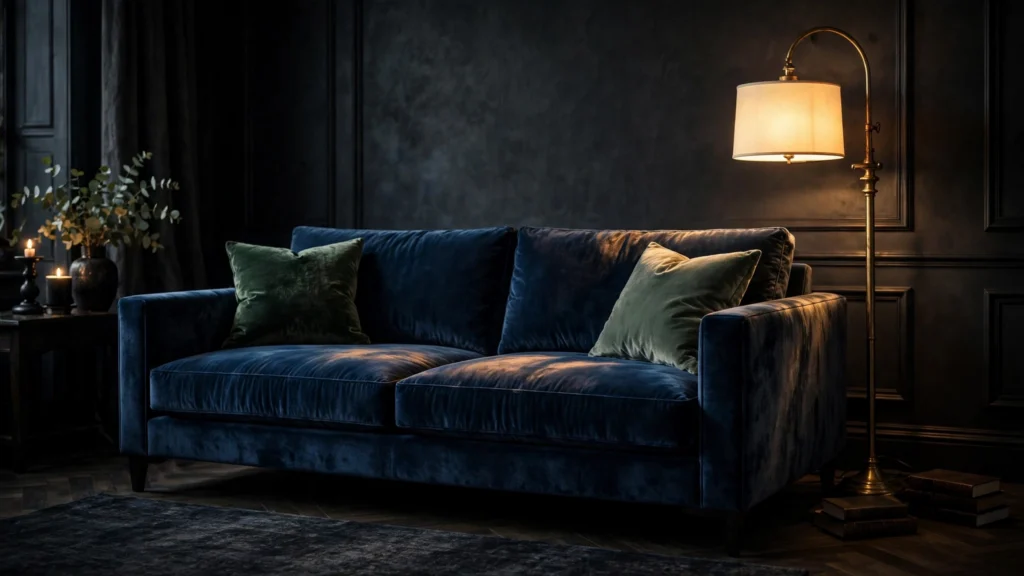
Velvet is the unofficial fabric of the moody living room. Its pile absorbs and reflects light in shifts, so a midnight blue or deep emerald velvet sofams to change color as you move around it — one moment nearly black, the next richly jewel-toned. That living quality is exactly what flat, dark fabrics lack. A velvet sofa or a pair of velvet club chairs instantly becomes the anchor of the room, no styling heroics required.
Caring for it is simpler than its reputation suggests. Vacuum weekly with an upholstery attachment and rotate cushions so they wear evenly. If a full velvet sofa feels like a leap, start with velvet throw pillows in two depths of the same color family — rust and burnt orange, or bottle green and sage — layered against a neutral sofa for instant mood.
3. Layer Warm Low Lighting Instead of Overhead Glare
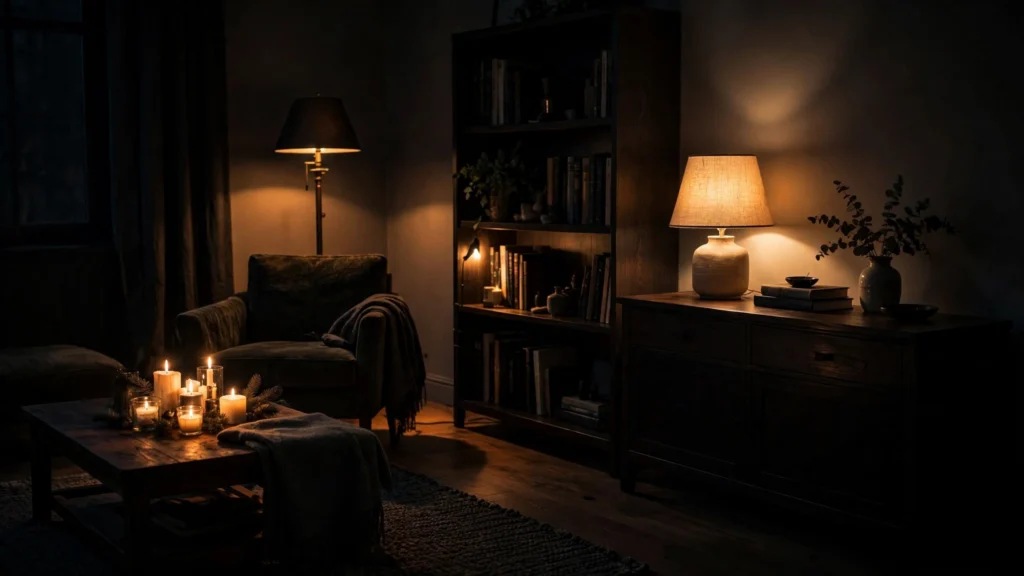
Overhead ceiling lights are the enemy of mood. Replace them with three to five low light sources spread around the room: a floor lamp behind a reading chair, a table lamp on a sideboard, a small accent light on the bookshelf, a candle cluster on the coffee table. Aim for 2200–2700K “wwarm whiteulbs at low wattages; the goal is pools of amber glow with shadowy corners left deliciously dark.
Dimmer switches are the single cheapest upgrade in this whole list. Put every lamp on a dimmer — plug-in dimmers work on standard lamps without any wiring — and set each one slightly differently so the room reads as layers rather than one flat wash. Shade choice matters too: linen or fabric shades diffuse light softly, while an opaque drum shade pushes light up and down for a more theatrical cone effect.
4. Add Brass and Gold Accents for Warmth
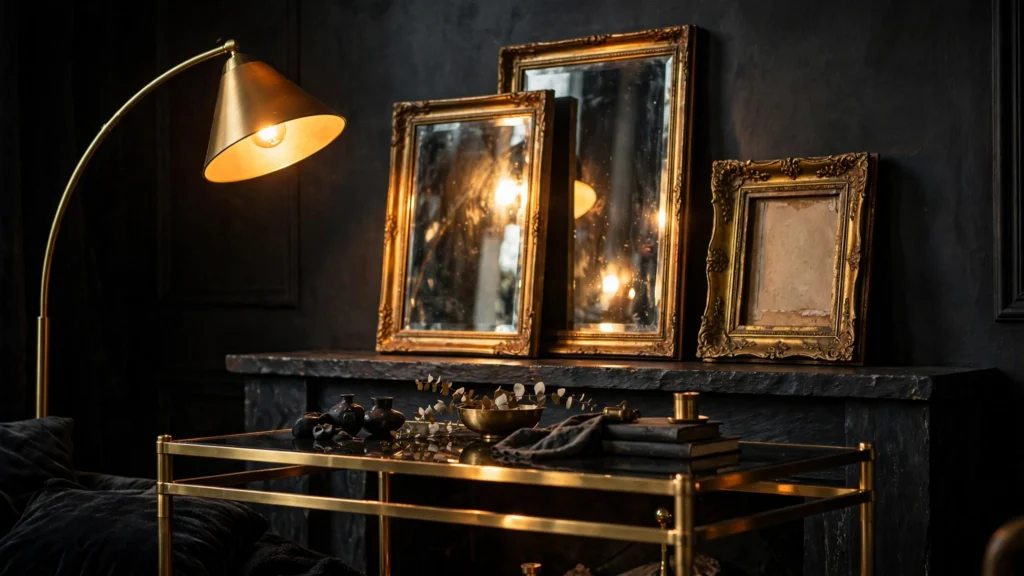
Against charcoal walls and dark upholstery, brass and warm gold read like candlelight made solid. A brushed-brass floor lamp arc, a pair of gold-frame mirrors leaning on the mantel, or brass coffee-table legs will catch every lamp in the room and scatter warm reflections everywhere. Unlike cool chrome or nickel, brass actively warms the color temperature of the space, which is exactly what a moody palette needs.
You don’t need much — five to seven touches scattered at different heights is plenty. Mix finishes deliberately: unlacquered brass that will patina over time next to polished gold keeps it from feeling like a matching set from a showroom. And let it be imperfect — slightly aged brass with a bit of darkening in the crevices suits moody rooms far better than anything mirror-polished.
5. Hang Oversized, Dramatic Artwork
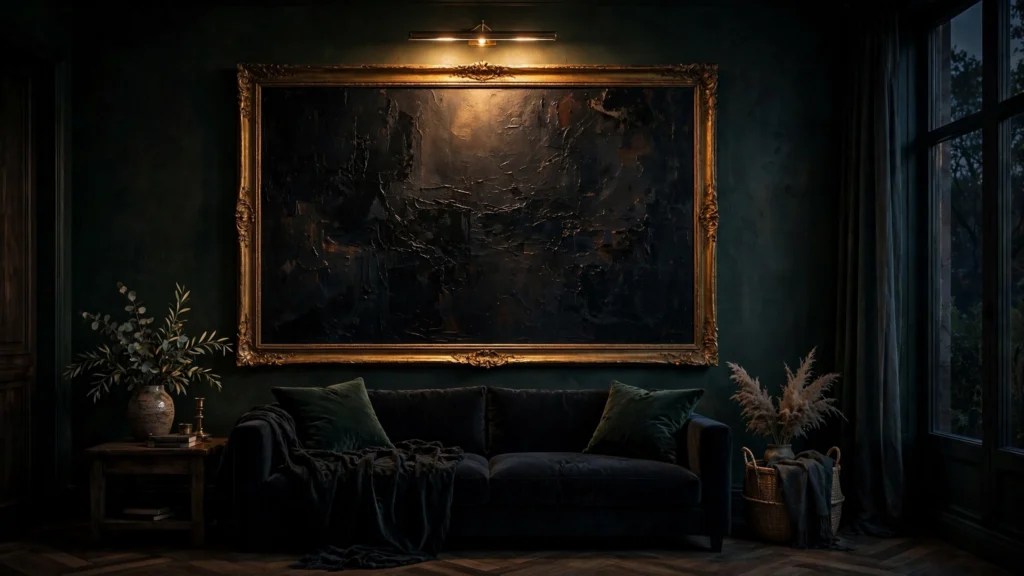
In a moody room, art should be an event, not a decoration. One oversized piece — a near-black abstract, a stormy landscape, a chiaroscuro-style portrait — commands a dark wall the way a postage-stamp gallery wall never could. Scale matters more than subject: aim for art that covers at least two-thirds the width of the furniture beneath it, and hang it so its center sits around 57 inches from the floor.
Picture lighting takes it from wall decor to gallery moment. A slim brass picture light mounted above the frame washes the canvas in warm light and turns it into a glowing focal point after dark. Choose a wide, substantial frame — blackened wood or antique gold — that can hold its own against the drama of the art and the wall behind it.
6. Go All-In on a Dark Ceiling
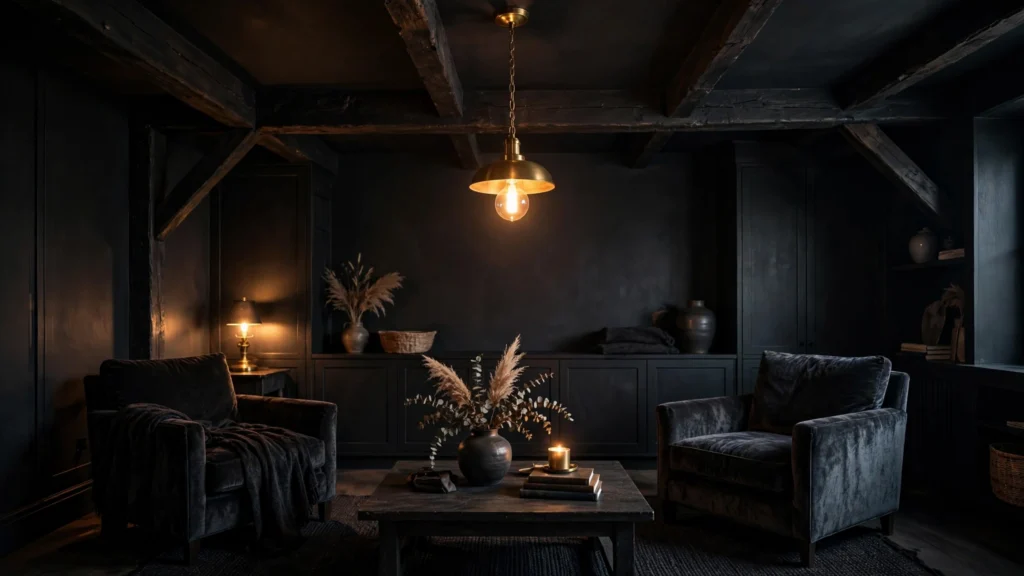
Painting the ceiling the same deep tone as the walls — or going one shade darker — dissolves the boundary between them and makes the room feel like a cocoon. It sounds risky, but it actually removes the visual “lid” that a white ceiling puts on a dark room; instead of a bright slab interrupting the mood, everything flows together and the room feels taller, not shorter, because your eye never finds an edge.
The trick is to give the eye something to land on elsewhere. A pendant with a warm bulb, dark-painted beams, or a ceiling medallion in a contrasting tone all keep the expanse from feeling flat. Keep the paint finish matte on the ceiling to avoid odd sheens from angled light, and cut in cleanly at the crown — a crisp edge reads intentional, a wobbly one reads unfinished.
7. Mix Rich, Tactile Textures
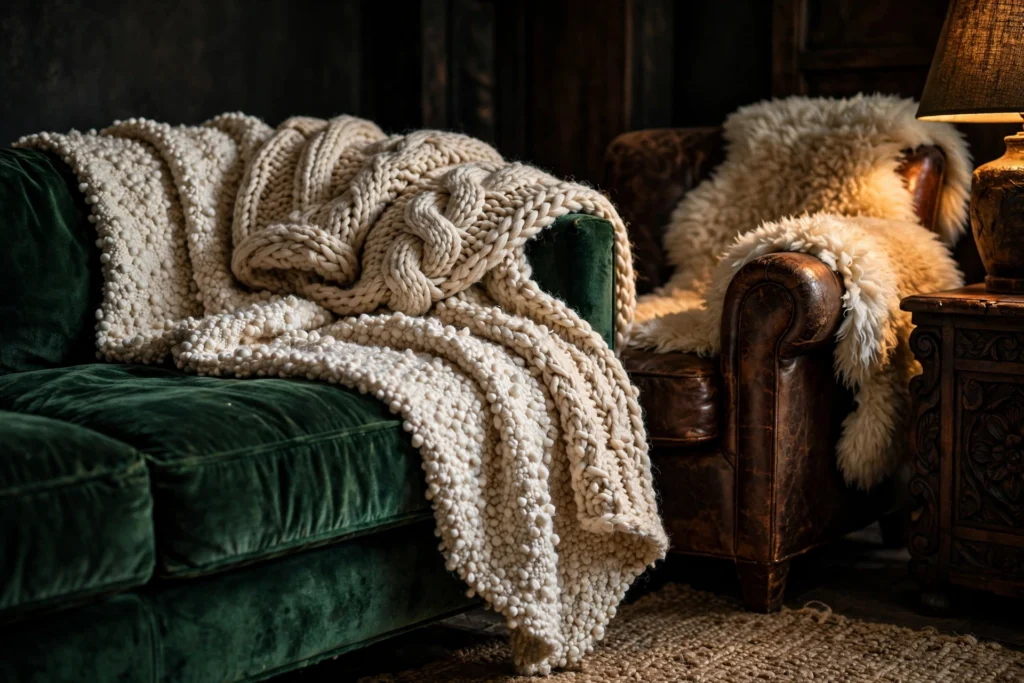
When the palette is restrained, texture does the talking. A moody room should be a catalog of touch: nubby bouclé, smooth velvet, raw linen, worn leather, carved wood, cool stone. The eye reads each surface differently in low light, and that variety is what keeps a dark room interesting instead of monolithic. Aim for at least five distinct textures in sightlines from any seat.
Layer them where your hands actually go — the throw on the sofa arm, the pillow against your back, the rug under your feet — because moody rooms are meant to be felt as much as seen. A chunky knit throw over a velvet sofa, a shaggy sheepskin draped on a leather chair, and a rough jute rug underfoot create a gradient of touch that makes the room feel deeply considered.
8. Anchor the Room With a Dark Area Rug
A dark rug does two jobs at once: it grounds the furniture grouping and deepens the room’s palette from the floor up. A charcoal Persian-style rug with faded medallion patterns, a nearly black wool rug with a subtle geometric weave, or a deep indigo vintage kilim all work — the pattern gives the eye somewhere to wander while the dark ground keeps the mood. Size it generously: front legs of every seat should rest on the rug, minimum.
In a moody room, natural fibers outperform synthetic every time. Wool and jute absorb light instead of reflecting it, which keeps the floor from looking glossy under lamps. Layer if you’re brave: a large dark jute rug under a smaller patterned Persian adds depth and lets you use a statement vintage piece without covering half of it with furniture.
9. Create a Candle-Lit Corner
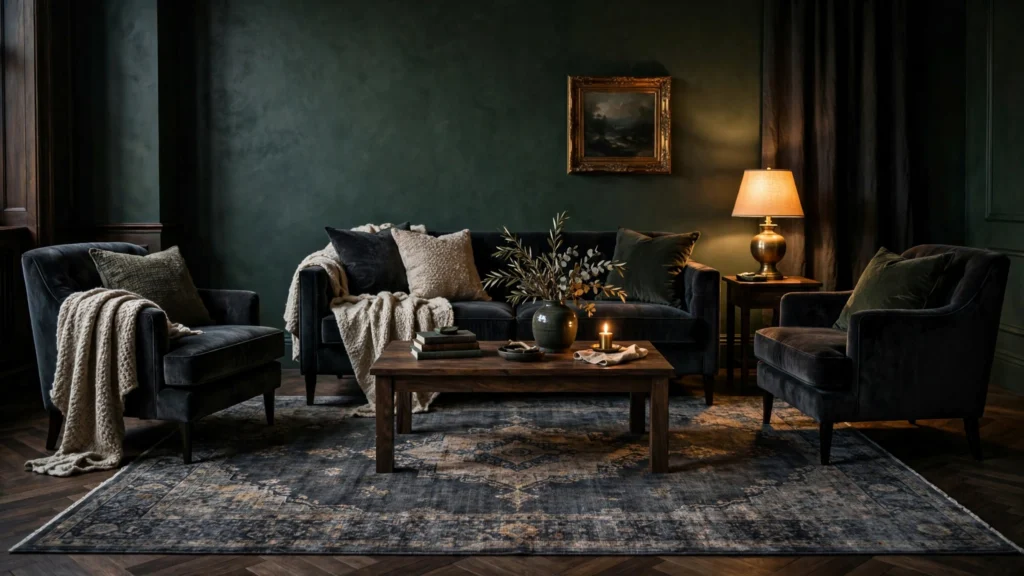
Nothing animates a moody room like real flame. Dedicate one corner — a side table, a windowsill, the hearth — to a generous cluster of candles at staggered heights: tall tapers in brass holders, chunky pillars on stone trays, and a few tea lights scattered low. The moving light softens every hard edge in the room and makes even a plain wall look cinematic.
Safety first, always: keep flames at least a foot from curtains and upholstery, never leave them burning unattended, and set pillars on heatproof trays. If real candles don’t fit your life, high-quality LED candles with a warm flicker mode are a legitimate stand-in — place them inside smoked-glass hurricanes where the glass itself does half the mood work. Either way, the corner should be its own little ceremony.
10. Let Natural Wood Ground the Palette
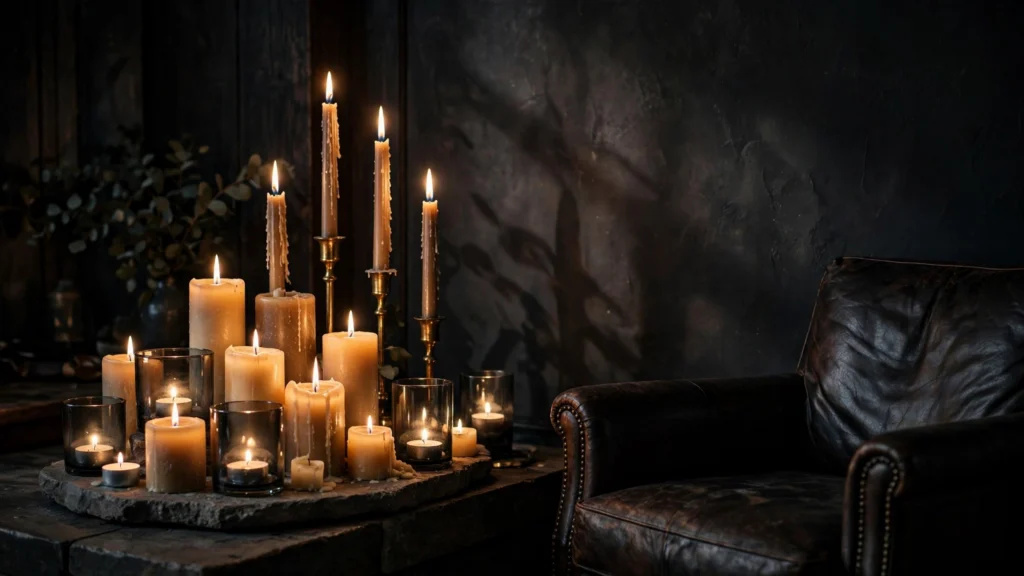
Dark rooms crave something organic to keep them from feeling stagey, and walnut, smoked oak, or ebonized wood delivers. A walnut coffee table, a dark-stained bookshelf, or exposed beams introduce grain and variation that paint and fabric can’t — the wood’s natural figure catches lamplight in ribbons and gives the room a sense of age and weight.
Mix your wood tones rather than matching them exactly; moody rooms look best when they feel collected over time. A blackened-oak media console next to a mid-tone walnut side table reads as a curated history, while everything in identical espresso reads as a furniture set. Let at least one piece show its grain proudly — a live-edge shelf or a burl-wood box adds a focal point of natural pattern.
11. Style Open Shelving Like a Moody Library
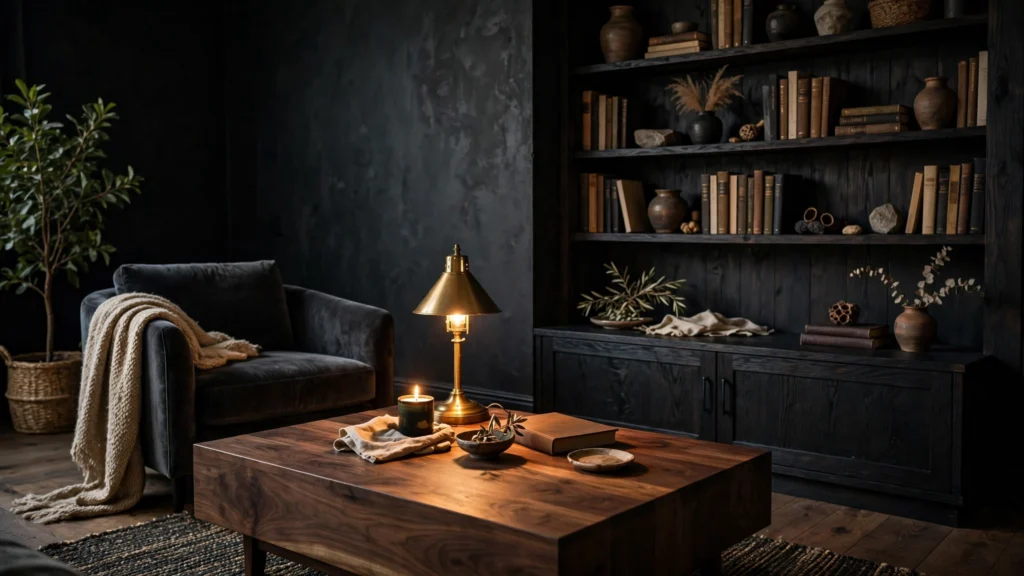
Bookshelves are mood machines. Style yours with intention: group books by tonal range rather than alphabet — deep spines together, tan and cream spines together — so the shelves read as a gradient of color. Leave breathing room between groups for objects: a brass candlestick here, a small framed print leaning there, a stone sculpture anchoring a shelf end. The gaps matter as much as the contents.
Back-painting the shelves in the same dark tone as the walls turns the whole unit into an alcove of shadow that makes books and objects glow. Add a slim LED strip or a pair of small picture lights at the top of each section, angled down — lit shelves in a dark room are pure atmosphere. And prune ruthlessly: a half-full shelf styled well beats a crammed one every time.
12. Use a Dark Backdrop for Plants
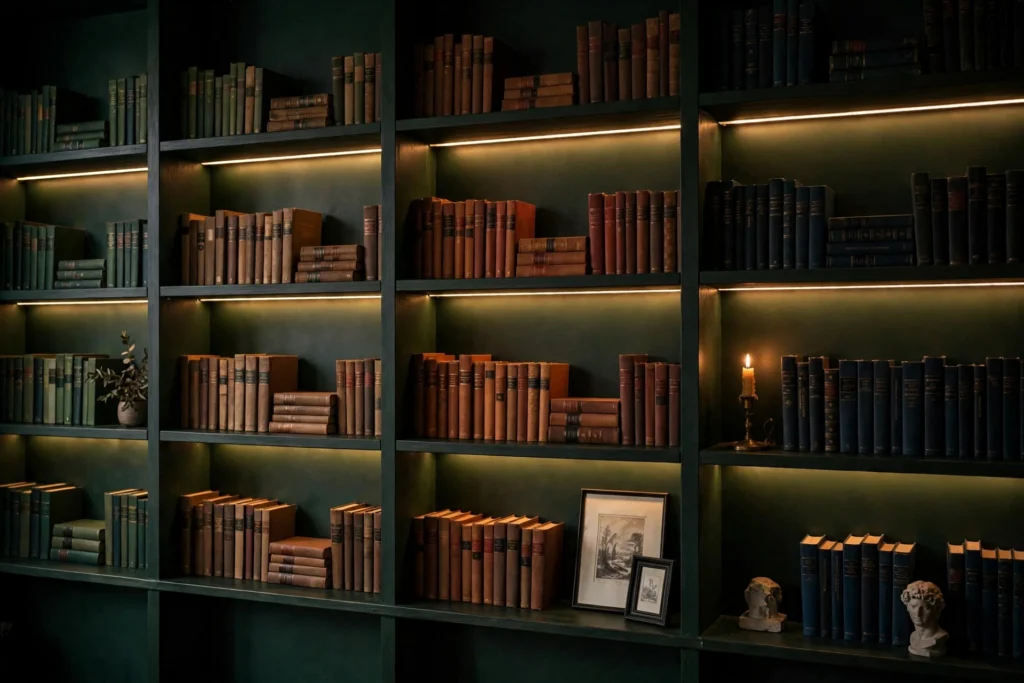
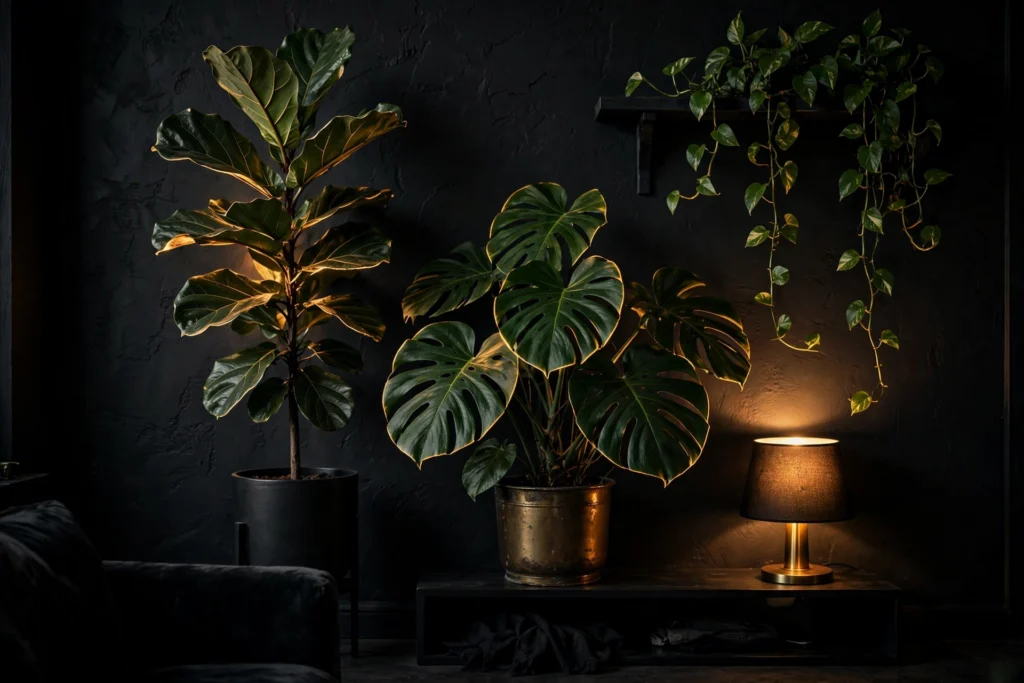
Greenery pops hardest against darkness. A tall fiddle-leaf fig, a sculptural monstera, or a cascade of trailing pothos against a charcoal or deep-green wall reads almost electric — every leaf edge sharpens in the contrast. Plants are also the cheapest way to make a moody room feel alive rather than staged, which matters when the palette is heavy.
Choose plants with bold, architectural shapes and dark green foliage that echoes the room’s palette. Skip fussy specimens; moody rooms need survivors — snake plants, ZZ plants, and cast-iron plants tolerate low light and irregular watering. Pot them in matte black, aged brass, or dark stone vessels so the containers disappear and the leaves do all the work.
13. Add an Antique or Vintage Statement Piece
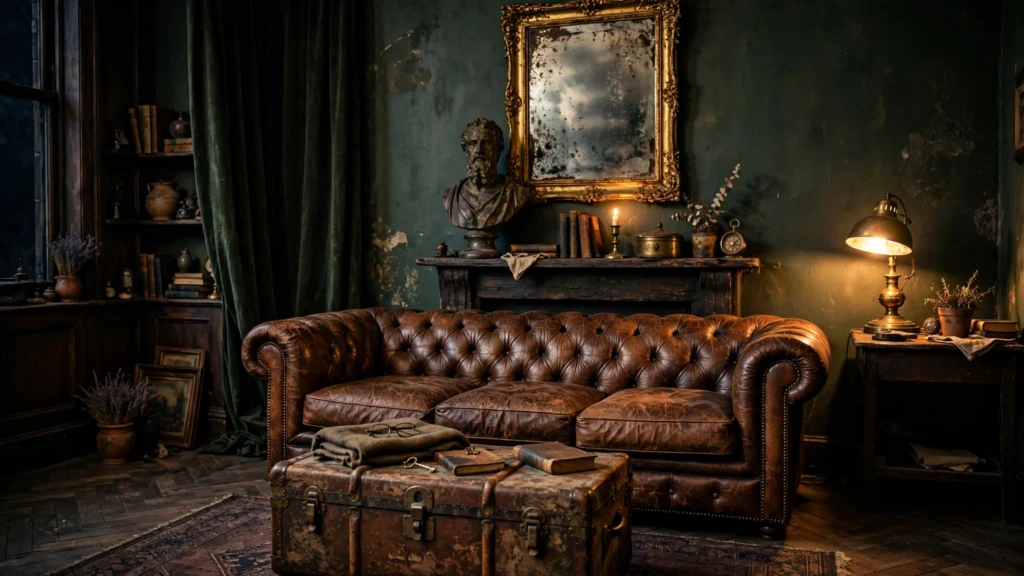
Every moody room needs at least one object with a past. A worn leather Chesterfield, an antique gilt mirror with foxed glass, a weathered trunk as a coffee table, or a vintage oil painting in a heavy frame — these pieces carry patina that no new purchase can fake, and patina is the soul of the moody aesthetic. One genuine antique outshines five “vintage-style” reproductions.
Hunt where the deals hide: estate sales, flea markets, and architectural salvage yards beat antique shops on price. Look for solid construction and good bones over perfect condition — a scratch in the leather or a tarnished corner is character, not damage.
14. Drape the Windows in Heavy Curtains
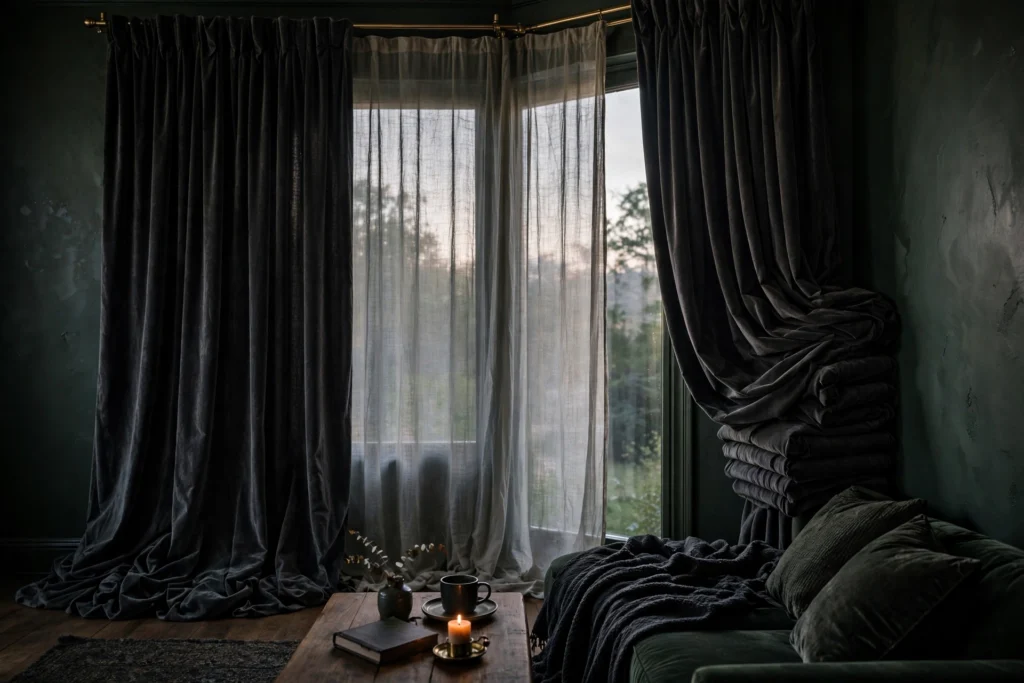
Heavy curtains are the finishing frame of a moody room. Floor-to-ceiling velvet drapes in charcoal, deep plum, or forest green soften the hard rectangle of the window, absorb sound, and close out the daylight for a true cocoon feeling. Hang the rod at least six inches above the frame and extend it a foot past each side so the panels stack on the wall, not the glass — this makes the window read larger and the curtains more generous.
Double up with a sheer or linen layer underneath for daytime: it filters light into a soft glow instead of a hard beam, keeping the room from going flat during the day. Choose a lining for the velvet panels — it protects the fabric from sun fade and gives the drapes the weight they need to fall in clean, dramatic folds.
15. Finish With Small, Intentional Glows
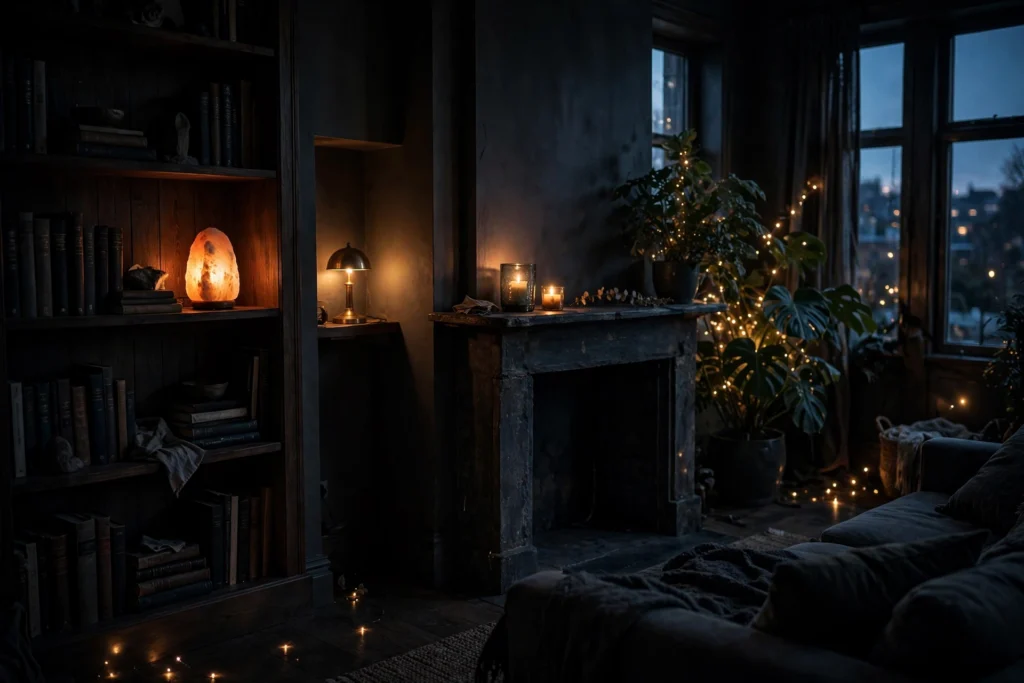
The final layer of a moody room is a scattering of tiny light sources that reward a second look: a salt lamp on the bookshelf, a small brass table lamp in an alcove, fairy lights tucked behind plants, a lit candle in a smoked-glass holder on the mantel. These micro-glows create depth the big lamps can’t — they draw the eye into corners and make the room feel bigger and more mysterious.
Put them on timers or smart plugs so they fade on at dusk automatically — a moody room that lights itself as evening falls is a room you’ll never want to leave.
Frequently Asked Questions
How do you make a moody living room without it feeling depressing?
Warmth is the antidote to gloom. Use warm-toned light bulbs (2700K or lower), layer at least three low light sources, and mix in natural materials like wood, leather, and plants that keep the room feeling alive. Keep one or two lighter elements — a cream chair, a pale wood table — for contrast, and make sure your dark colors have rich undertones (green, blue, plum) rather than pure flat black, which reads as absence rather than depth.
What colors work best for a moody living room?
Deep greens (forest, hunter, blackened olive), inky navies, charcoal grays, rich plums, and warm near-blacks like espresso or oxblood are the core moody palette. Choose colors with visible undertones so they shift beautifully under lamplight. Pair them with warm metallics — brass, copper, antique gold — and one pale neutral for relief, and the room will feel enveloping instead of heavy.
Does a moody living room work in a small space?
Absolutely — dark colors can actually make small rooms feel larger by blurring the corners and edges so your eye can’t find the room’s boundaries. The keys are keeping the ceiling treatment cohesive with the walls, using mirrors to bounce lamplight, and editing clutter ruthlessly since dark rooms show disorder more harshly. A small moody room styled well feels like a jewel box, not a closet.
Can I rent and still get a moody look?
Yes — focus on the layers you can take with you. A dark rug, velvet curtains on a tension or no-drill rod, low warm lamps, candles, dark throw pillows, and large-scale art leaned against walls (not hung) deliver 80 percent of the mood with zero paint. Peel-and-stick wallpaper in a dark botanical or damask print is the renter’s secret weapon for dramatic walls that reverse cleanly at move-out.
Keep Exploring
A moody living room is never really finished — it deepens with every candle you light, every texture you add, and every lamp you dim a little lower. If this dark, dramatic look speaks to you,





[…] need a supporting actor or the room can feel flat, and transitional palettes allow one or two muted accent tones — sage green, dusty blue, warm taupe, soft terracotta, or muted olive. “Muted” is the […]
[…] drama, paint the nook’s wall behind the chaise a deep, moody color — our 15 Moody Living Room Design Ideas Full of Dark Drama shows how dark walls and warm brass lighting make any corner feel like an old […]
[…] Dark academia lives or dies on its lighting. Aim for three layers: a task light at the desk (the banker’s lamp), ambient warmth from wall sconces or table lamps, and small points of glow — a candle-style lamp, a lit bookcase strip, fairy lights tucked behind shelves. Keep every bulb at 2700K or warmer, and put the main lamps on dimmers so the room can shift from working bright to evening mellow. […]
[…] the whole room in layered creams and beiges with wood and brass for warmth is endlessly elegant. Our moody living room design ideas explore the darker end of this palette if deep, enveloping color calls to […]
[…] primer so the dark color covers in two coats instead of four. For more moody inspiration, see our 15 moody living room design ideas full of dark drama. Pair navy with brass accents, and keep the other walls warm […]
[…] These 15 dark academia bedroom ideas will help you build that scholarly, romantic atmosphere layer by layer. Whether you’re starting from a blank white box or layering the look over existing furniture, you’ll find practical moves here — paint colors that set the mood, thrifted pieces worth hunting for, and lighting tricks that make everything glow. For more dark, dramatic inspiration beyond the bedroom, see our moody living room design ideas. […]