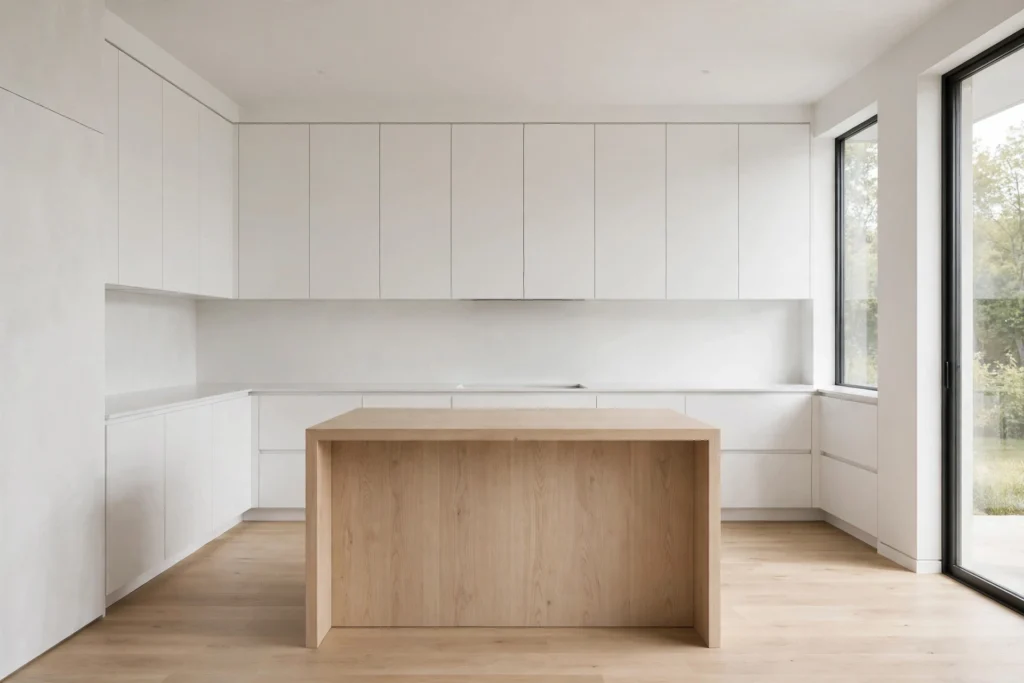

The minimalist kitchen is a quiet rebellion. Against the gadget graveyard on the counter, the drawer of single-use tools, the visual noise of seventeen things competing for attention — it says: less, but better. And the reward is a kitchen that feels calm at 7 a.m. and still looks good at 7 p.m.
Minimalism in the kitchen isn’t about deprivation; it’s about intention. Clean lines, honest materials, everything in its place, and room to breathe. These fifteen minimalist kitchen design ideas will help you build a kitchen that works beautifully because it holds only what matters.
1. Commit to Clear Counters
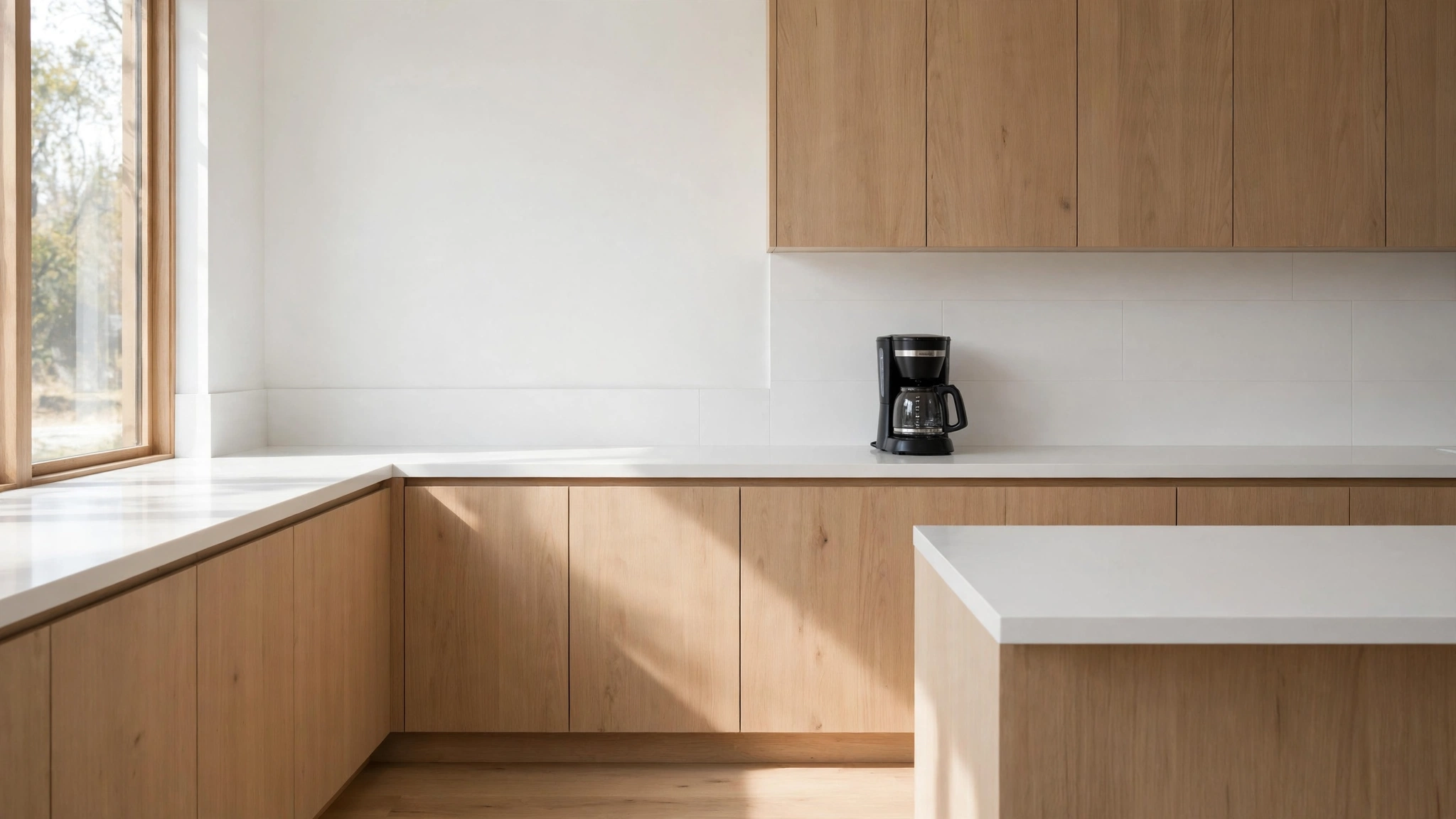
The single most powerful minimalist kitchen move costs nothing: clear the counters. Everything except daily essentials (coffee maker, maybe a knife block, one beautiful object) gets a home inside cabinets. The visual calm is instant and dramatic.
Make it stick with the one-in-one-out rule and a nightly “shutdown” — two minutes to return everything to its place. The Spruce’s minimalist decorating ideas put clear surfaces at the heart of the philosophy: in a minimalist kitchen, the counter is a workspace, not a warehouse.
Start with the worst offender — usually the corner by the coffee maker or the stretch beside the stove — and clear just that zone first. Once you feel the calm of one clear stretch, the rest follows naturally. Many minimalist converts report that clear counters actually change how they cook: with space to work, prep becomes pleasurable instead of cramped, and cleanup takes minutes because there’s nowhere for mess to hide.
2. Choose Flat-Front, Handleless Cabinets
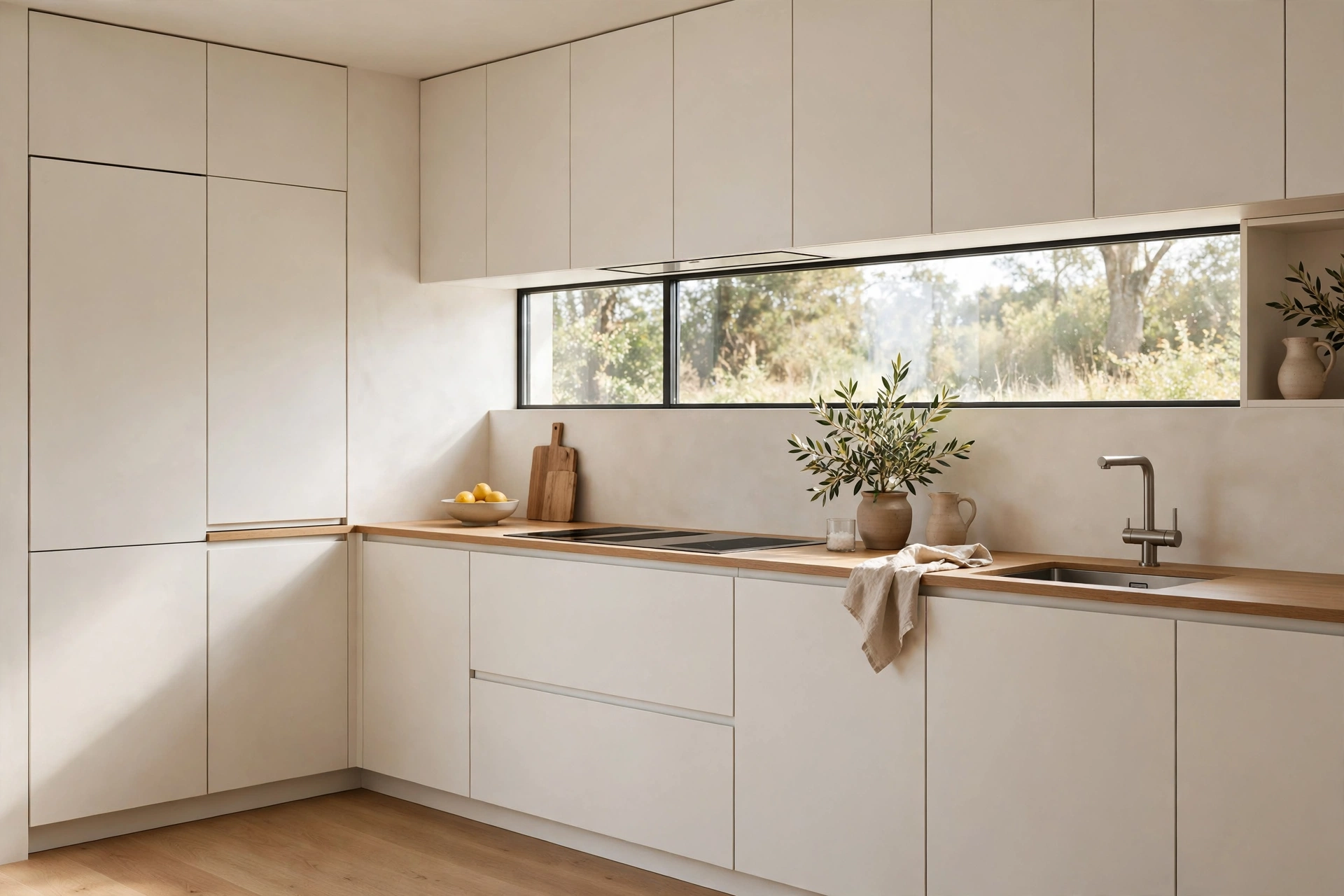
Cabinetry sets the minimalist tone, and flat-front (slab) doors with no visible hardware are the purest expression. Push-to-open mechanisms or slim integrated pulls keep the lines unbroken; the kitchen reads as calm planes of color rather than a grid of doors and knobs.
If full handleless feels too stark, choose the slimmest possible hardware — a simple linear bar pull in a quiet finish. Keep every cabinet in one finish and one color for maximum serenity. The fewer visual interruptions, the calmer the room.
3. Stick to a Restrained Palette
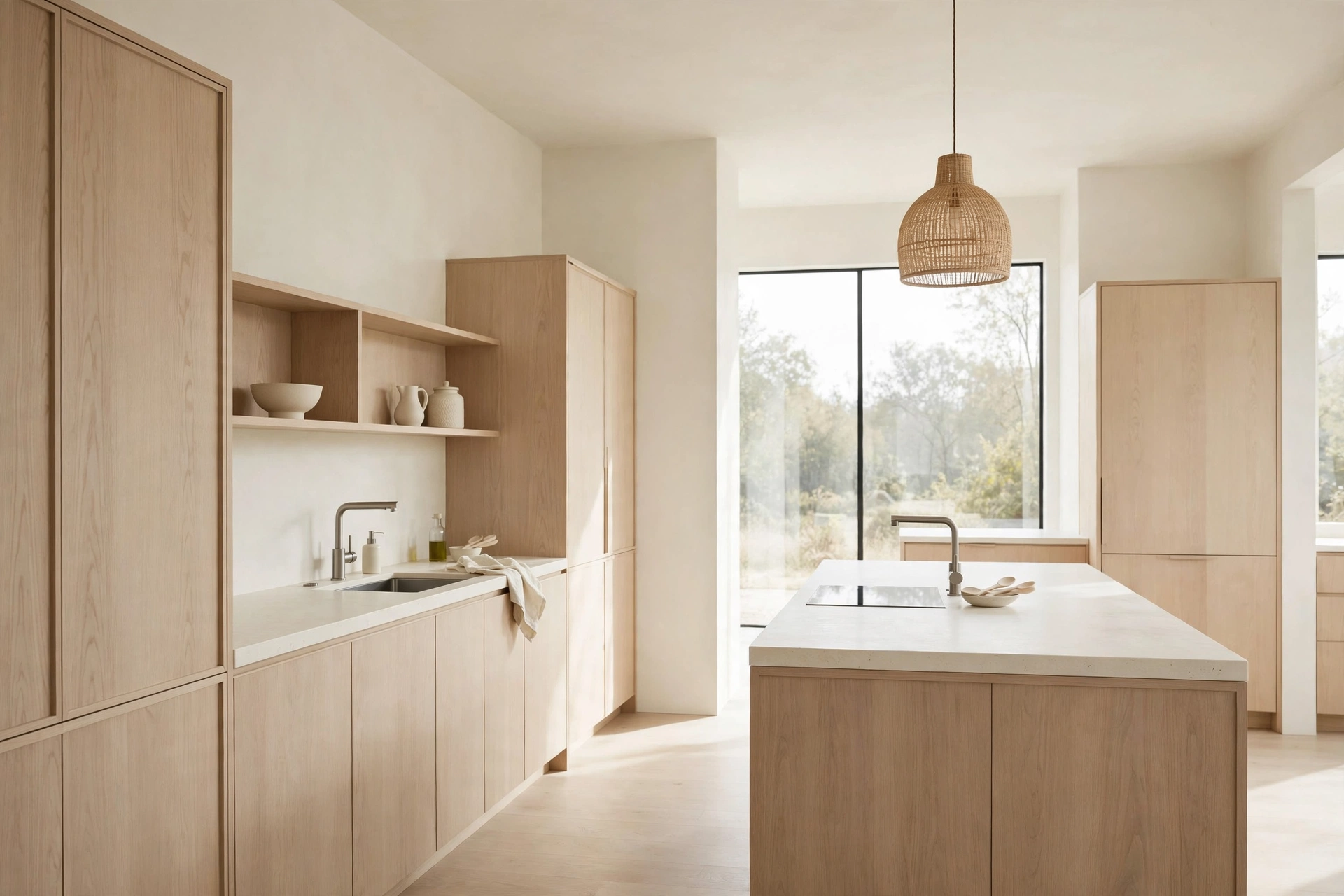
Minimalist kitchens thrive on restraint: white, warm white, soft gray, pale wood — one dominant color with one quiet accent at most. A monochromatic palette makes even a small kitchen feel larger and lets the architecture and light do the talking.
Warm minimalism is the move for 2026: creamy whites and pale oak instead of cold gray and stark white. The palette should feel like a deep breath, not a laboratory. If you crave color, add it in one removable place — bar stools, a runner, a single piece of art.
4. Hide the Small Appliances
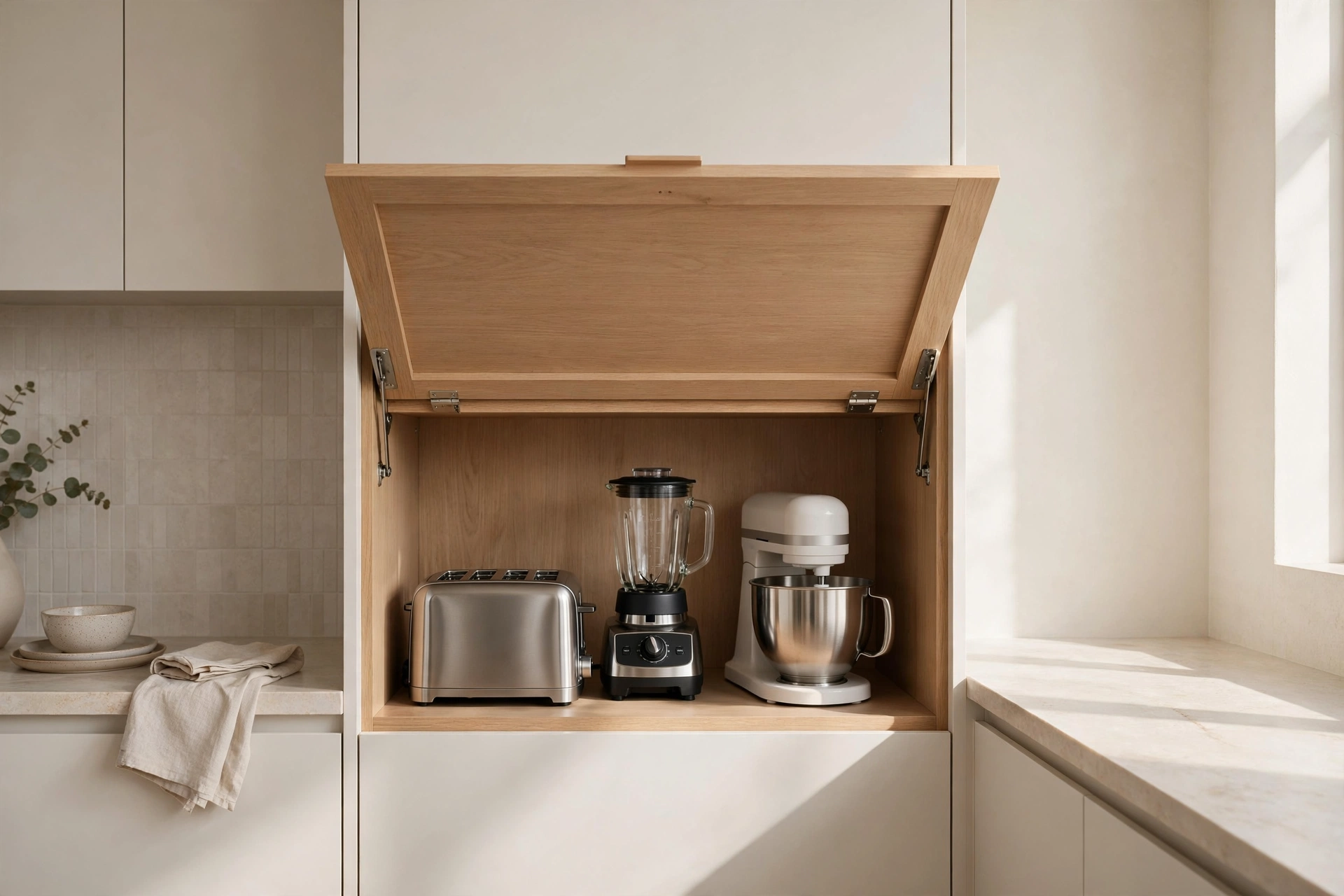
The toaster, the blender, the stand mixer, the air fryer — individually useful, collectively chaos. Give small appliances a home behind closed doors: an appliance garage with a lift-up or pocket door, a deep drawer with outlets inside, or simply a designated cabinet shelf.
Be honest about what you actually use daily. The coffee setup earns counter space; the bread maker used twice a year does not. Minimalist kitchens aren’t anti-appliance — they’re anti-appliance-on-display. Everything accessible, nothing visual.
5. Invest in Smart, Hidden Storage
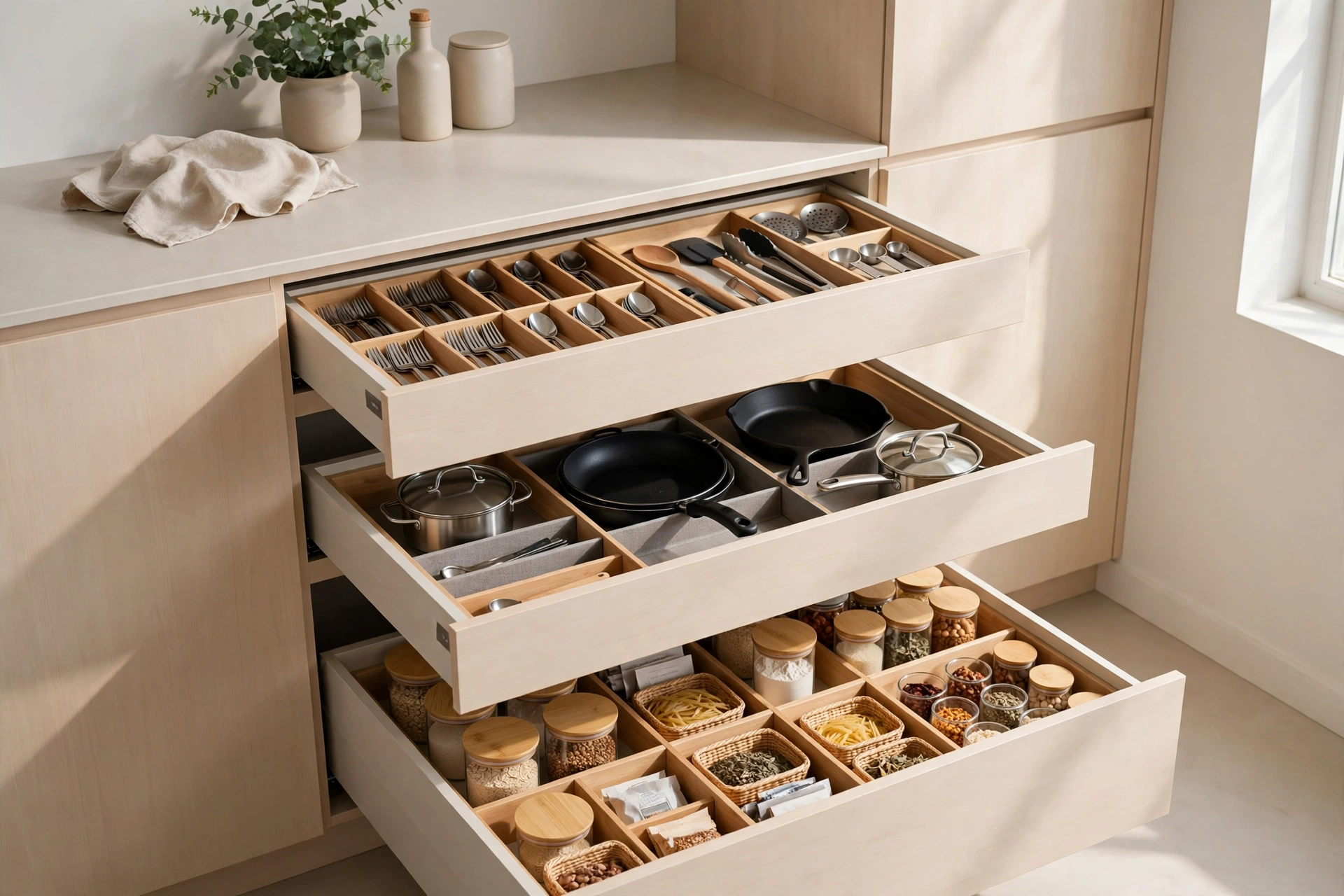
Minimalism only works if everything has a place, so storage has to be smarter, not just more. Deep drawers with dividers instead of cavernous lower cabinets, pull-out pantries, toe-kick drawers, corner solutions that actually get used — design storage around how you cook.
Apartment Therapy’s small kitchen ideas prove the point: custom inserts, monochromatic palettes, and sleek hardware make compact kitchens feel calm and generous. The principle scales to any size — the goal is that every item has exactly one home.
Plan storage around your actual cooking flow, not an idealized one. The oils and spices live by the stove, the prep tools by the main work counter, the everyday dishes between the dishwasher and the table. When storage follows habit, putting things away stops feeling like a chore and starts feeling automatic — which is the whole secret of a kitchen that stays minimalist without constant effort.
6. Let One Material Shine
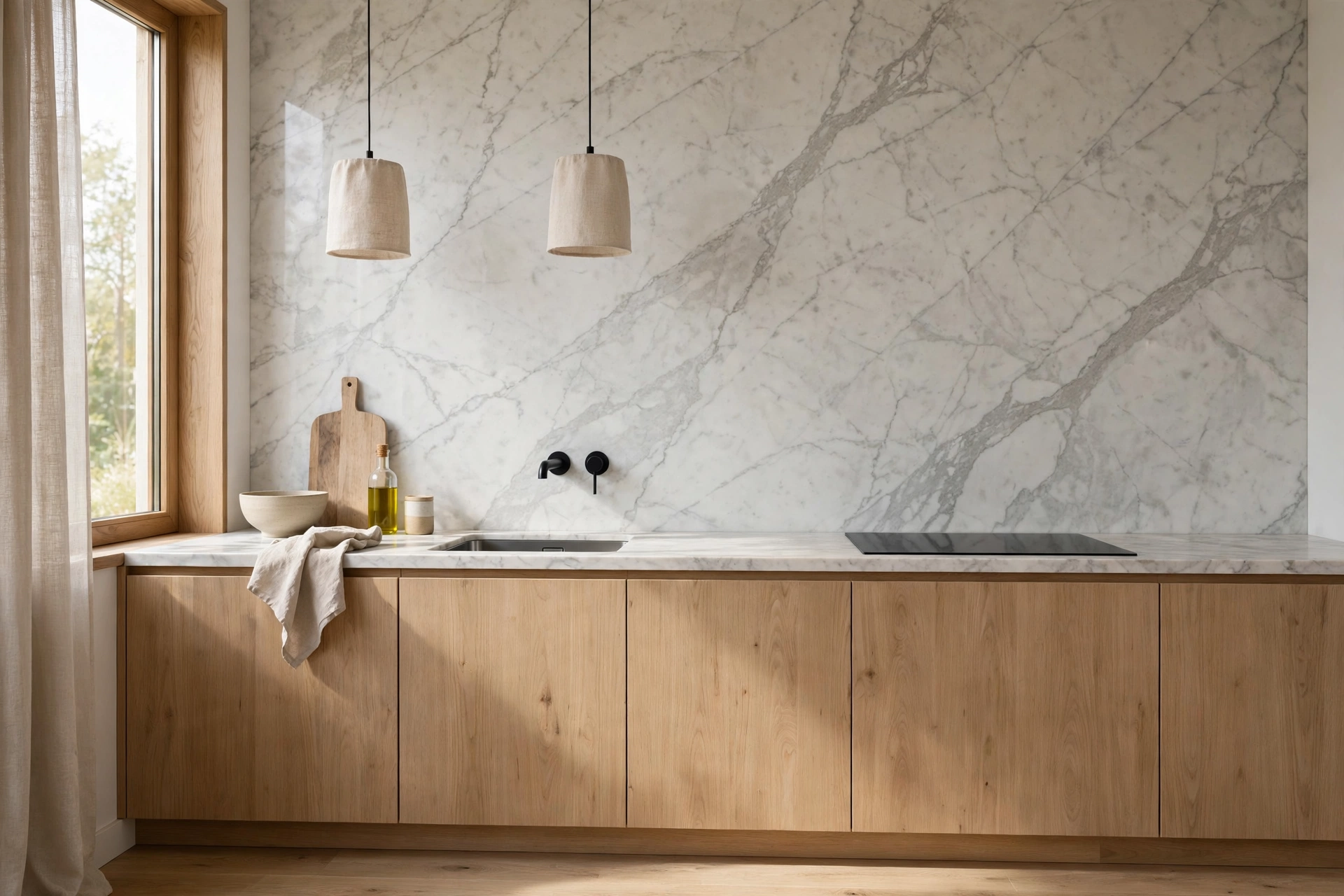
In a restrained kitchen, materials carry the design. Choose one beautiful material and let it be the star: honed marble with dramatic veining, warm white oak, brushed brass, handmade zellige tile. Keep everything else quiet so the star can shine.
The classic minimalist move is matching the countertop to the backsplash in the same stone — the seamless flow erases visual breaks and makes the kitchen feel larger and more serene. One great material beats five good ones every time.
7. Maximize Natural Light
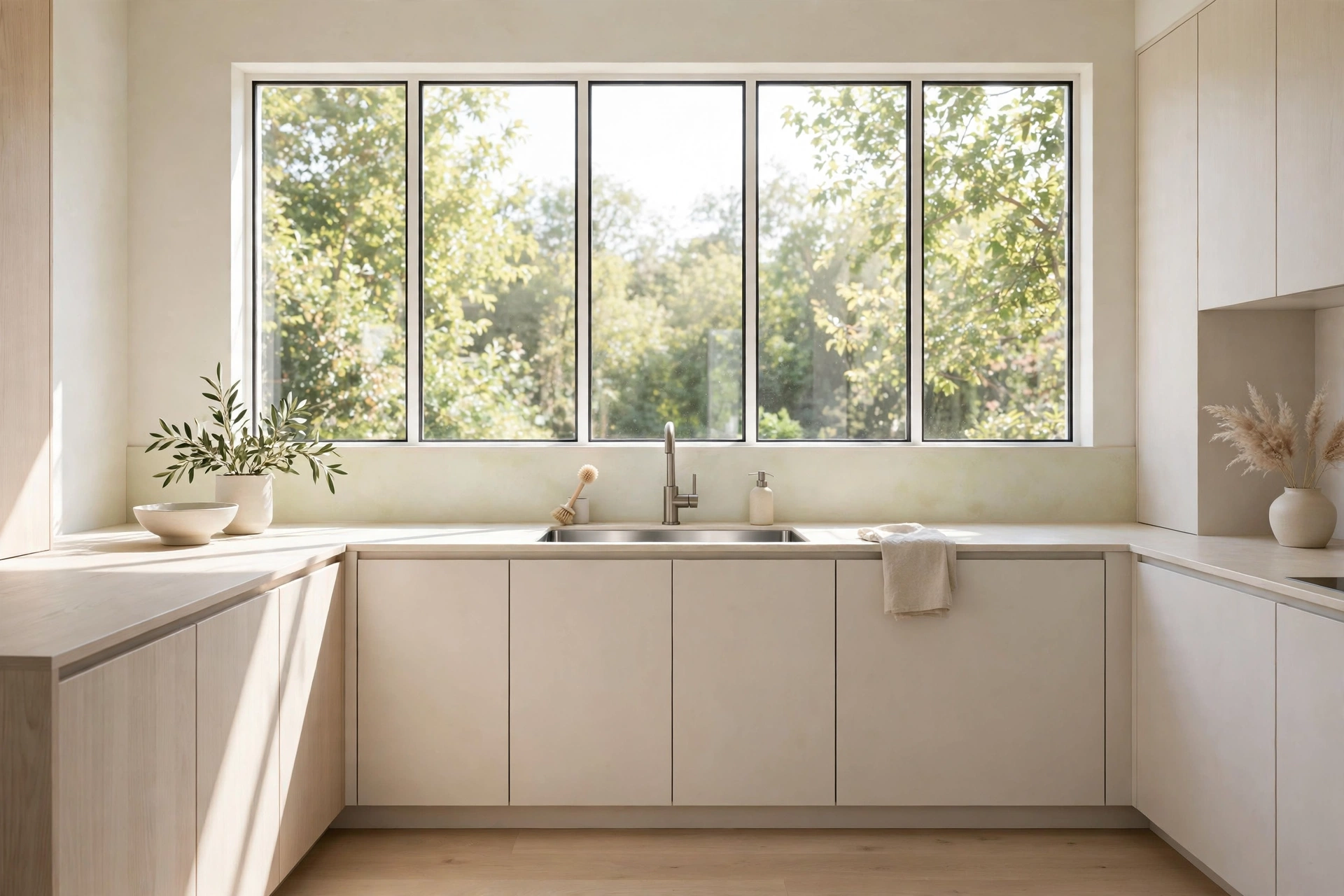
Light is a minimalist kitchen’s best material. Keep window treatments minimal — or skip them entirely where privacy allows — and let daylight flood the workspace. Pale surfaces bounce it around; a large window over the sink turns dishwashing into a pleasure.
Where natural light is limited, layer artificial light thoughtfully: recessed ceiling lights for even ambient light, under-cabinet strips for task light, and one sculptural pendant over the island for character. Keep all of it warm-white (3000K) for a welcoming glow.
8. Choose Integrated Appliances
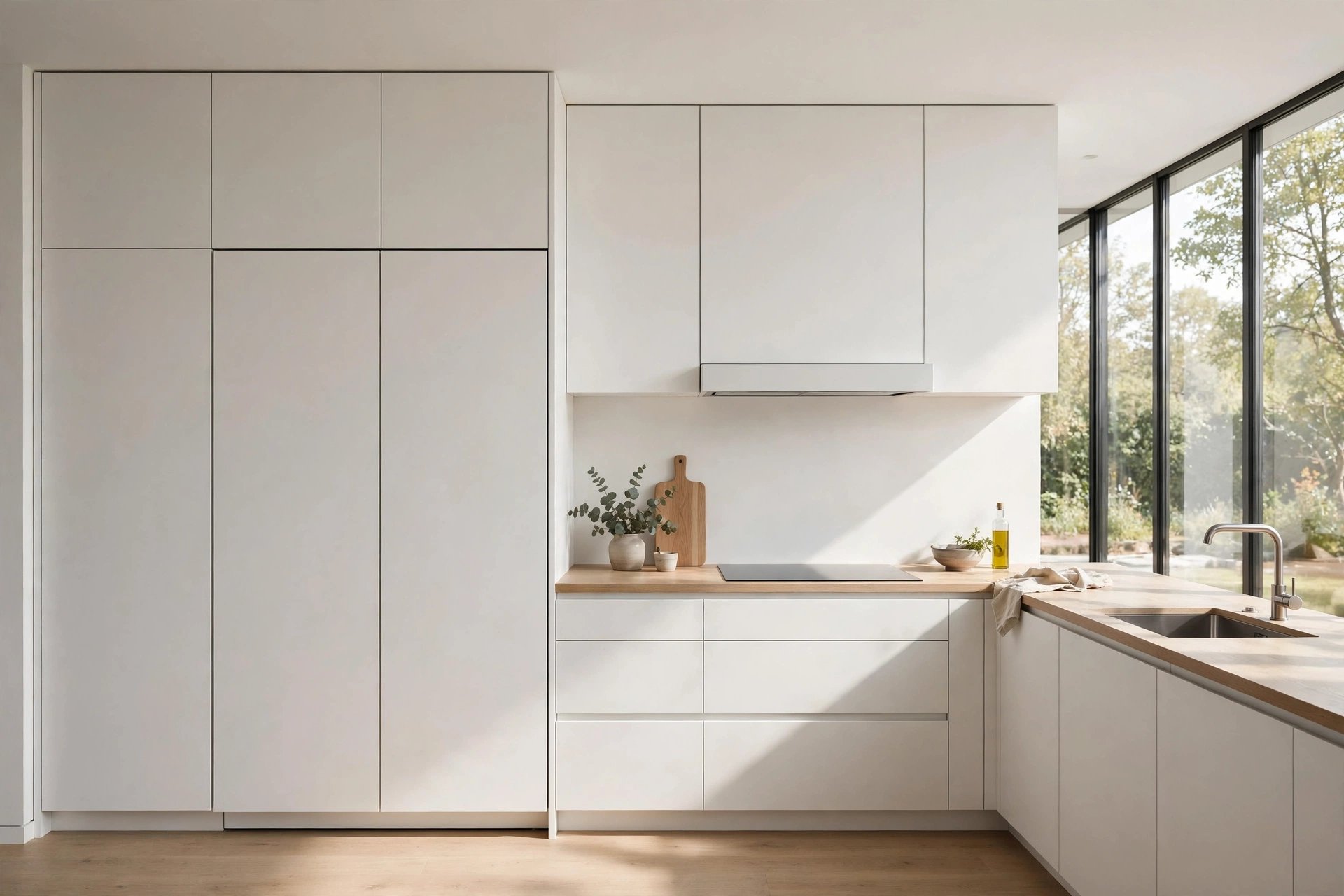
Nothing breaks minimalist calm like a wall of stainless steel shouting for attention. Panel-ready appliances — refrigerator, dishwasher, even the microwave — disappear behind cabinet fronts, leaving clean planes of cabinetry. The kitchen reads as furniture, not machinery.
Where integration isn’t possible, choose appliances in quiet finishes: matte black, white, or panel-matching colors over flashy stainless. And corral the necessary evils (the kettle, the toaster) in the appliance garage from idea 4.
There’s a practical bonus beyond looks: integrated appliances are easier to clean around (no grimy gaps between the fridge and the cabinet), and a kitchen with fewer visual interruptions genuinely feels larger. In open-plan homes this matters doubly — the kitchen is visible from the living areas, so its calm sets the tone for the whole floor.
9. Keep the Backsplash Simple
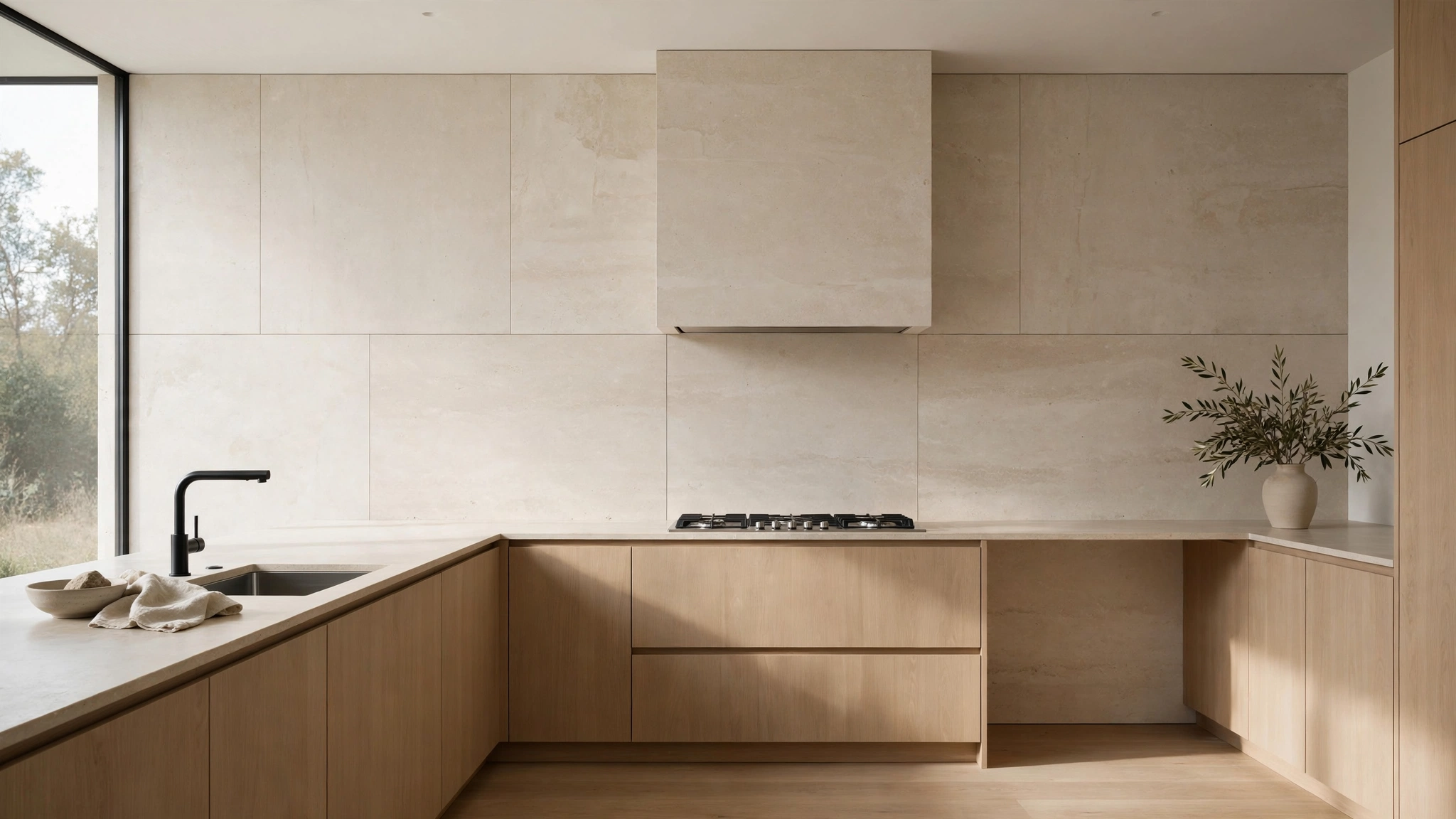
The backsplash is not the place for a statement in a minimalist kitchen — it’s the place for quiet continuity. A slab of the countertop stone carried up the wall, simple handmade-look subway tile in white or cream, or limewash plaster for texture without pattern.
Grout lines are visual noise, so minimize them: large-format tiles, slab stone, or a single sheet of material. If you love pattern, confine it to one small area — behind the range, for instance — and keep the rest serene.
10. Edit Your Tools Ruthlessly
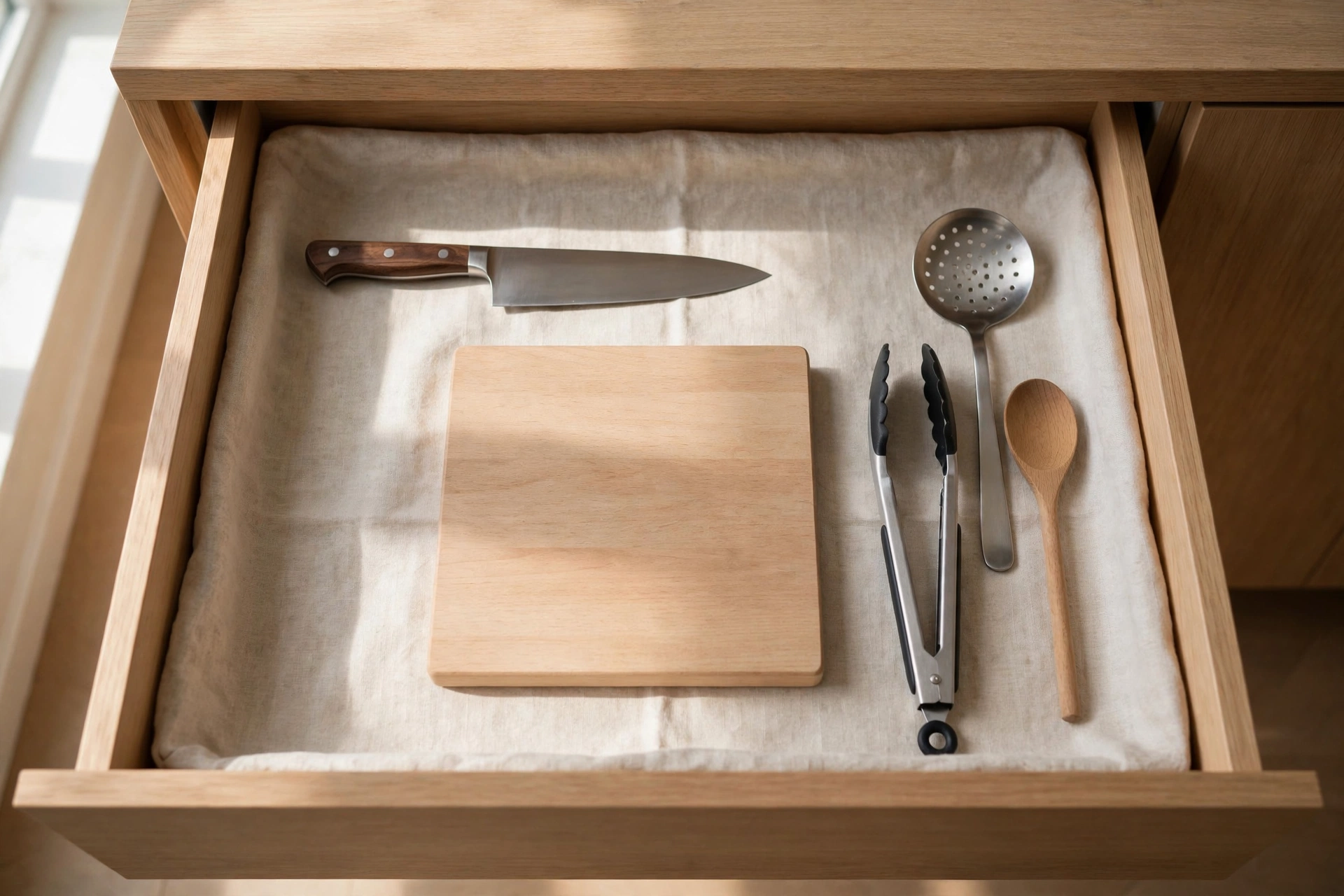
The minimalist kitchen demands an honest audit: the avocado slicer, the third spatula, the novelty mug collection. Keep the tools you use weekly; relocate or release the rest. A well-edited kitchen is a joy to cook in because everything in it earns its place.
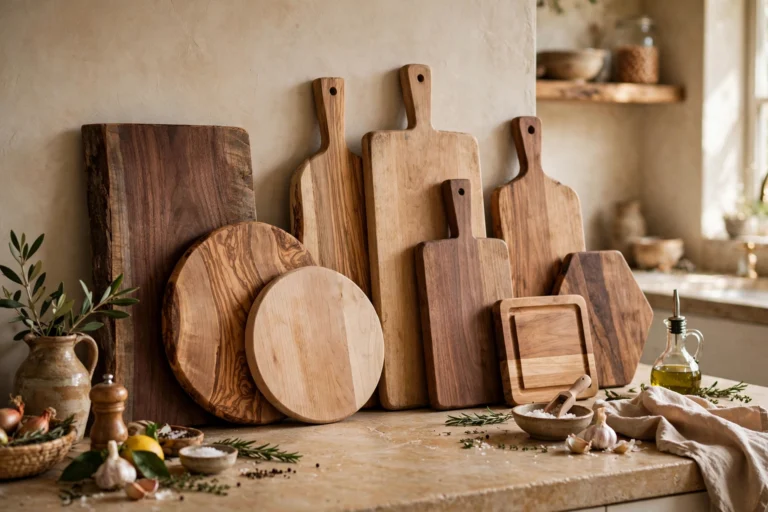
Replace five mediocre tools with one excellent one: a great chef’s knife instead of a block of dull ones, one beautiful cutting board instead of three warped ones. Quality over quantity is the minimalist kitchen’s founding principle, and it applies to everything from knives to dish towels.
11. Add Warmth With Wood
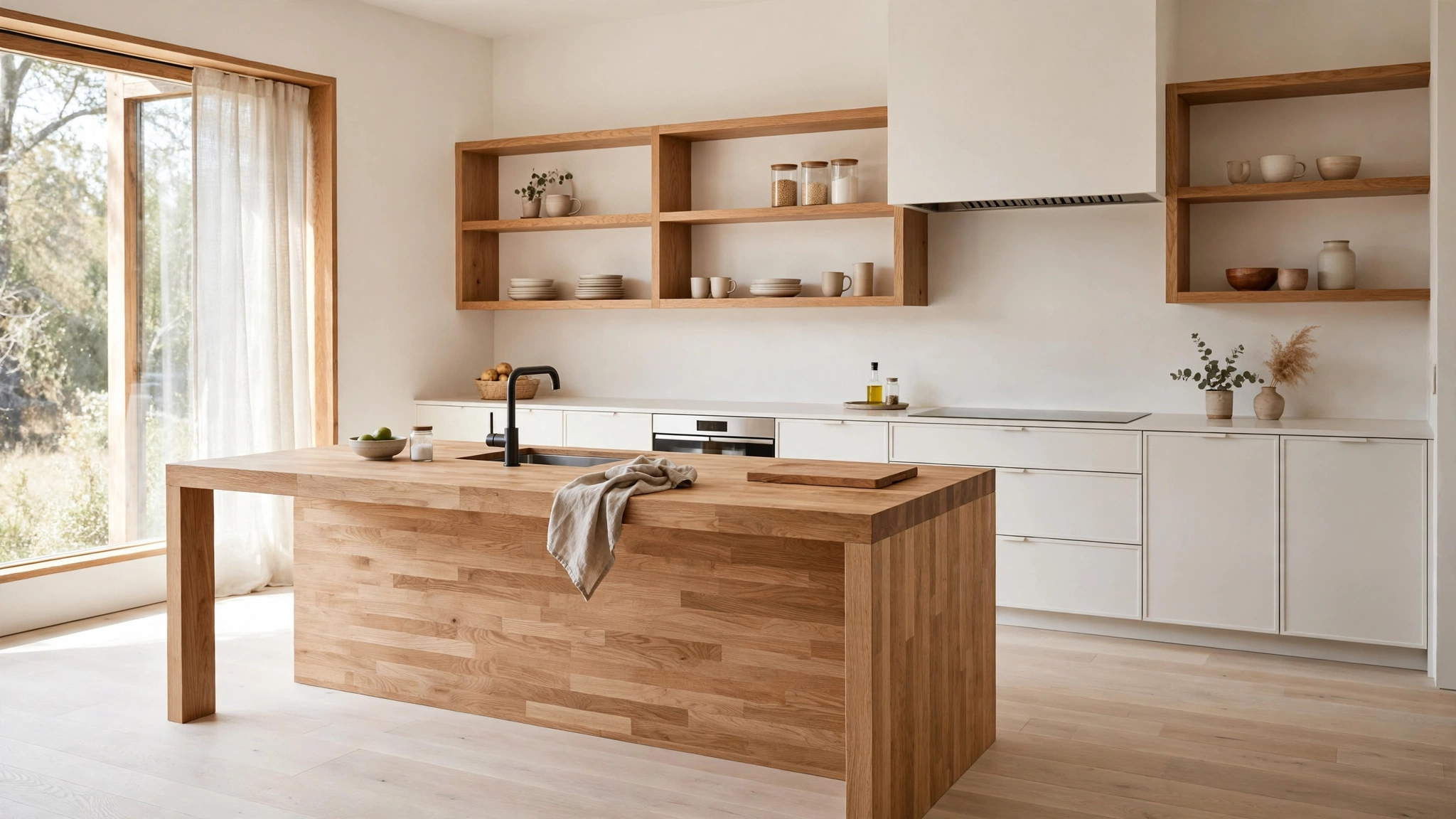
Minimalist doesn’t mean cold. Warm wood — white oak floors, a butcher-block island top, open oak shelving with a few beautiful objects — keeps a restrained kitchen feeling human and welcoming. Wood is minimalism’s warmth dial.
Use it strategically: if the cabinets are white, warm up with wood floors and open shelves; if the cabinets are wood, keep counters and walls pale. The balance of warm wood against cool stone or white is what makes minimalist kitchens feel serene rather than sterile.
Wood also ages gracefully, which suits the minimalist ethos of buying once and buying well. A solid oak worktop develops a patina that tells the story of every meal; a cheap laminate just looks tired. Choose the wood elements you’d still love in ten years, because in a minimalist kitchen there’s nowhere for regret to hide.
12. Style Open Shelves Sparingly
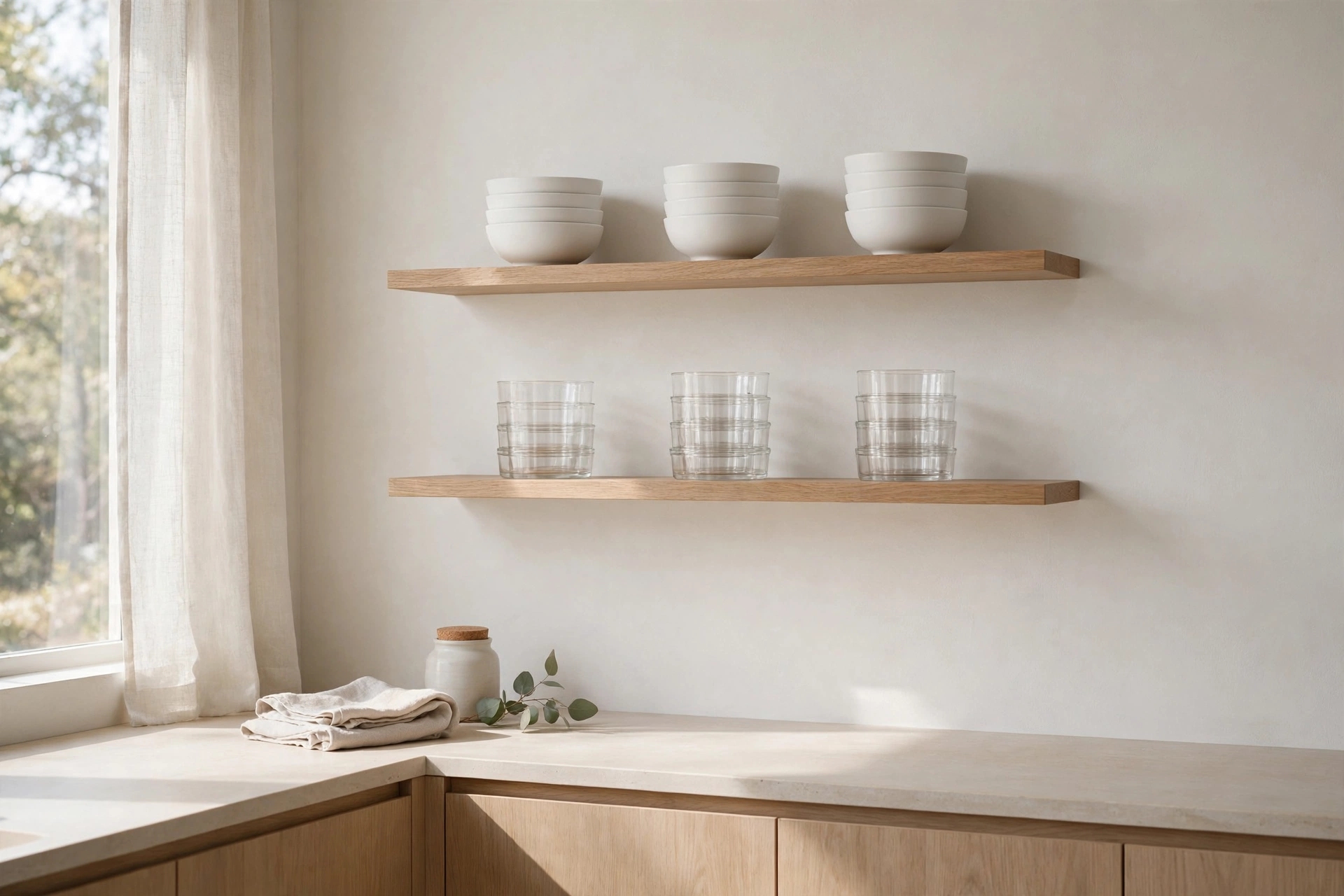
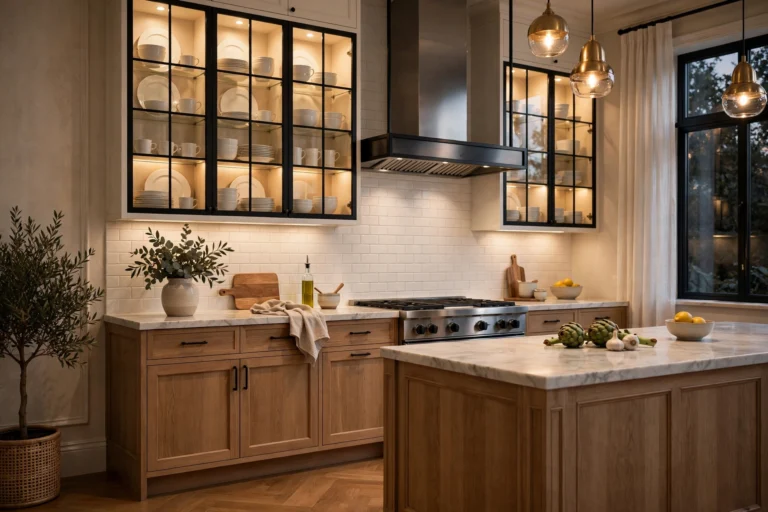
If you go for open shelving, style it like a minimalist: everyday dishes in one color family, a few beautiful objects, plenty of breathing room. Open shelves are a commitment — they must stay tidy and dust-free, so only choose them if you’ll maintain them.
The rule is repetition and restraint: stacks of white bowls, a row of clear glasses, one small plant. Anything chipped, mismatched, or purely decorative in excess goes behind closed doors. Two well-styled shelves beat four cluttered ones.
13. Choose a Simple, Sculptural Faucet
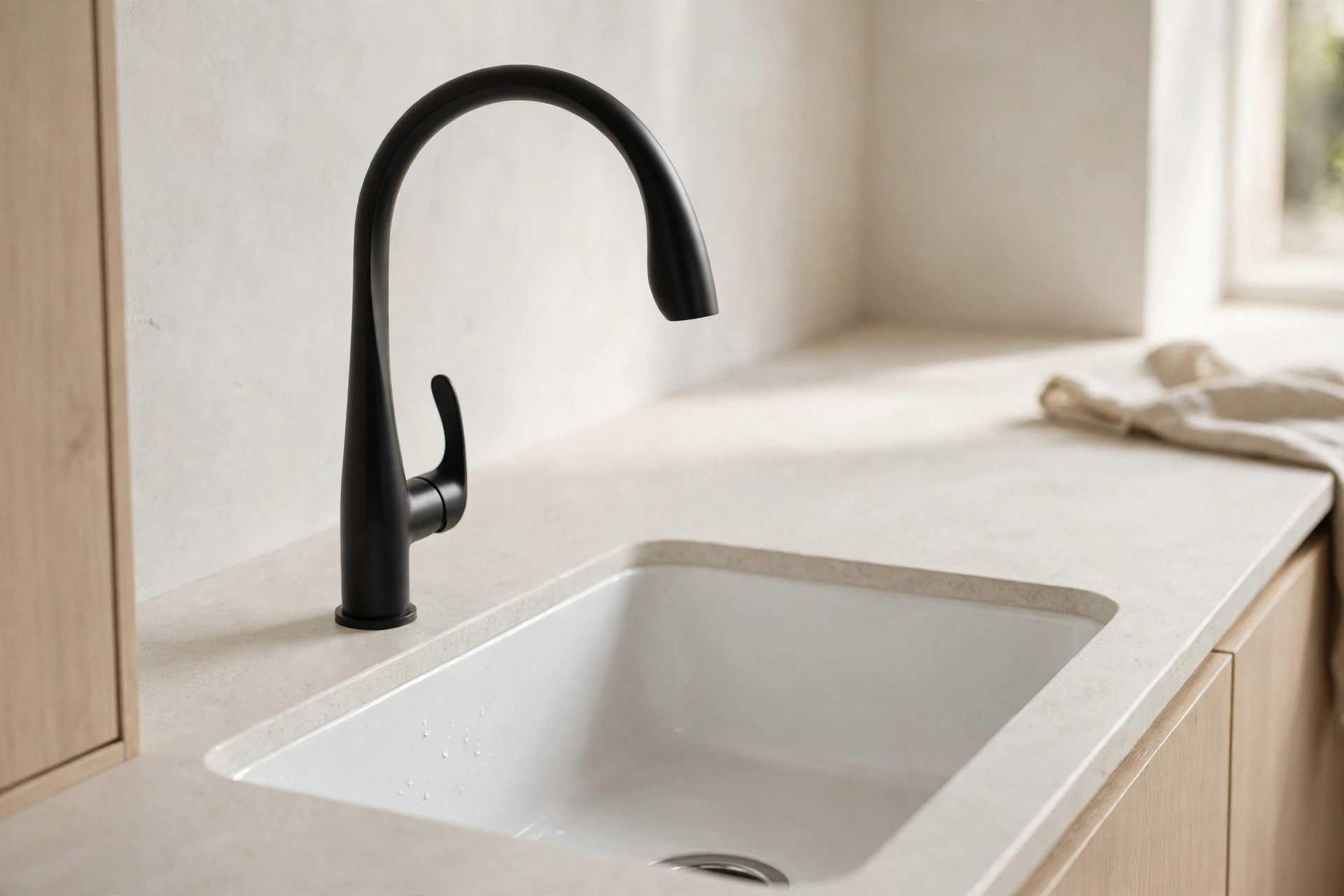
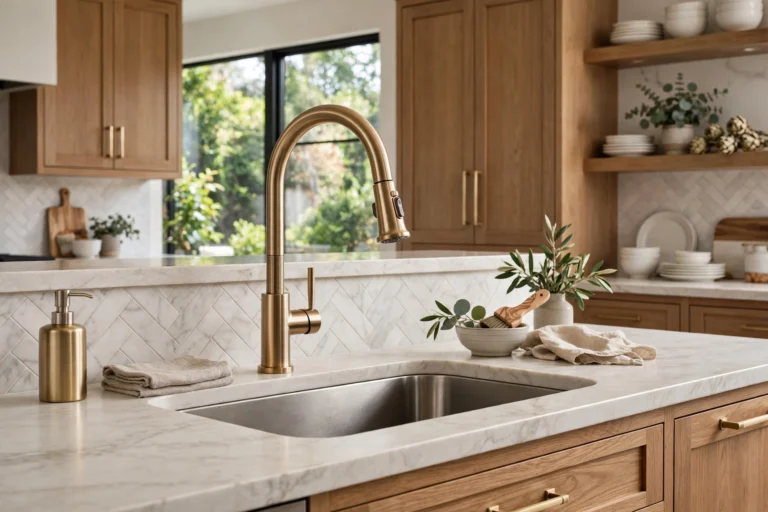
In a quiet kitchen, the faucet is jewelry — so choose it carefully. A single sculptural faucet in matte black, brushed brass, or brushed nickel becomes a focal point precisely because everything around it is calm. Gooseneck or L-shaped profiles read modern and clean.
Match the faucet finish to the cabinet hardware and lighting for cohesion — mixed metals are for maximalist kitchens. And choose function to match form: a pull-down sprayer and solid brass construction mean it works as beautifully as it looks.
14. Keep Decor to a Whisper
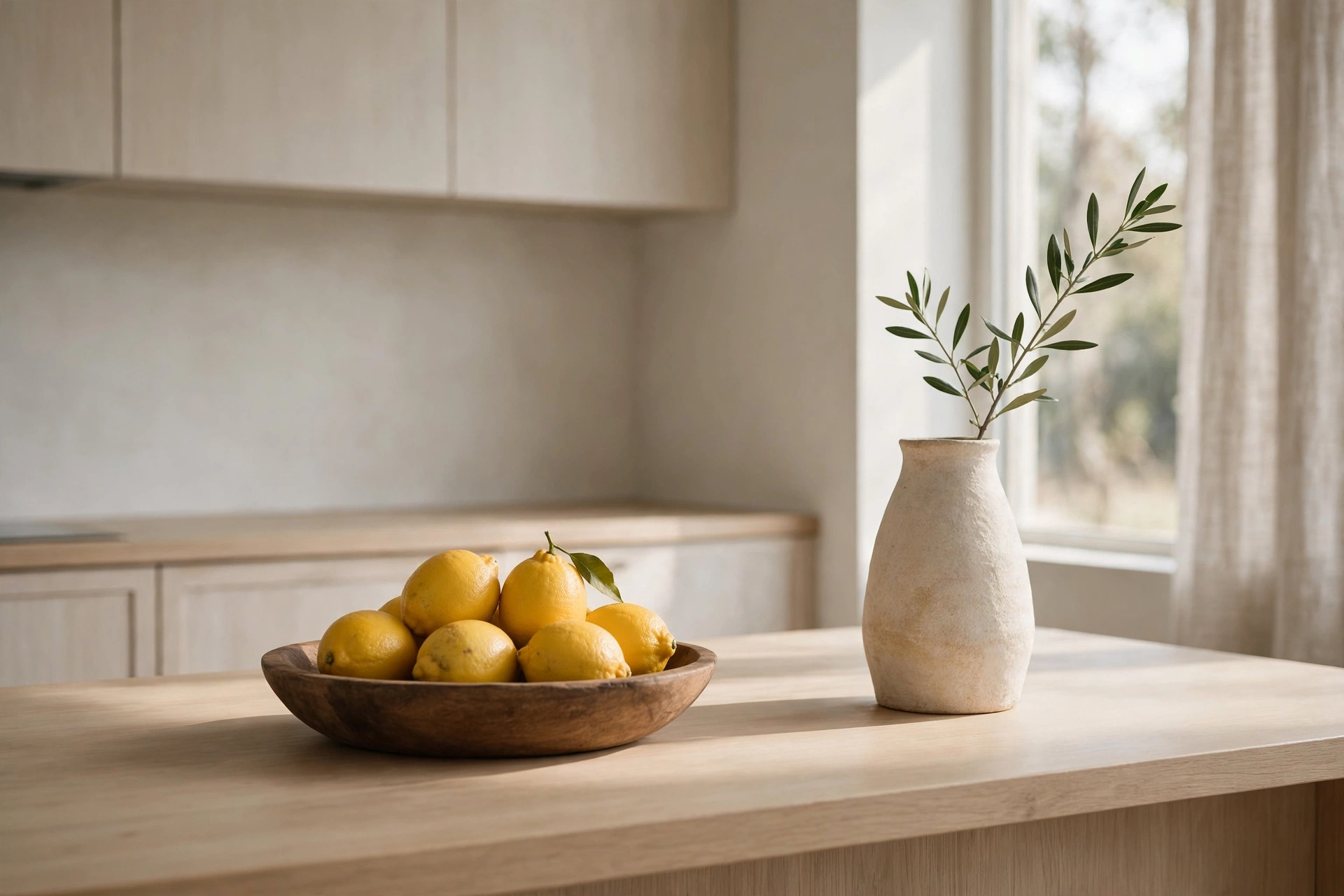
A minimalist kitchen allows decor, but at a whisper: one beautiful bowl of fruit, a single stem in a handmade vase, a small framed print leaned against the backsplash, a wooden board hung as art. Each piece should be beautiful enough to justify its counter space.
Rotate seasonally rather than accumulating: the ceramic pumpkin in October, fresh herbs in a pot in spring. The discipline of “one in, one out” applies to decor too. A minimalist kitchen’s beauty is in what isn’t there as much as what is.
The payoff is a kitchen that’s faster to clean, easier to cook in, and calmer to be in. Guests notice it immediately — not the absence of things, but the presence of calm. That’s the real luxury of minimalist design: not the look, but the feeling of a room that asks nothing of you.
15. Maintain the Calm Daily
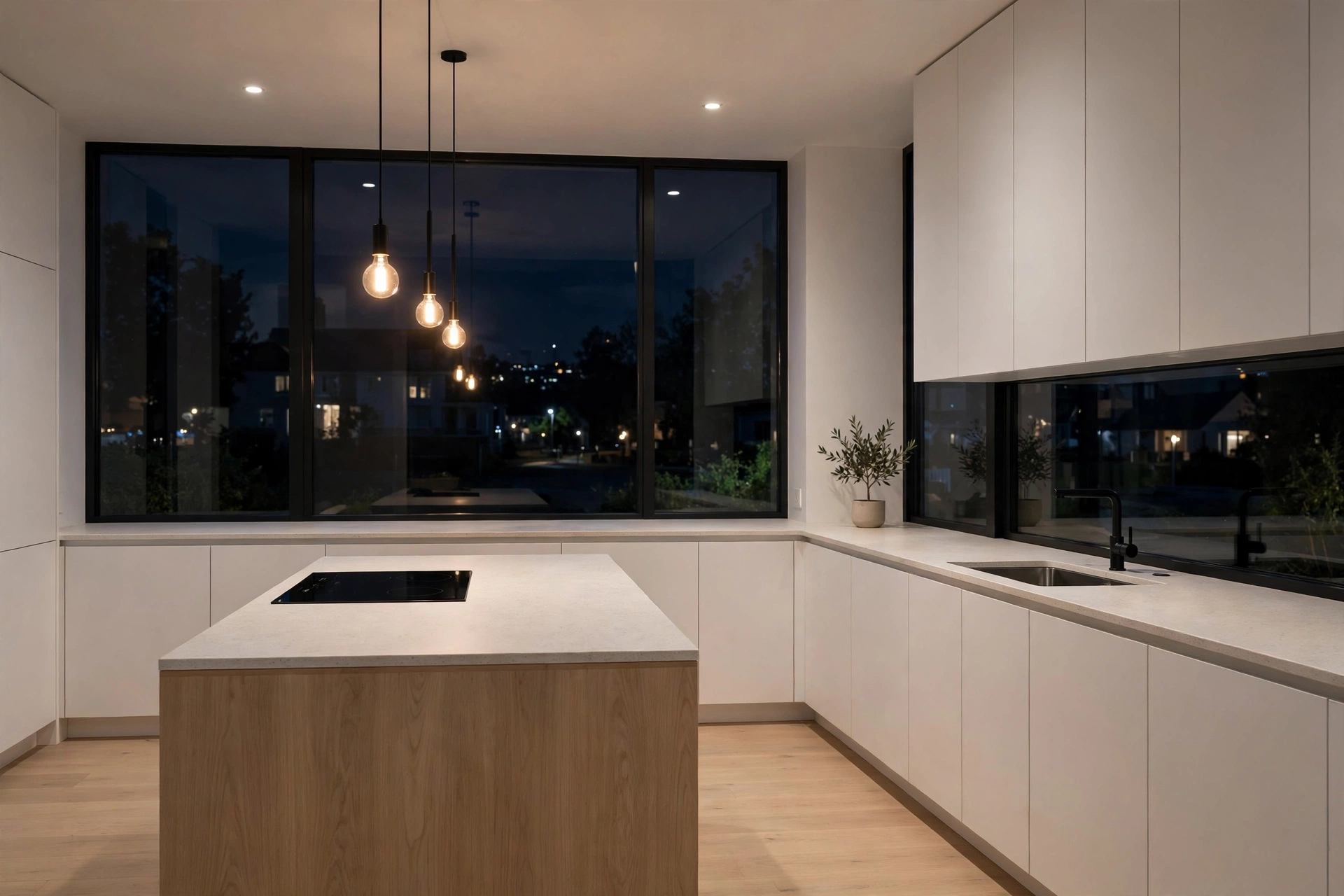
Minimalism is a practice, not a purchase. The two-minute nightly reset — counters cleared, dishes away, one quick wipe — is what keeps a minimalist kitchen feeling minimalist. Without the habit, even the most beautifully designed kitchen drifts back to clutter.
Build the habit into the design: a designated landing spot for the mail (not the counter), a drawer for the charging cables, a home for every tool. Our minimalist bedroom design ideas apply the same everything-has-a-home discipline to the most personal room in the house — calm is a whole-home project.
Frequently Asked Questions
What defines a minimalist kitchen?
Clean lines (flat-front cabinets, minimal hardware), a restrained neutral palette, clear counters, hidden storage for appliances and tools, and one or two beautiful materials carrying the design. Everything has a place; nothing is on display without earning it.
Can a minimalist kitchen still feel warm and inviting?
Yes — that’s the difference between minimalism and starkness. Warm wood tones, textured natural materials, warm-white lighting (2700-3000K), and a few personal touches keep it human. Minimalist means intentional, not empty.
How do I start decluttering my kitchen?
Pull everything out of one cabinet at a time and sort into keep-daily, keep-occasionally (relocate to less prime storage), and release. Be ruthless with duplicates and single-use gadgets. Start with the easiest cabinet to build momentum.
Is a minimalist kitchen practical for a family?
More practical, if the storage is designed well — deep drawers, a proper pantry, and an appliance garage handle family volume behind closed doors. The nightly two-minute reset is the real key; without it, any kitchen gets chaotic.
What’s the difference between minimalist and modern kitchen design?
Modern describes an era and aesthetic (clean lines, new materials); minimalist describes a philosophy (less, intentional, uncluttered). A kitchen can be modern without being minimalist (think bold colors and statement pieces), but the two pair beautifully.
Keep Exploring
A minimalist kitchen gives back what it asks for: a little discipline, rewarded with daily calm. Start with the counters, hide the appliances, and let the materials speak quietly.
If the calm-clutter-free philosophy resonates, our minimalist living room design ideas bring the same serenity to your main gathering space. For a workspace with the same clarity, our modern minimalist home office design ideas prove that less really is more. And for more kitchen inspiration, explore our kitchen decor ideas — because every kitchen should feel like a deep breath.





[…] daily. Store only your prettiest, most-used items up top. To keep the rest of the kitchen serene, our minimalist kitchen design ideas pair perfectly with this airy […]