
Bathroom windows face a unique challenge: they must let in natural light while keeping the room completely private, all in the steamiest room of the house. Fabric curtains absorb moisture and mildew, wood warps, and cheap vinyl yellows. These bathroom window treatment ideas focus on privacy-first solutions — shutters, shades, blinds, and films — chosen specifically to survive humidity and look good doing it.
Note the scope: this is about hard treatments for privacy — blinds, shutters, shades, and frosted film — distinct from decorative bathroom curtains. Every idea below balances three things: how much light it admits, how completely it blocks views, and how well its materials handle daily steam.
1. Faux-Wood Plantation Shutters
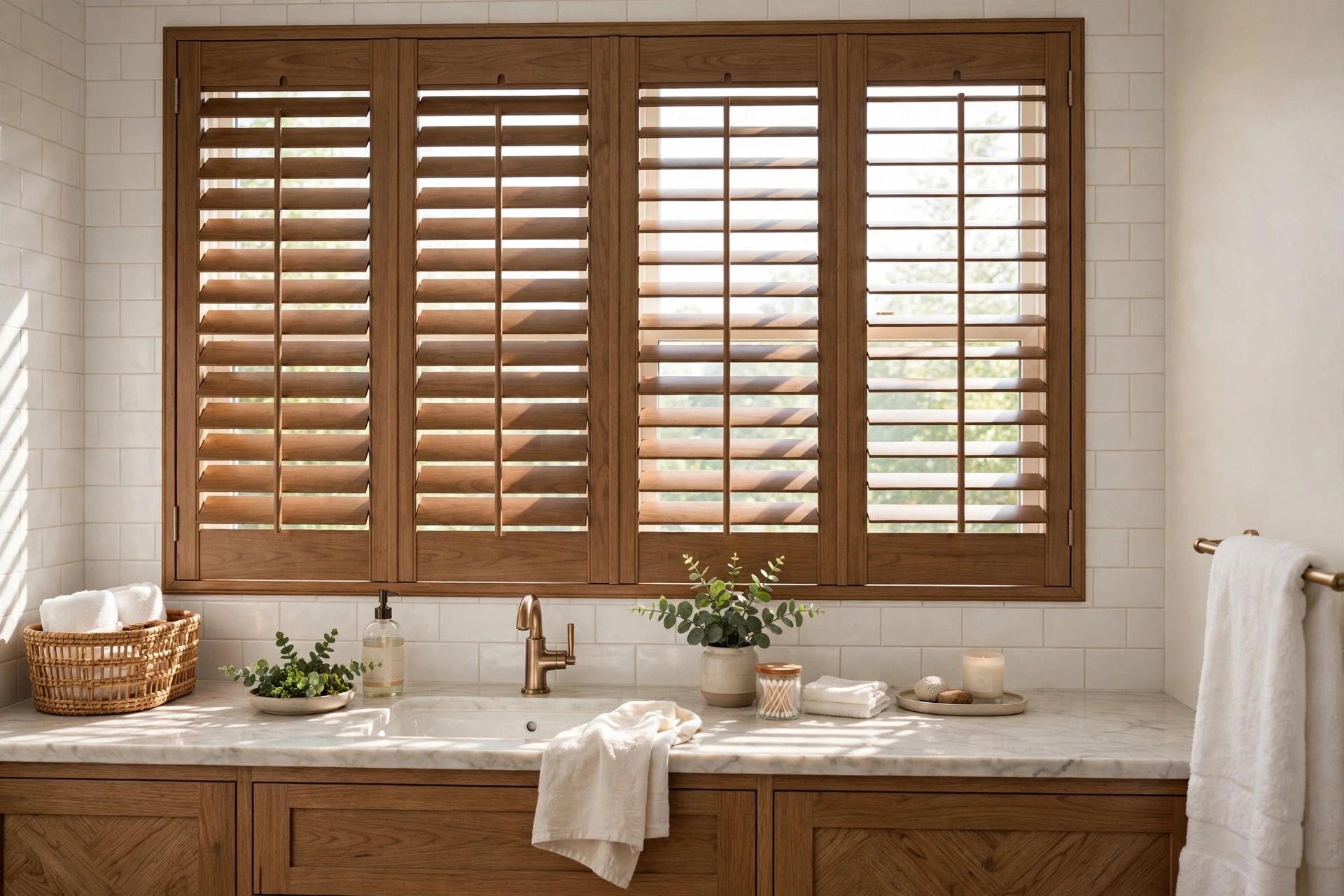
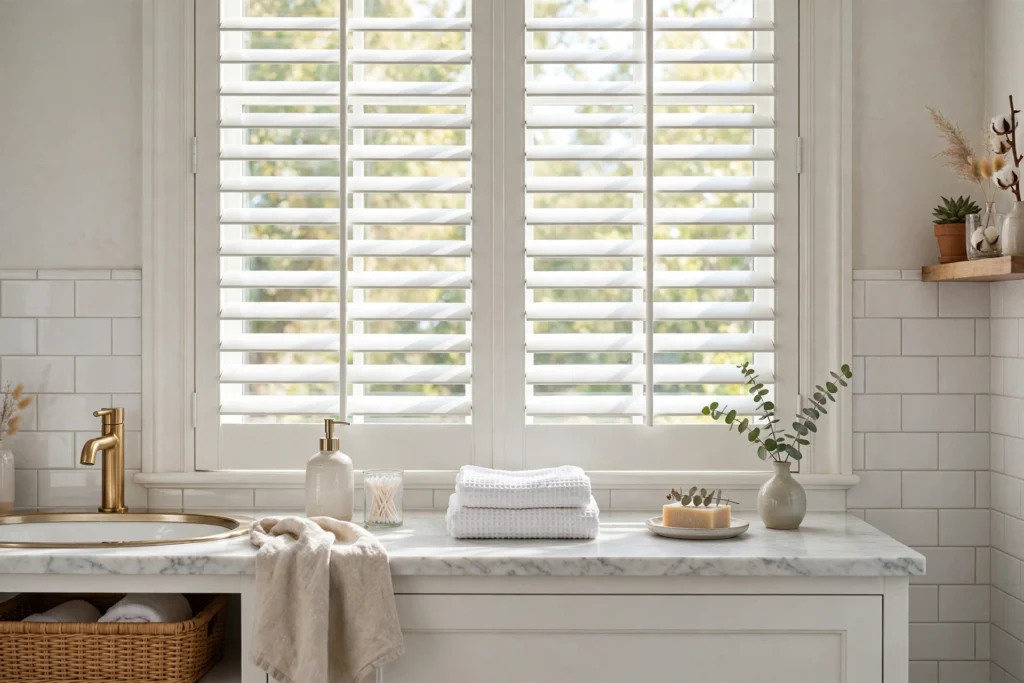
Faux-wood plantation shutters are the gold standard for bathroom windows: they look like painted wood but are made of moisture-proof PVC or composite that never warps, cracks, or peels in steam. The adjustable louvers give you precise control — tilt them up for light with privacy, close them flat for full blackout.
Measure for inside mount: take three width measurements (top, middle, bottom) and use the narrowest, minus 1/4 inch for clearance. Standard louver sizes are 2.5, 3.5, and 4.5 inches; larger louvers suit larger windows and give a clearer view when open. Expect $150–$350 per window for custom-sized faux-wood shutters.
White shutters suit every bathroom style and wipe clean with a damp cloth. They also add resale value — buyers recognize shutters as a premium, permanent upgrade. For a coordinated look, match the shutter white to your trim paint.
2. Top-Down Bottom-Up Cellular Shades
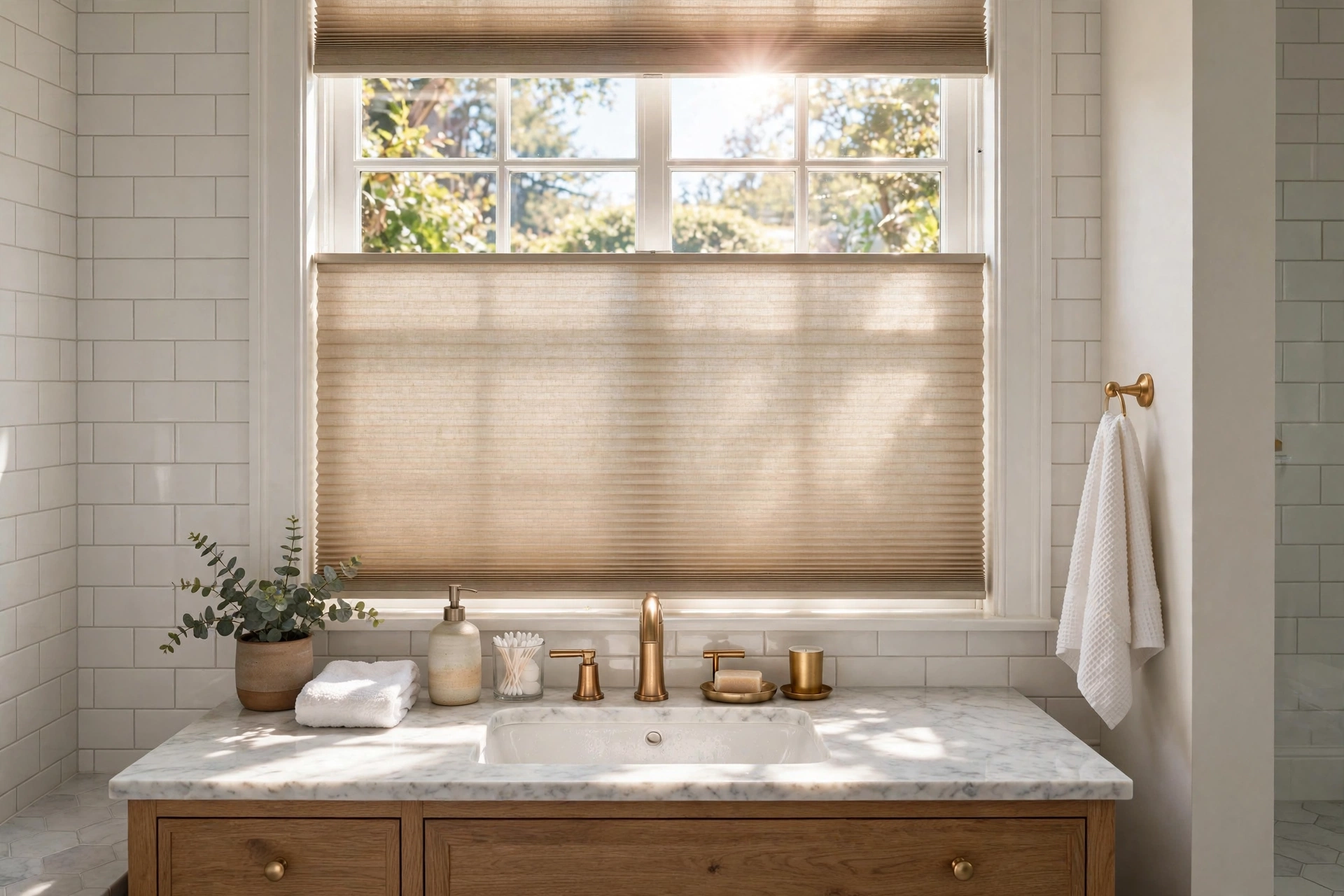
Top-down bottom-up cellular shades are the privacy genius of window treatments: lower the top to let daylight stream in from above while the bottom stays closed over the sightline. In a bathroom, this means natural light all day with zero visibility from outside — the exact balance bathroom windows need.
Cellular (honeycomb) construction also insulates, a real bonus on a cold bathroom window in winter. Choose light-filtering fabric for daytime glow or blackout for a window facing a close neighbor. Look for cordless operation — safer, cleaner-looking, and required by current safety standards for homes with children.
Measure inside the frame for a clean fit, and choose moisture-resistant fabrics (most polyester cellular shades qualify). The shades stack tightly at the top when raised, preserving the full window view. This is one of the most practical bathroom window treatment ideas for street-facing bathrooms.
3. Frosted Window Film
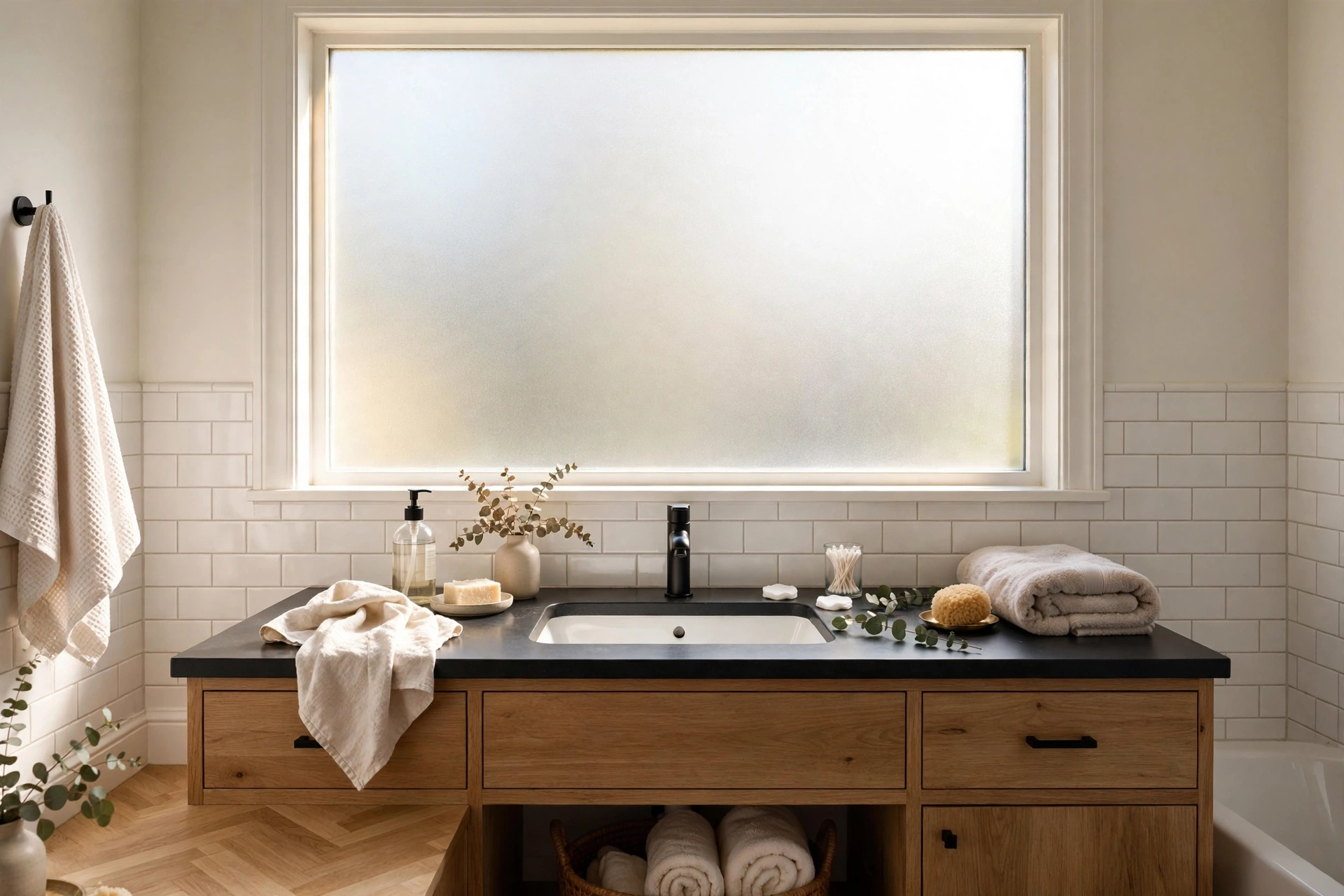
Frosted privacy film is the cheapest, fastest bathroom window treatment — a $15–$30 roll covers a standard window in under an hour, with no hardware and no landlord issues. Static-cling films apply with just water and a squeegee, and peel off cleanly when you move. They obscure views completely while transmitting about 80% of natural light.
Cut the film 1/2 inch smaller than the glass on all sides, spray the glass generously with soapy water, and squeegee from the center outward to push out bubbles. Trim edges with a sharp utility knife. Decorative patterns — rain glass, rice paper, geometric etchings — add style beyond plain frost.
Film is ideal for rentals and for windows where you want permanent, maintenance-free privacy. It never needs cleaning beyond a wipe with glass cleaner, and quality films last 5+ years. Pair it with a simple valance or leave the window bare — the film is the whole treatment.
4. Vinyl Roller Shades
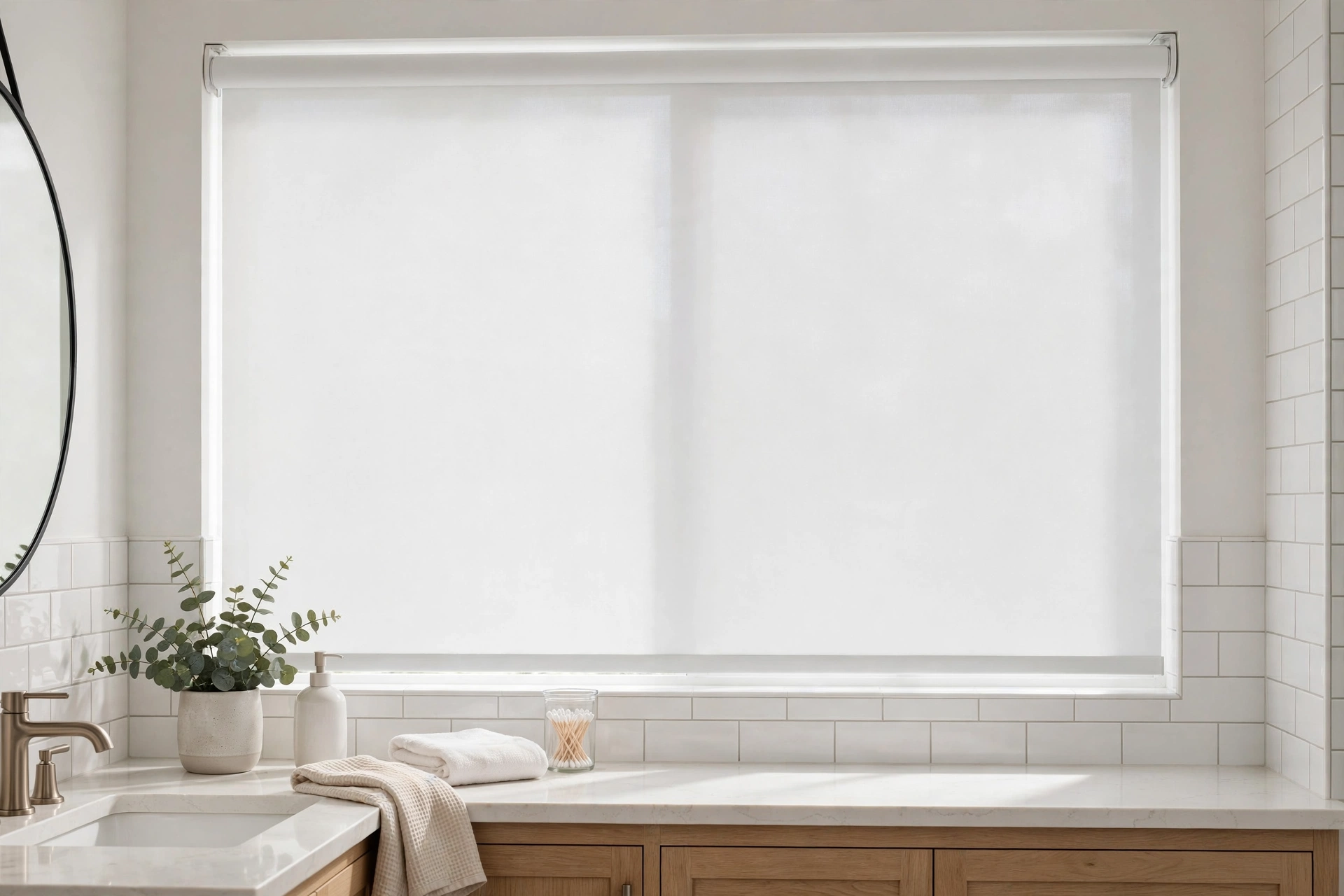
Vinyl or PVC roller shades are the workhorse bathroom shade: waterproof, wipeable, and available in light-filtering to blackout opacities. A simple roller in white or natural texture disappears when raised and provides full privacy when lowered. Cordless spring rollers cost $30–$80 per window.
For bathrooms, avoid fabric-wrapped rollers and bamboo (which mildews); solid vinyl or fiberglass-vinyl composite is the right material. Inside mount keeps the look clean; the shade should be ordered 1/8 inch narrower than the narrowest frame measurement. A bottom hem bar keeps the shade hanging straight.
Roller shades pair well with a decorative element — mount a simple wood valance or cornice above to hide the roller mechanism and add a finished look. For more ideas on finishing the window area, see these bathroom door decor ideas for style and function, which cover complementary trim details.
5. Cafe-Style Shutters on the Lower Half
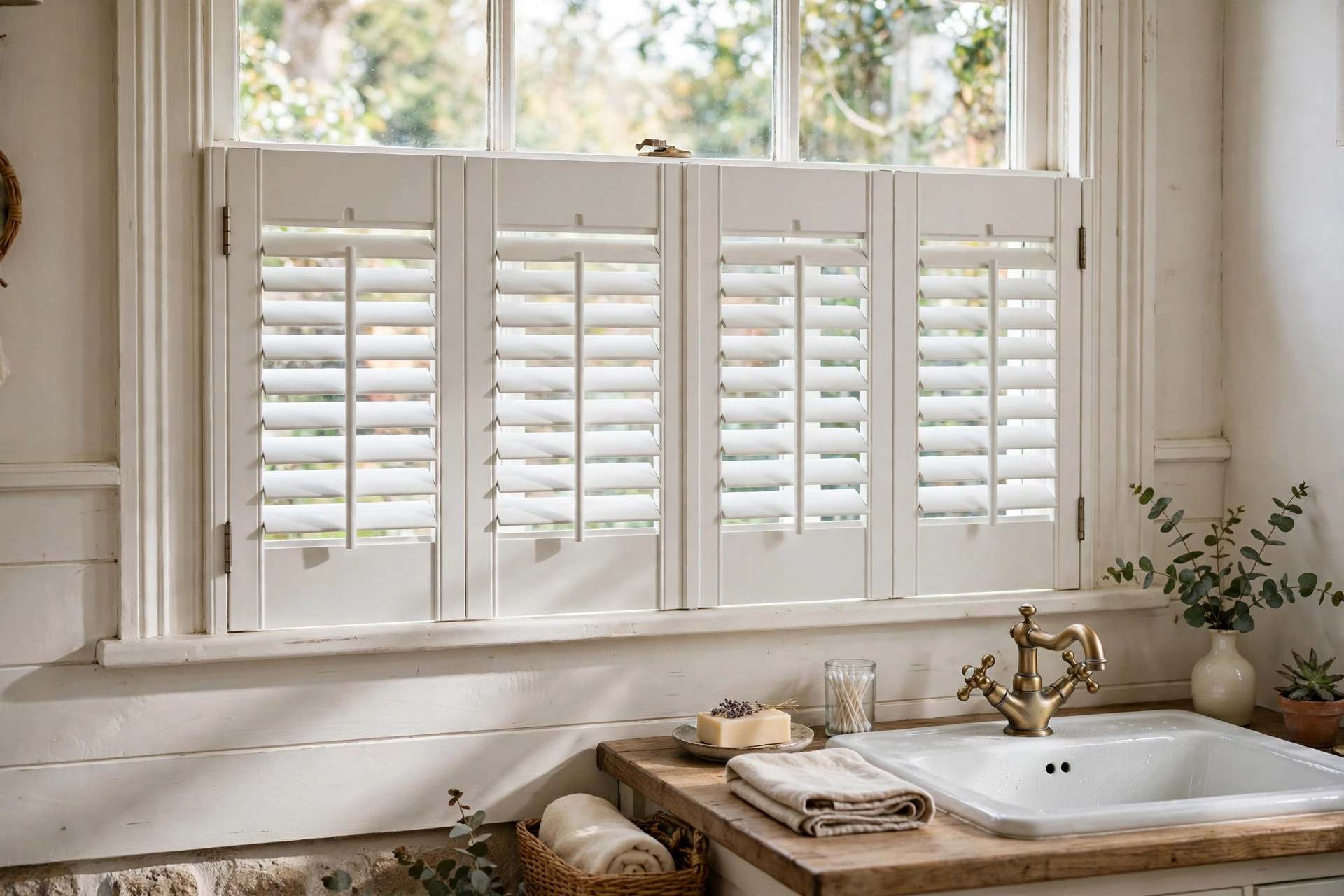
Café shutters cover only the lower half or two-thirds of the window, leaving the top open for light and sky views. In a bathroom, this works when the sightline concern is at standing height — a window above a tub or beside a vanity where neighbors could see in at eye level but not over the top.
Measure the coverage height carefully: sit and stand at the window’s sightlines from outside if possible, or have someone walk the property line while you observe. The shutter top should sit 6–12 inches above the highest sightline. Café shutters cost less than full-height (roughly 60% of the price) since they use fewer materials.
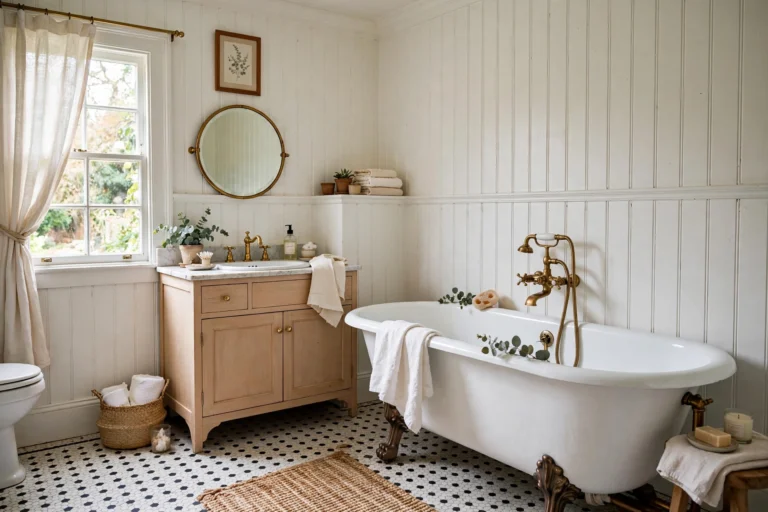
Style the exposed upper glass with a simple frosted band or leave it clear for maximum light. Café shutters in white with a beadboard bathroom wall is peak cottage charm.
6. Aluminum Mini Blinds
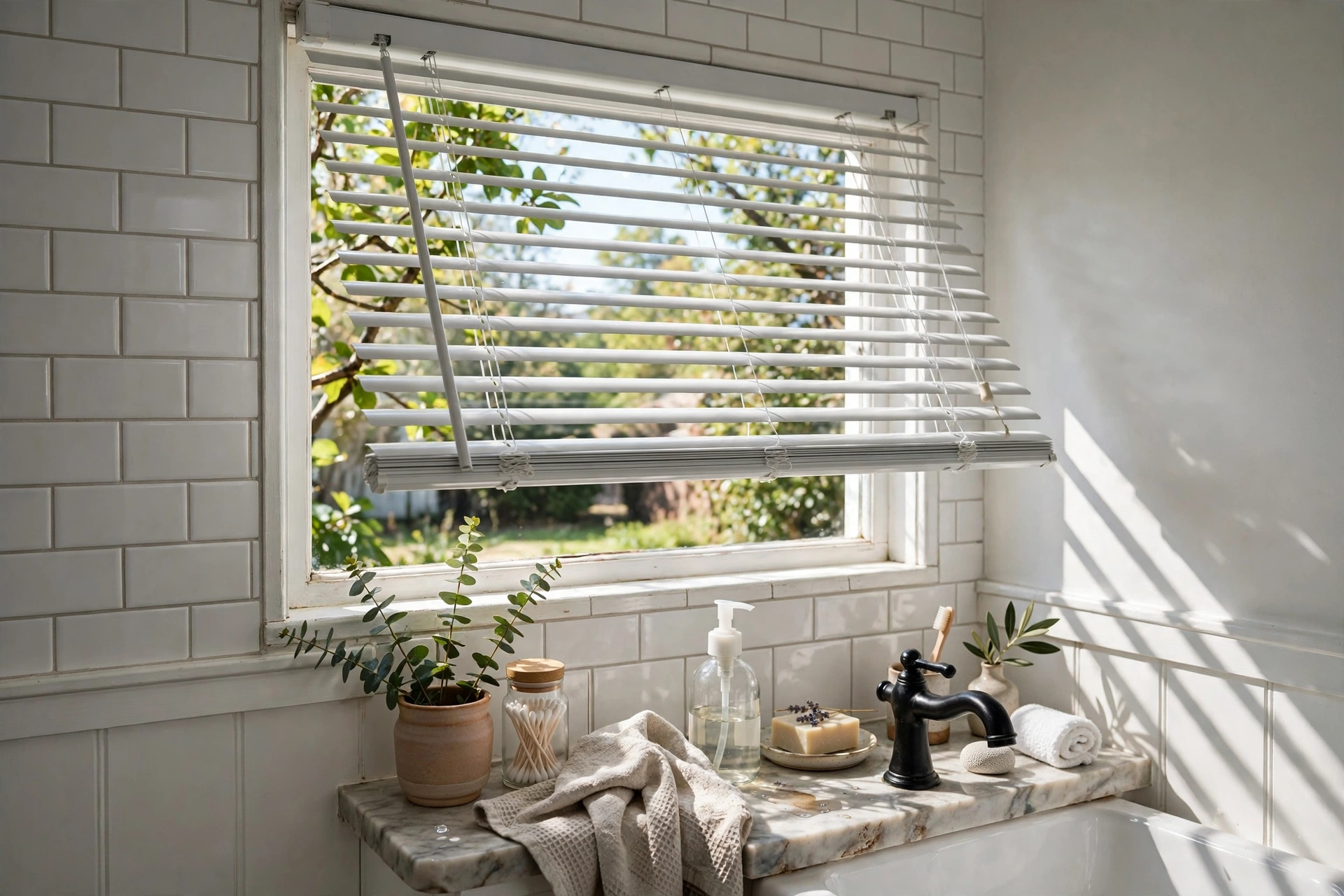
Aluminum mini blinds are the budget privacy solution that actually survives bathrooms — aluminum never rusts, warps, or absorbs moisture, and a 1-inch blind costs $15–$40 per window. The tilt wand gives instant privacy adjustment, and they wipe clean with a damp cloth or a blind-cleaning tool.
Choose a white or light neutral; dark aluminum shows dust and water spots. Cordless versions are worth the small premium for a cleaner look and child safety. Inside-mount blinds need 2+ inches of frame depth; shallower frames require outside mount on the trim.
Mini blinds are not glamorous, but they are honest, functional, and replaceable. In a rental bathroom or a tight renovation budget, they deliver full privacy and light control for the price of a pizza. Upgrade the look by pairing them with a simple fabric valance — the blinds do the work, the valance does the styling.
7. Woven Wood Shades (With Liner)
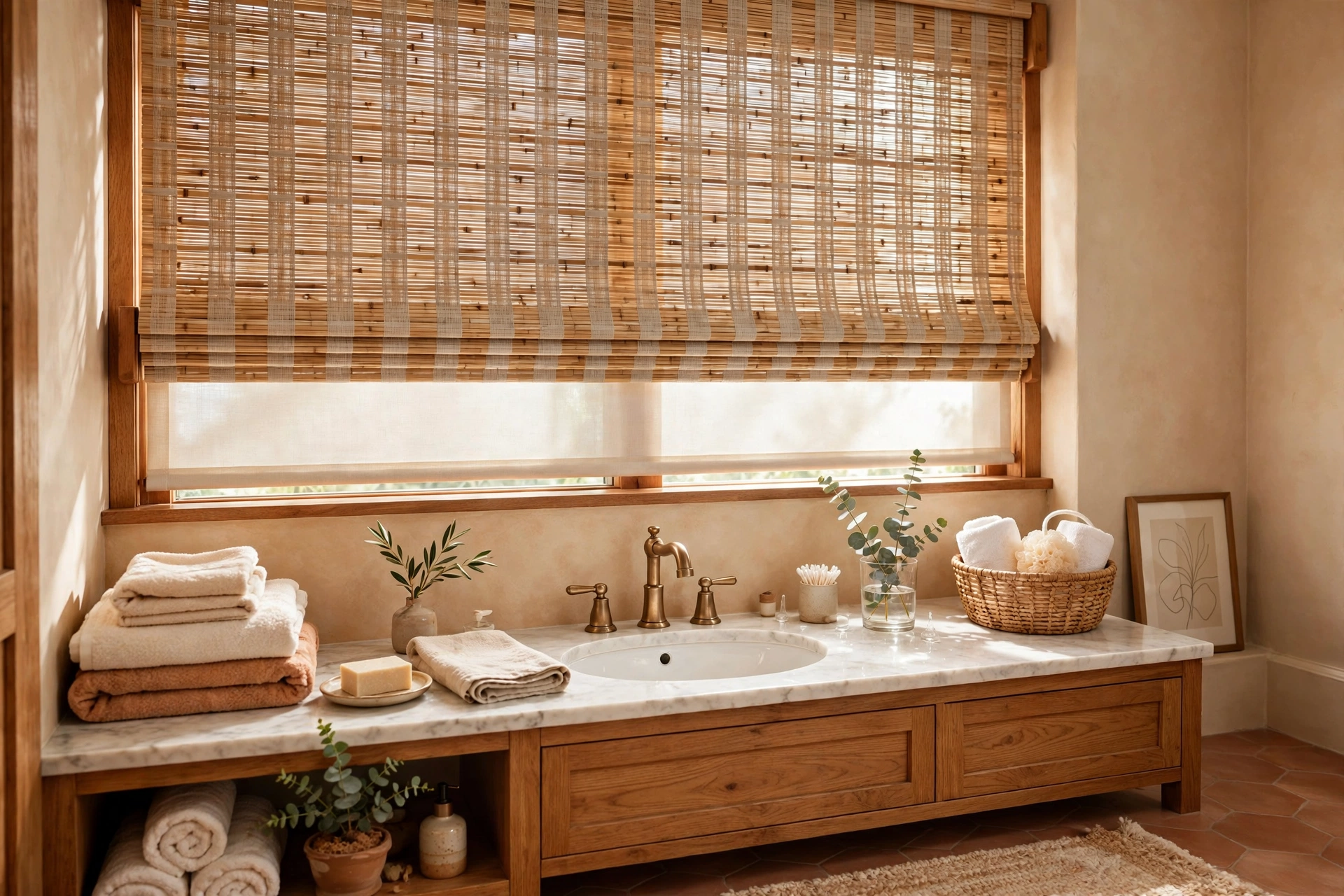
Woven wood shades in bamboo, jute, or grasses bring warm natural texture, but in a bathroom they need a privacy liner — unlined woven shades are semi-sheer and offer little privacy at night with lights on. A light-filtering or blackout liner mounted behind the shade solves this while preserving the natural look from inside.
Moisture is the concern: choose shades labeled for humid environments, run the vent fan consistently, and keep the shade out of direct shower spray. Woven shades over a bathroom window away from the tub (a vanity window, a water-closet window) fare far better than one inside the splash zone. Expect to replace them sooner than synthetic options — 5–7 years versus 10+.
The texture payoff is significant: woven shades warm up all-white bathrooms and pair beautifully with wood vanities and natural fiber rugs. Just go in knowing they are a style choice with a maintenance cost, not a fit-and-forget solution.
8. Stained Glass Privacy Panel
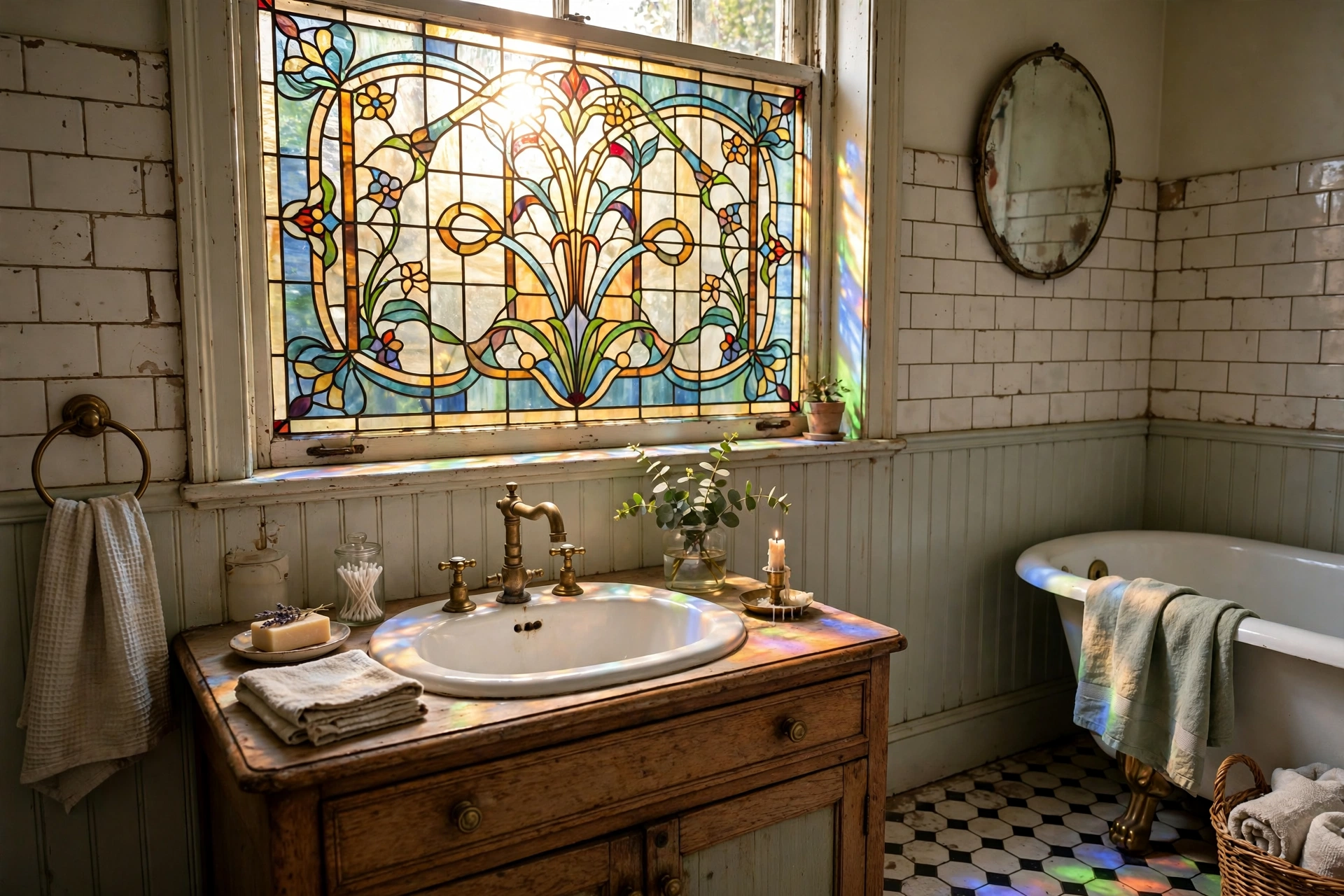
A stained or textured glass panel — real leaded glass, or a quality faux version — turns the bathroom window into art while providing permanent, maintenance-free privacy. Textured glass (rain, reed, or hammered patterns) obscures views completely while transmitting beautiful diffused light. Real stained glass panels start around $200 for small windows; faux film versions cost under $30.
For a real panel, have it cut 1/4 inch smaller than the opening and mount it inside the existing frame with silicone and trim stops — no need to replace the whole window. Leaded glass is heavy, so verify the frame can support it; most standard window frames handle a small panel fine.
This is the heirloom option: it never needs replacing, never mildews, and becomes a selling feature. A simple amber-and-clear geometric pattern suits craftsman bathrooms; soft blues and greens suit coastal ones.
9. Blackout Shades for Night Privacy
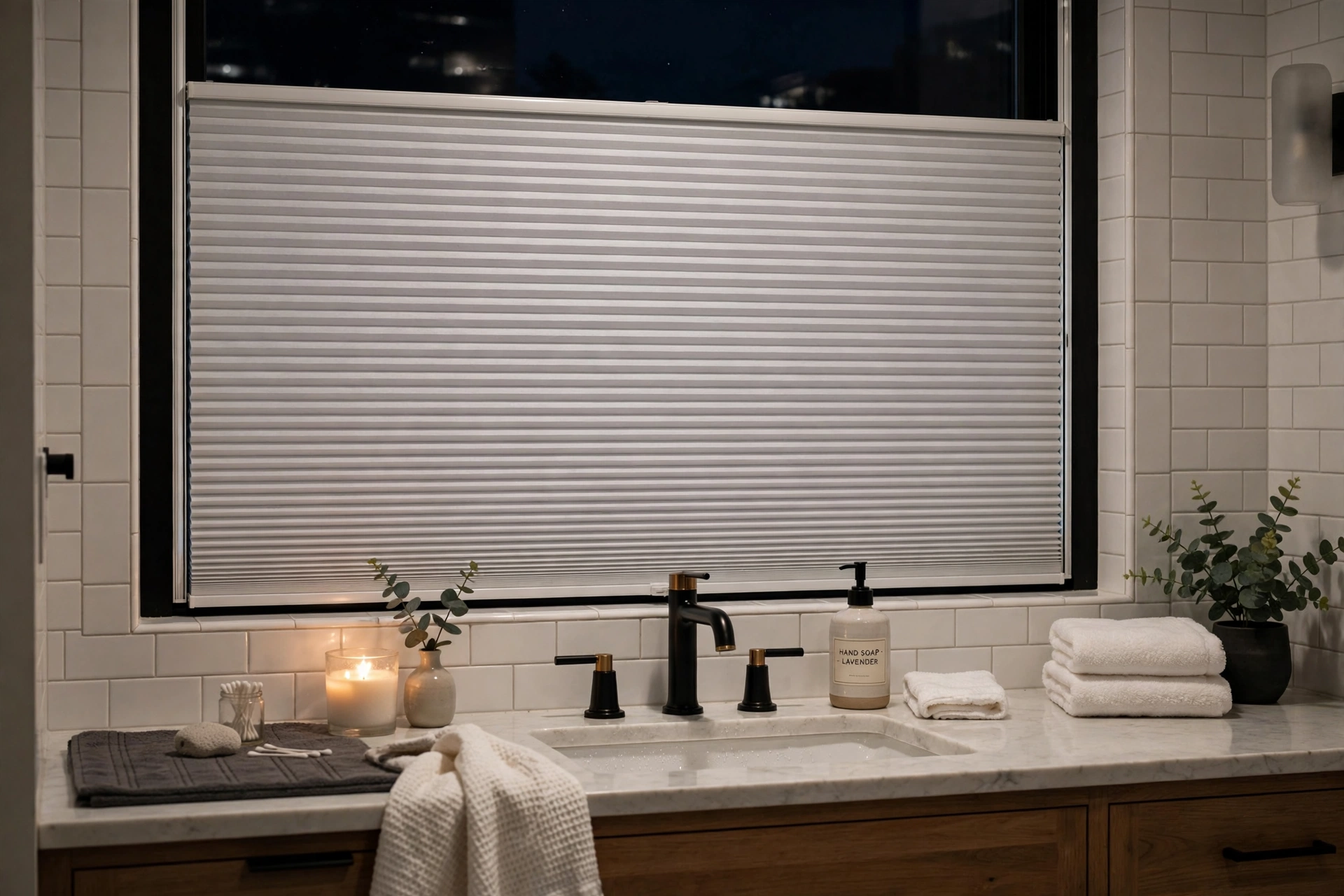
If your bathroom window faces a neighbor’s window or a streetlight, blackout shades give complete nighttime privacy — no silhouettes, no light bleed. Side channels (thin tracks on the window sides) block the light gaps at the edges that standard blackout shades leave; without channels, expect 1–2 inches of light leak per side.
Blackout roller or cellular shades in white keep the daytime look bright — the blackout layer faces the glass, invisible from inside. Motorized blackout shades ($150–$300 per window) are worth considering for high or hard-to-reach bathroom windows; remote or app control beats climbing on the tub edge.
This is less about style and more about function, but function matters most at night. Pair blackout shades with a decorative valance so the window looks finished during the day when the shade is raised.
10. Roman Shades in Outdoor Fabric
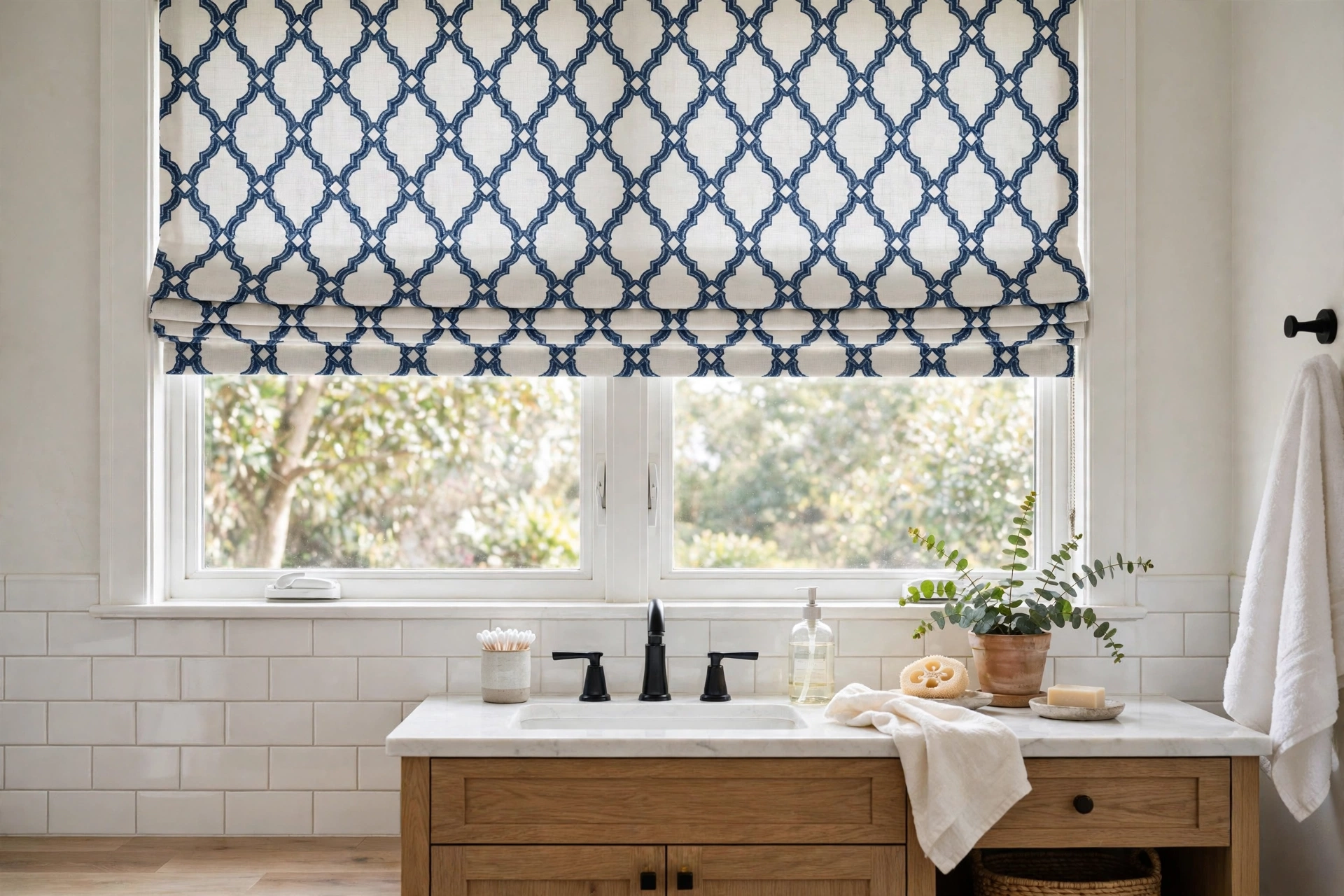
Roman shades bring soft fabric folds to the bathroom — but only in outdoor-rated fabrics (solution-dyed acrylic like Sunbrella) that resist moisture and mildew. Standard cotton or linen Romans will spot and mildew within months in a steamy bathroom; outdoor fabric looks nearly identical and survives indefinitely.
The flat-fold style stacks most compactly when raised; the classic hobbled style has permanent soft folds. Cordless lift is standard on quality Romans now. Inside mount needs 3+ inches of depth for the folds to clear the glass when raised.
Outdoor fabrics come in hundreds of patterns, from subtle textures to bold botanicals — the one place in this list where pattern takes center stage. A patterned Roman shade can be the bathroom’s entire color story, so keep the rest of the room neutral. For wall colors that complement a statement shade, see these bathroom paint design ideas.
11. Window Film in Decorative Patterns
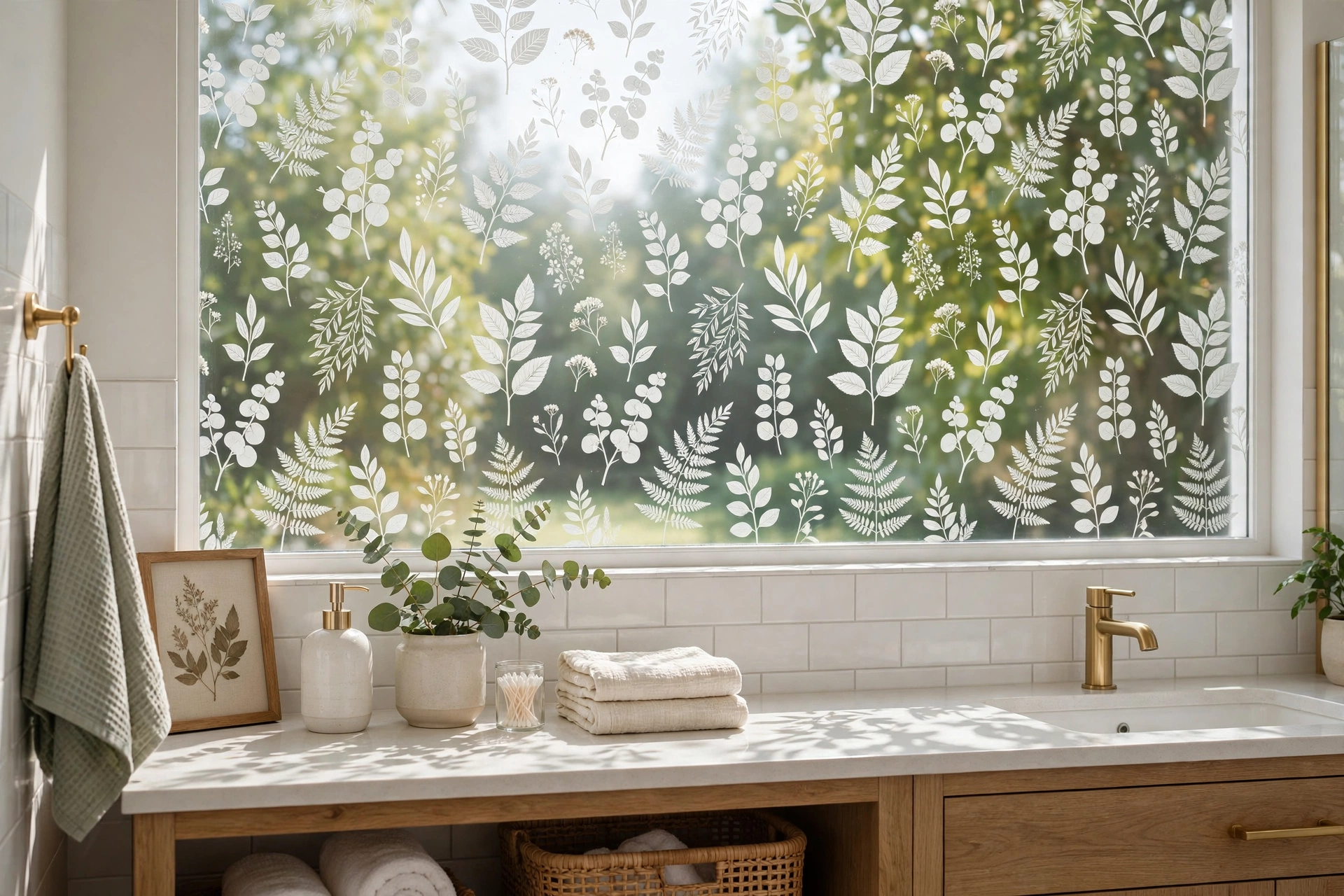
Beyond plain frost, decorative window films — stained-glass patterns, botanical prints, geometric etchings, rice-paper textures — make the window a design feature. Modern printed films look remarkably like real textured or leaded glass from a few feet away, at roughly 5% of the cost of actual specialty glass.
Apply like standard frosted film: soapy water, squeegee, trim. The pattern repeat matters on large windows — buy enough from the same production run so the pattern matches across panels. Most decorative films still transmit 70–85% of light while fully obscuring the view.
This is the highest style-per-dollar option in bathroom window treatments. A $25 roll of botanical film on a plain bathroom window looks like a $500 custom glass job. It is also fully renter-friendly and endlessly changeable — swap patterns with the seasons if you like.
12. Shutters Paired With a Valance
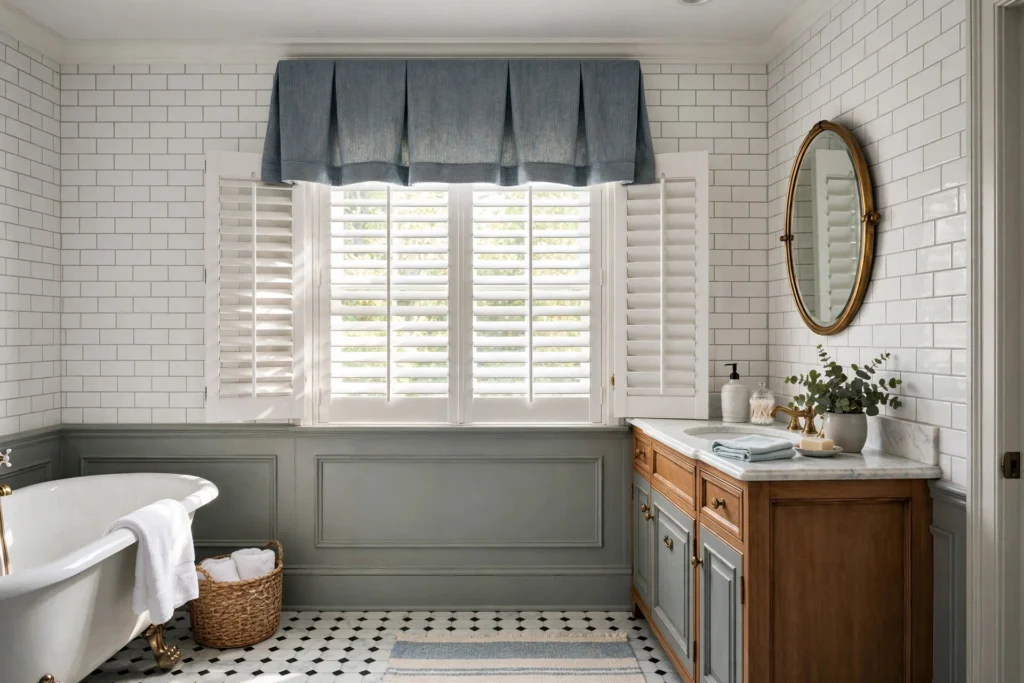
Plantation shutters handle privacy; a simple valance adds the softness. A tailored flat valance or a relaxed pleated valance in outdoor fabric mounted above the shutters finishes the window like a styled room rather than a purely functional one. The valance hides the shutter frame’s top rail and any mounting hardware.
Keep the valance shallow — 10–14 inches deep — so it does not block light from the upper window. Mount it on a board or a simple rod 2–4 inches above the window frame. Outdoor or performance fabric is essential; a standard cotton valance in a steamy bathroom will mildew at the folds.
This combination suits traditional and transitional bathrooms where you want both the crisp function of shutters and a touch of fabric softness. Choose a valance fabric that picks up an accent color from the room — towels, art, or a rug.
13. Privacy Glass Block Window
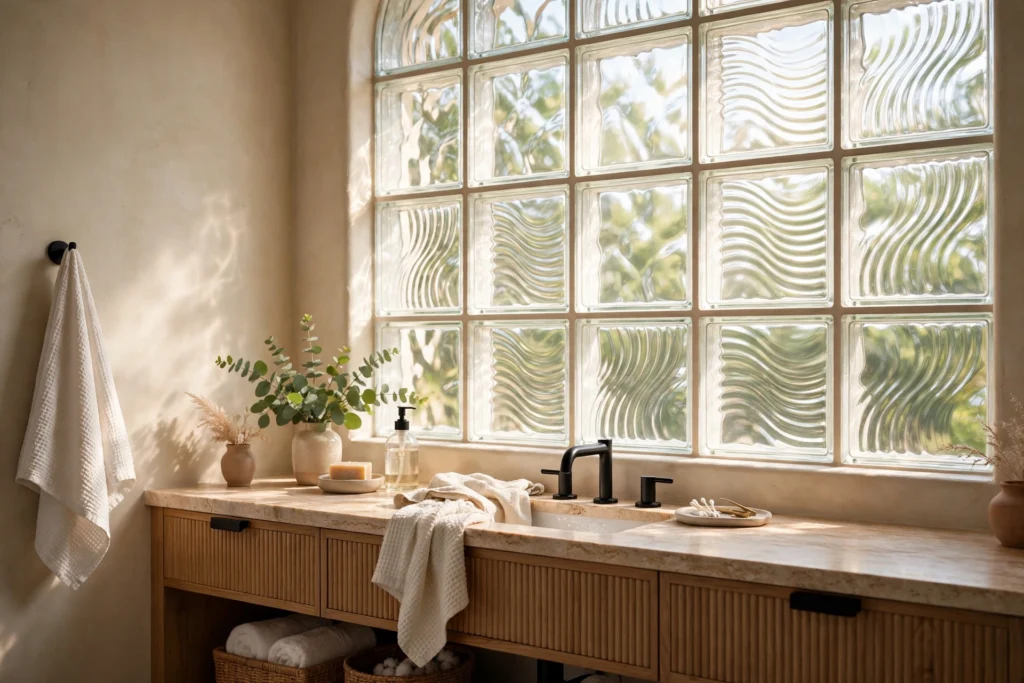
Glass block windows are the permanent, zero-maintenance bathroom window: mortar-set glass blocks transmit abundant diffused light, provide total privacy, and never need any treatment at all. They are also the most secure window option — nearly impossible to break through.
Installing glass block means replacing the existing window, so this is a renovation-level project ($300–$800 installed for a standard bathroom window). Prefabricated glass block window units in vinyl frames simplify installation enormously versus traditional mortar-set blocks. Check local code — some jurisdictions require an operable window or vent fan for bathroom ventilation, which a fixed glass block window does not provide.
The wavy, retro patterns of glass block suit mid-century and vintage bathrooms especially well. Once installed, the window treatment question is permanently answered — there is nothing to clean, adjust, or replace.
14. Layered Sheer Plus Blackout
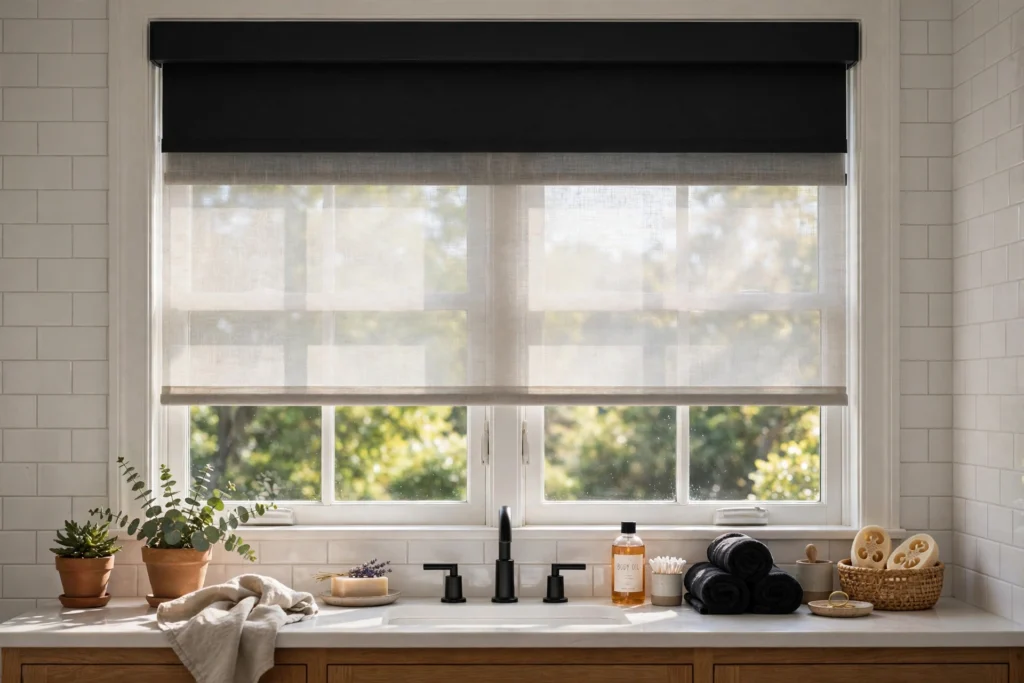
Layering — a light-filtering sheer or shade for daytime plus a blackout shade or blind for night — gives you two treatments for two jobs. By day, the sheer glows with diffused light and daytime privacy; at night, the blackout drops for total seclusion. Mount the blackout closest to the glass and the sheer on the room side.
In a bathroom, both layers must be moisture-appropriate: a vinyl light-filtering roller behind an outdoor-fabric sheer panel, for example. A double rod or a dual-mount bracket holds both layers in a standard-depth frame. Total cost runs $60–$150 per window for both layers.
This is the most flexible approach — you are never stuck with one light level. It suits bathrooms used at all hours, like a primary ensuite, where daytime brightness and nighttime privacy are equally important. As Better Homes & Gardens’ window treatment guide notes, layering is the professional trick for windows that must do double duty.
15. Smart Glass (Switchable Privacy Film)
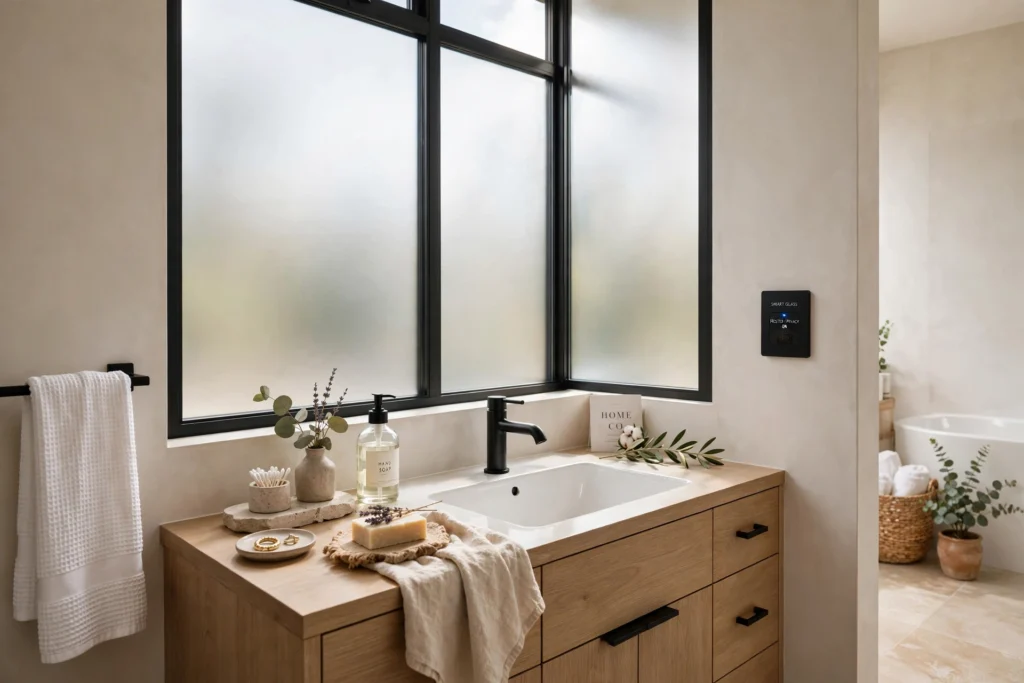
Switchable privacy film — applied to existing glass and wired to a switch — turns from clear to frosted opaque with a tap. It is the most high-tech bathroom window treatment: full view and light when you want it, instant privacy when you need it. The film runs on low-voltage power, typically 48–65V AC via a small transformer.
Cost is the barrier: $50–$100 per square foot for the film plus electrician costs for the wiring, putting a standard bathroom window at $400–$900. The film requires constant power to stay clear (it defaults to frosted when off — a privacy-safe failure mode). Professional installation is strongly recommended since the electrical connections must be waterproof.
This is a splurge for a luxury primary bathroom renovation, not a budget update. But for a bathroom with a view worth keeping — a garden, a skyline, the woods — switchable film is the only treatment that gives you both the view and the privacy on demand. For technical background on how these films work, see Wikipedia’s overview of smart glass technology.
Frequently Asked Questions
What is the best window treatment for a bathroom?
Faux-wood plantation shutters are the best all-around choice: moisture-proof, adjustable for light and privacy, easy to clean, and attractive in every bathroom style. For renters or tight budgets, frosted window film gives instant full privacy for under $30. For maximum light with privacy, top-down bottom-up cellular shades are unbeatable. The “best” depends on your window’s exposure, your budget, and whether you own or rent — but any of these three covers the core bathroom needs.
How do I get privacy without blocking natural light?
Use treatments that obscure the view while transmitting light: frosted or decorative window film (about 80% light transmission), top-down bottom-up shades lowered from the top, café shutters on the lower half, or textured/stained glass. Avoid blackout treatments during the day. Also consider placement: a mirror opposite the window bounces the incoming light deeper into the room — these bathroom mirror ideas from round to arched show shapes that maximize that reflective boost.
Will real wood blinds survive in a bathroom?
Not well. Real wood absorbs steam, warps, and the finish eventually cracks or peels — especially on a window near the shower. Faux-wood (PVC/composite) blinds and shutters look nearly identical, cost about the same, and are impervious to moisture. If you love the warmth of real wood, use it only on a bathroom window far from steam with excellent ventilation, and accept that it will need refinishing sooner than elsewhere in the house.
Are curtains OK in a bathroom?
Lightweight curtains can work in a low-humidity powder room, but in a full bathroom with a shower, fabric curtains absorb moisture and develop mildew — especially at the hem where steam condenses. If you want fabric, use outdoor-rated or performance fabrics and wash them regularly. For the window itself, a hard treatment (shutters, shades, blinds, or film) handles privacy far better in steam; save fabric for a decorative valance above, out of the direct moisture zone.
How do I measure a bathroom window for shutters or shades?
For inside mount, measure the width in three places (top, middle, bottom) and the height in three places (left, center, right); use the narrowest width and the tallest height, then subtract the manufacturer’s recommended clearance (usually 1/4 inch total for shutters, 1/8 inch for shades). Check that the frame is square by measuring diagonally — if the diagonals differ by more than 1/2 inch, order an outside mount instead. Always measure in inches to the nearest 1/8 inch, and never assume two windows in the same room are identical.
Keep Exploring
The right bathroom window treatment gives you daylight without exposure and style without maintenance headaches. Whether you choose the permanence of shutters, the simplicity of frosted film, or the flexibility of layered shades, match the material to your steam level and the coverage to your sightlines — and enjoy a bathroom that feels bright and completely private.