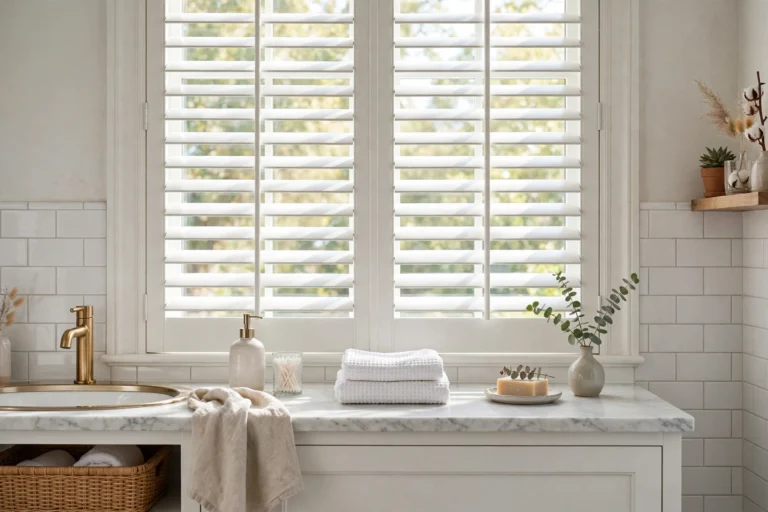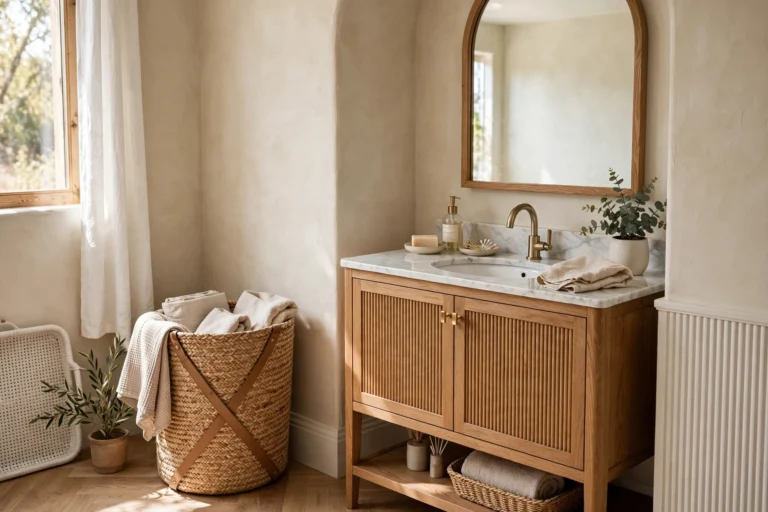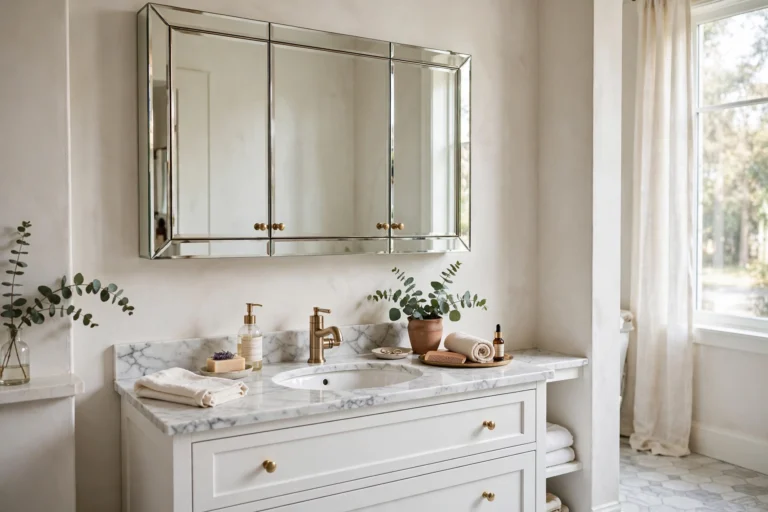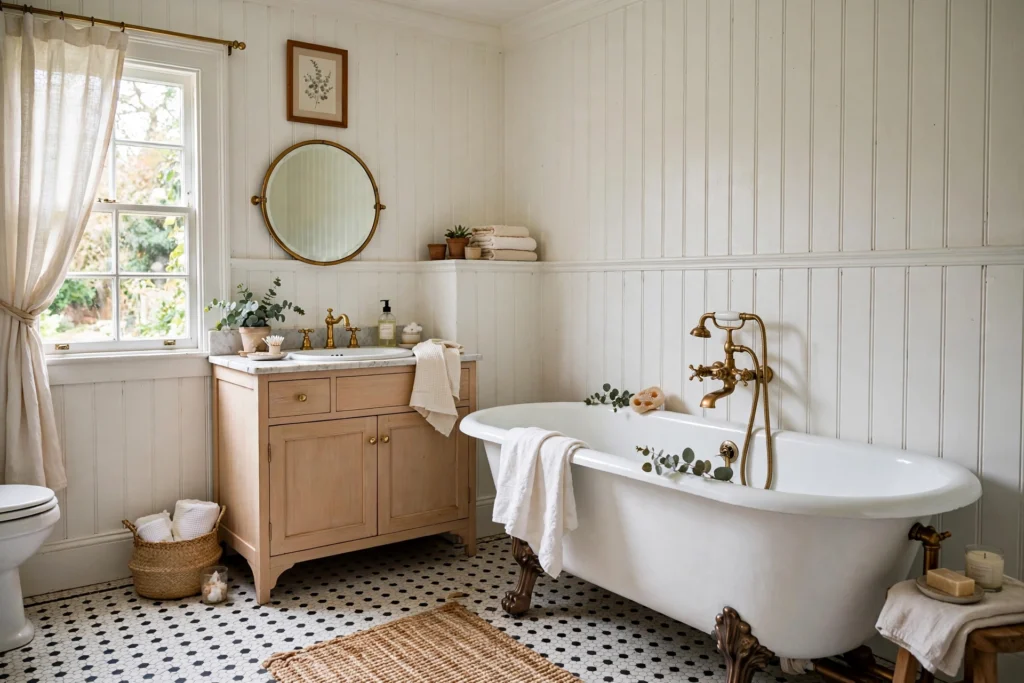

Beadboard is the narrow-groove vertical paneling that instantly says “classic cottage bathroom.” Unlike horizontal shiplap with its wide shadow lines, beadboard is made of slim tongue-and-groove boards — typically 2.5 to 3 inches wide — with a small rounded bead milled between each groove. These bathroom beadboard ideas show how that fine, rhythmic texture works everywhere from tiny powder rooms to spacious primary baths.
Beadboard is often confused with wainscoting, but they are not the same thing. Wainscoting is a general term for lower-wall paneling that can be built from flat panels, trim boxes, or beadboard itself; beadboard is the specific grooved board material. In a bathroom, beadboard’s real advantage is that it comes in moisture-proof PVC versions that look identical to painted wood, making it one of the most bathroom-friendly wall treatments you can install.
1. Full-Height White Beadboard
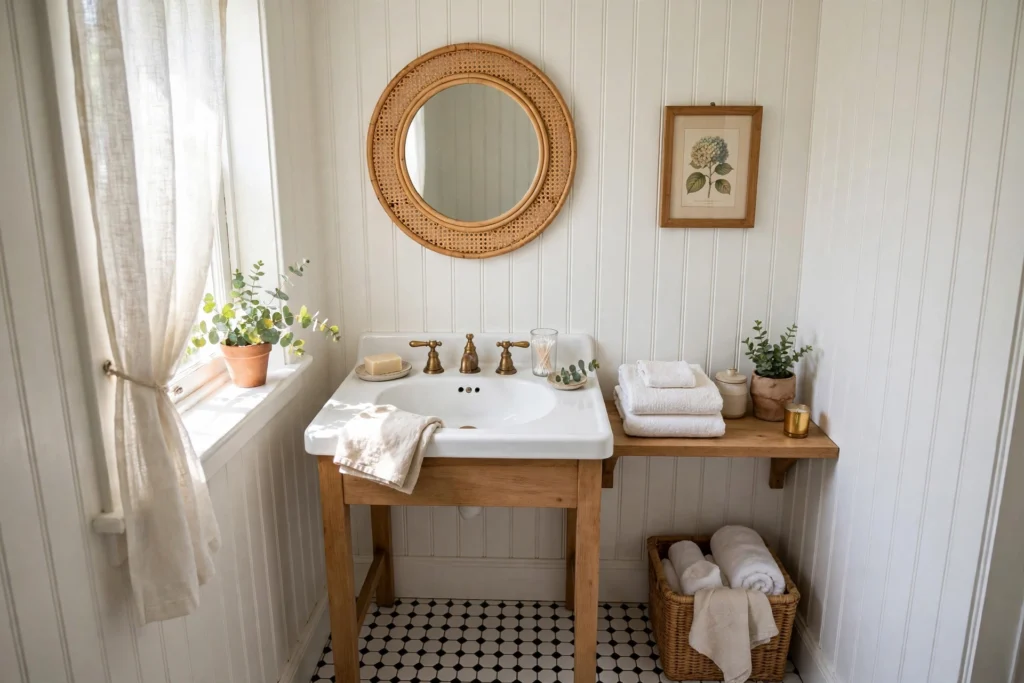
Running beadboard floor to ceiling in crisp white is the timeless cottage look. Full-height coverage works especially well in small bathrooms, where the continuous vertical grooves make 8-foot ceilings feel taller and the unbroken white surface reflects light. Use 4×8-foot PVC beadboard sheets (about $30–$45 per sheet) rather than individual wood boards — sheets install in hours and never swell.
Scribe the sheets around fixtures carefully, leaving 1/8-inch gaps at inside corners for caulk. Prime PVC with a bonding primer like Zinsser Bulls Eye 1-2-3, then apply two coats of semi-gloss bathroom paint. The bead profile catches light beautifully, so even plain white has depth.
Keep trim minimal — a simple baseboard and a thin crown or cove molding at the ceiling — so the beadboard texture is the star. This is the single most forgiving of all bathroom beadboard ideas: it suits farmhouse, coastal, and traditional styles alike.
2. Bold Navy Beadboard Walls
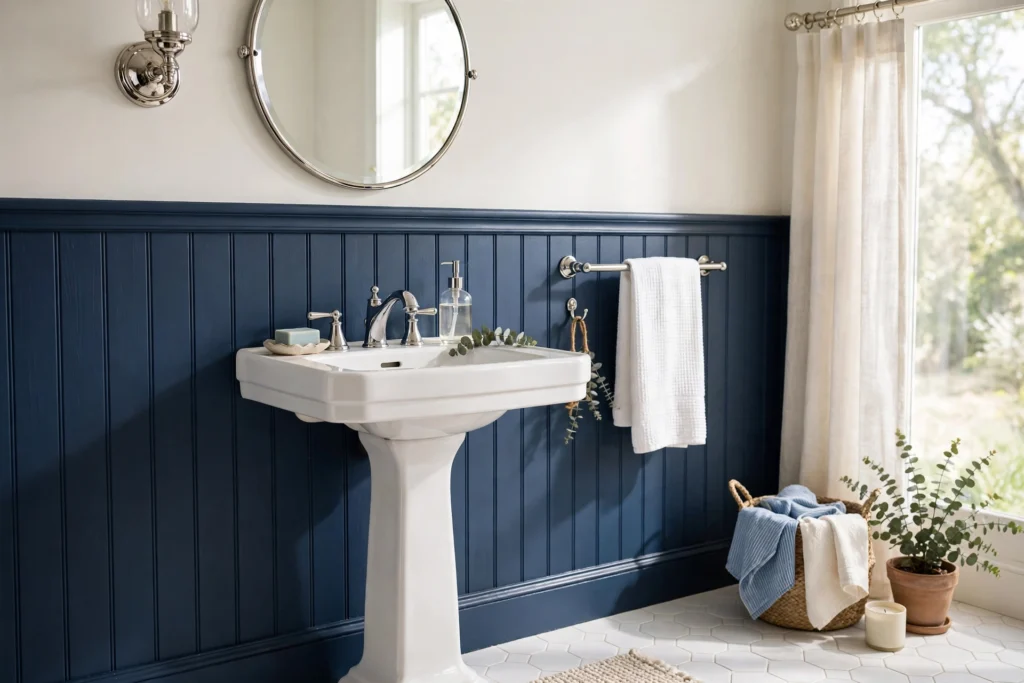
Painting beadboard a saturated navy turns classic paneling into a statement. The fine grooves of beadboard hold dark color better than flat drywall because the texture breaks up the surface and prevents the color from reading as one flat void. Benjamin Moore Hale Navy or Sherwin-Williams Naval both deliver that deep, inky look.
Because beadboard has hundreds of linear feet of grooves, use a sprayer if you have one — brushing every groove by hand is tedious. A $60 handheld airless sprayer pays for itself on this job. Two coats of satin enamel over primer give a rich, wipeable finish that resists steam.
Contrast the navy with a white pedestal sink, polished chrome fixtures, and a large round mirror. The palette is classic nautical without a single anchor motif. For more guidance on bold color choices, see these bathroom paint design ideas.
3. Beadboard Wainscoting With Wallpaper Above
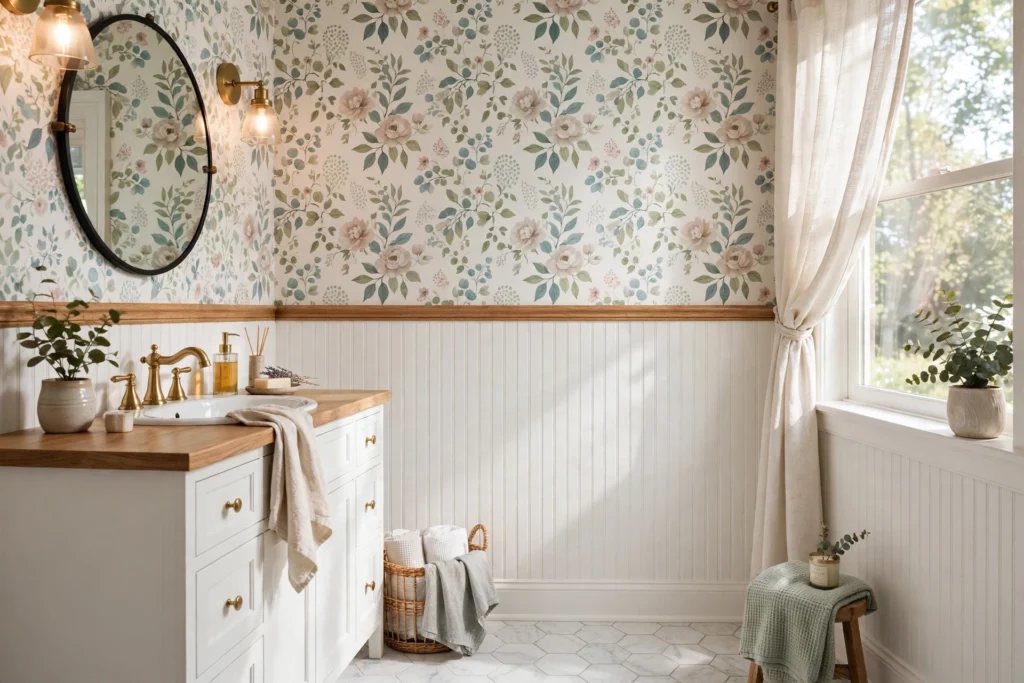
Beadboard on the lower third of the wall with wallpaper above is the quintessential cottage combination. Stop the beadboard at 36 inches, cap it with a 1×3 chair rail, and hang a patterned wallpaper — small florals, ticking stripes, or a classic damask — on the upper wall. The textures play off each other: fine grooves below, flat pattern above.
In a bathroom, choose a vinyl or solid-vinyl wallpaper rated for humid rooms; standard paper wallpaper will bubble near a shower. The chair rail cap should be caulked on both edges to block moisture migration behind the beadboard. Paint the beadboard and the chair rail the same white so the trim package reads as one piece.
This is also a budget-friendly approach: you cover only about a third of the wall with beadboard, and one roll of wallpaper often covers the upper walls of a powder room. If you want more patterned-wall inspiration, browse these bathroom wallpaper ideas for bold beautiful walls.
4. Sage Green Beadboard
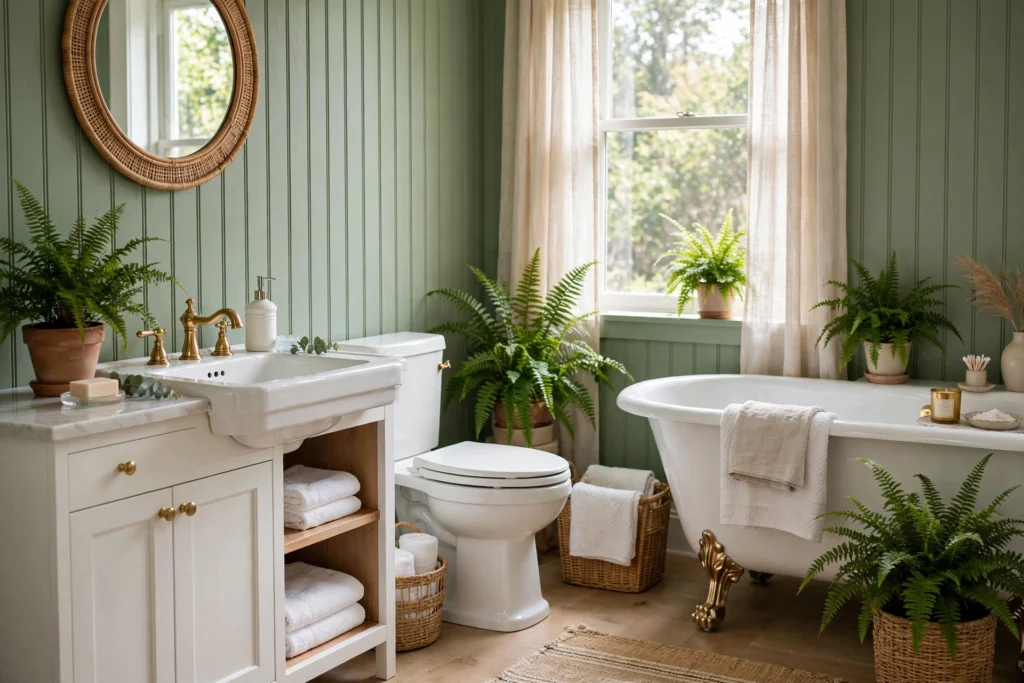
Sage green beadboard brings a soft, botanical calm to a bathroom without going full color-drama. Shades like Benjamin Moore Saybrook Sage or Behr Quietude have enough gray to read neutral, so the room still feels restful. The green-gray tone also flatters skin in mirror light — a real consideration in a bathroom.
Sage pairs naturally with white fixtures, brushed nickel hardware, and eucalyptus or potted ferns. Keep the ceiling bright white and use a light floor tile so the room does not feel heavy. Two coats of eggshell or satin finish are enough in a powder room; use semi-gloss near a tub or shower where splashes happen.
For a cohesive look, carry the sage onto the vanity or a single piece of furniture like a small stool. Repeating the color twice makes the palette feel designed rather than accidental.
5. Beadboard Ceiling
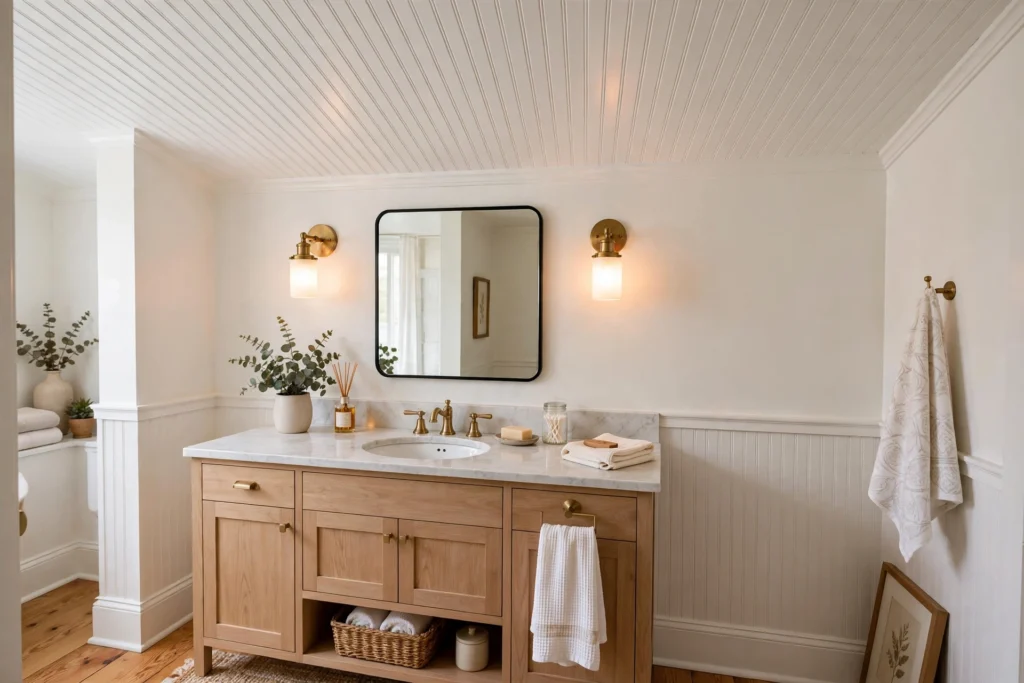
A beadboard ceiling adds cottage texture overhead, where it catches light from vanity sconces and creates gentle shadow play. Ceiling beadboard is traditionally installed as individual tongue-and-groove boards or 4×8 sheets nailed to joists or furring strips; sheets are dramatically faster and work fine on flat ceilings.
Paint the ceiling beadboard the same white as the trim for a seamless look, or go one shade warmer (a soft cream) so the ceiling feels cozy rather than stark. Always run the vent fan during and after showers — ceiling beadboard in a poorly ventilated bathroom will show moisture staining at the seams first.
If your bathroom has a sloped ceiling, run the beadboard along the slope. The lines emphasize the architecture and make a small attic bathroom feel intentionally designed. Use a satin finish, which hides minor imperfections better than semi-gloss overhead.
6. Black Beadboard for Modern Contrast
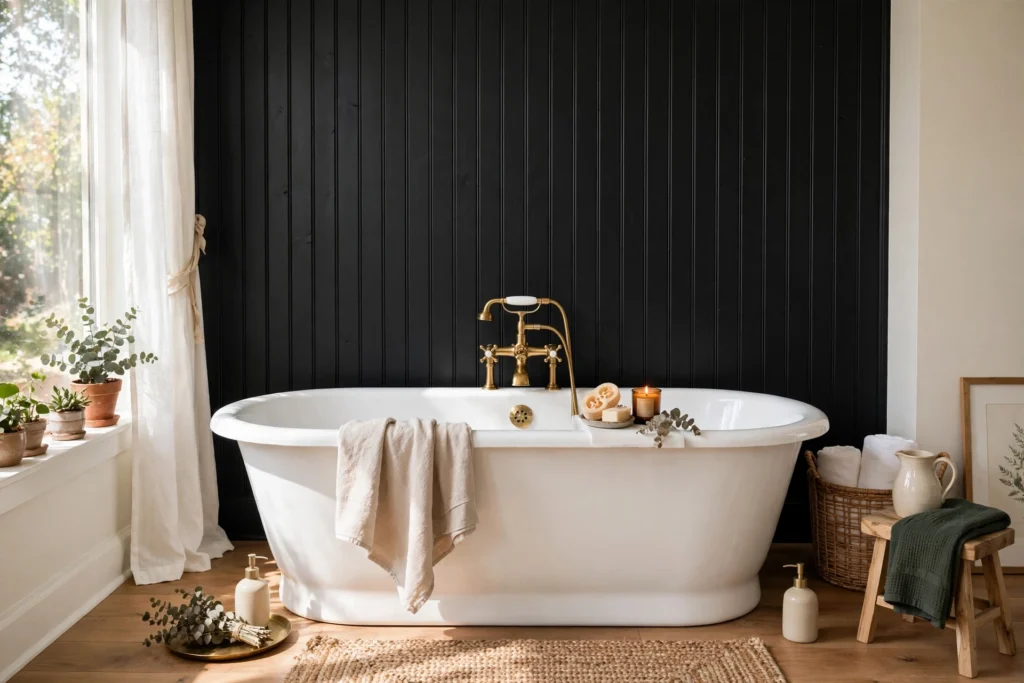
Black beadboard is the moody modern cousin of the classic white version. The fine grooves keep black from looking flat, creating a textured backdrop that makes white fixtures and brass hardware glow. It works best in a bathroom with a window or skylight; in a windowless room, limit black beadboard to one accent wall.
Prep is critical: caulk every seam, fill nail holes, and prime with a high-hide gray-tinted primer so the black topcoat covers in two coats instead of three. Use semi-gloss enamel for wipeability. A soft black like Sherwin-Williams Iron Ore reads warmer than a pure jet black.
Style it with restraint — white towels, a light wood bench, one green plant. The contrast does all the work. Black beadboard behind a white freestanding tub is one of the most striking combinations in bathroom design right now.
7. Beadboard Behind the Vanity
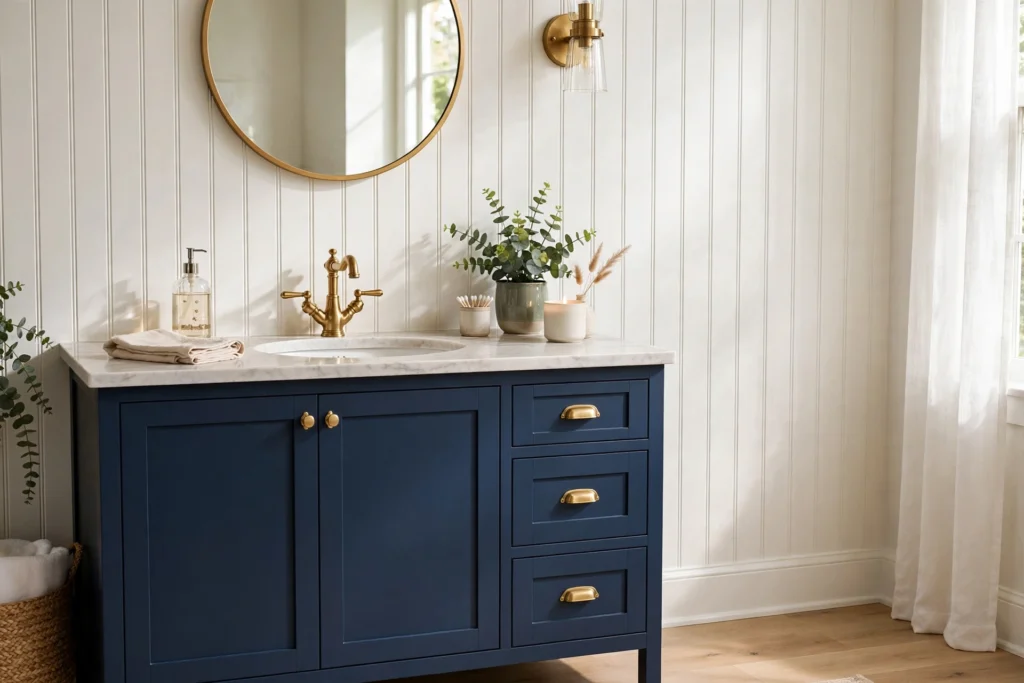
A beadboard backsplash-style wall behind the vanity protects the wall from splashes while adding texture exactly where the eye lands. Run beadboard from the countertop up to the mirror or medicine cabinet — typically 24 to 36 inches of coverage. PVC beadboard is ideal here since it sits inches from the faucet spray zone.
Caulk the bottom edge where beadboard meets the countertop with 100% silicone, not paintable caulk, so water cannot wick behind the panels. Paint to match the vanity for a built-in look, or contrast it: white beadboard behind a navy vanity is a classic pairing.
This is a one-afternoon project — a single 4×8 sheet usually covers the vanity wall of a standard bathroom. Style the countertop with a simple tray, a small plant, and matching soap dispensers to complete the look.
8. Two-Tone Beadboard: White Above, Color Below
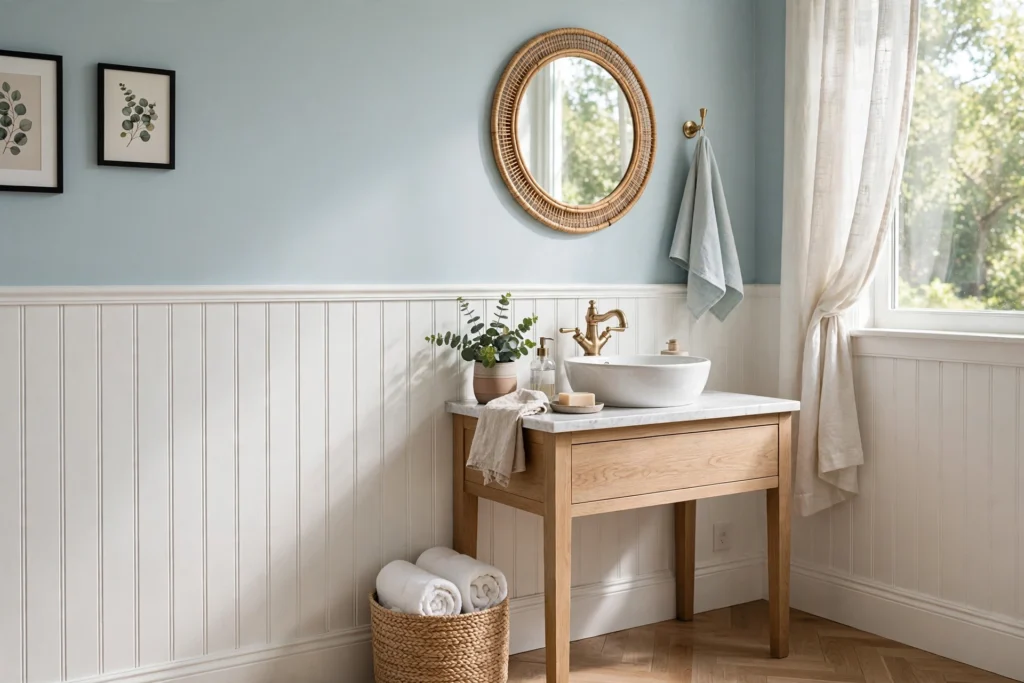
Two-tone walls — white beadboard on top, a saturated color below the chair rail, or vice versa — give you pattern and restraint in one wall. The most classic version: beadboard wainscot painted white, upper wall in a soft color like pale blue or warm greige. The reverse (colored beadboard, white upper wall) feels more modern.
The chair rail is the star of this treatment, so make it substantial: a 1×4 cap with a small cove molding underneath reads as custom millwork. Paint all the trim the same finish as the beadboard for cohesion, and caulk every joint before painting.
This approach lets you use a bold color without overwhelming the room, since it covers only part of the wall. It is also practical — the lower wall takes the most abuse, and semi-gloss beadboard wipes clean far easier than painted drywall.
9. Beadboard in a Small Powder Room
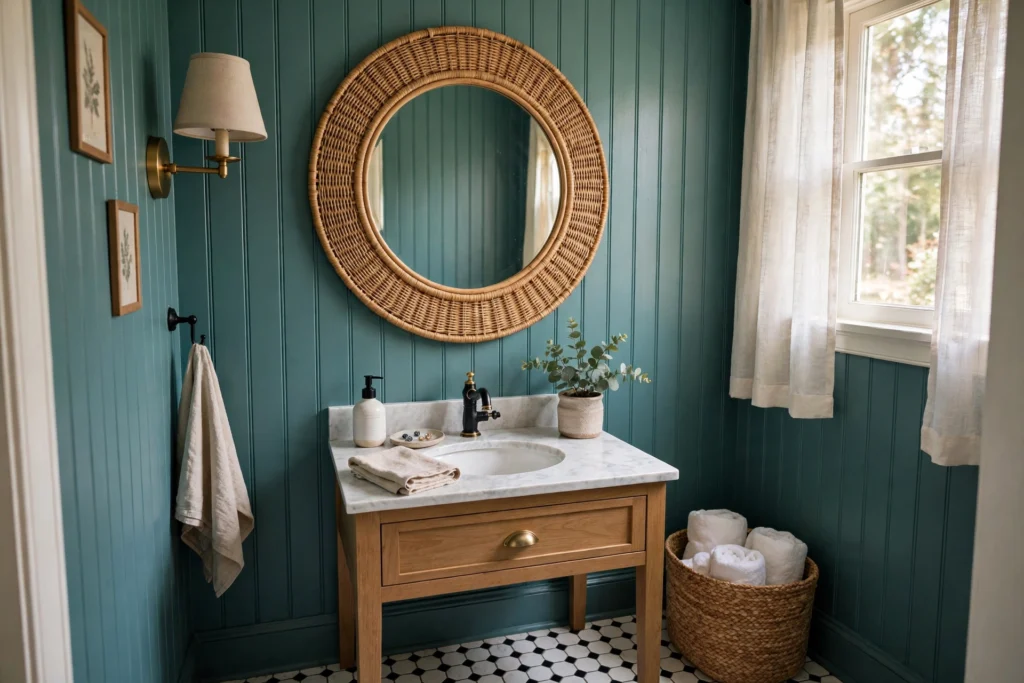
Powder rooms are where beadboard shines brightest: no shower steam, small square footage, and high guest visibility. A single afternoon and about $100 in PVC beadboard sheets can transform a builder-grade powder room into a cottage jewel box. Since there is no tub or shower, standard MDF beadboard and regular latex paint are perfectly fine here.
Try a full room of beadboard in an unexpected color — dusty rose, deep teal, or charcoal — since the small space makes bold choices feel intentional. Or keep it white and let a statement mirror and patterned floor tile carry the personality.
Because powder rooms are tiny, mind the details: use narrow 2.5-inch bead profiles rather than wide ones (wide grooves can overwhelm a small wall), keep the baseboard slim, and choose a mirror that spans most of the vanity width to bounce light around.
10. Gray Beadboard for a Soft Neutral
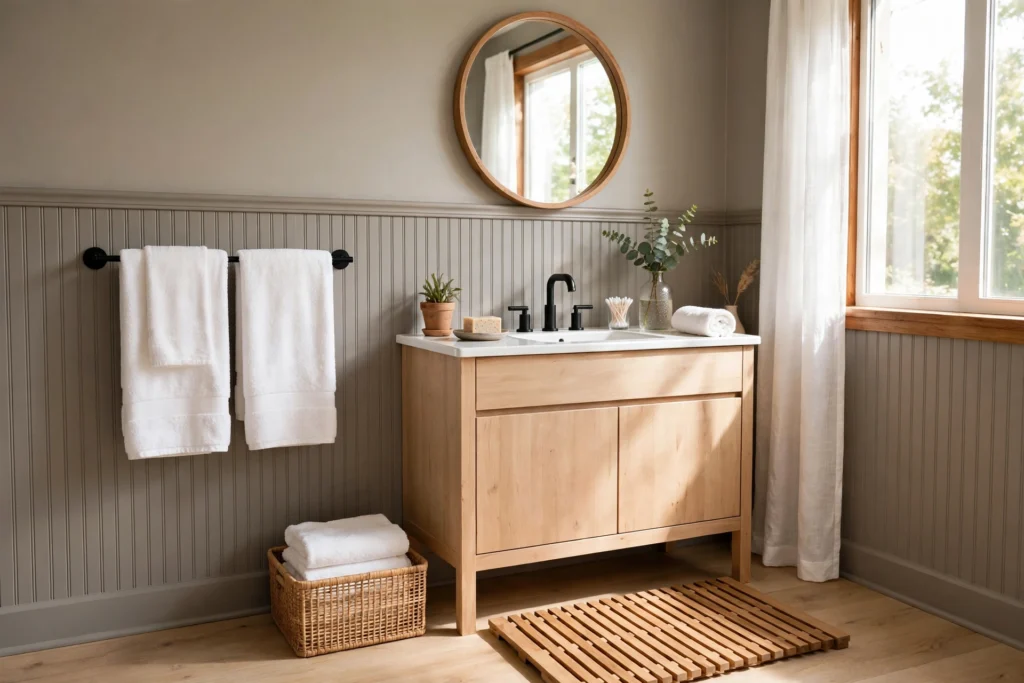
Warm gray beadboard is the neutral that is not boring. Shades like Benjamin Moore Revere Pewter or Sherwin-Williams Agreeable Gray have enough warmth to avoid the cold institutional feel that cool grays can give a bathroom. The bead texture adds the interest that a flat gray wall lacks.
Gray beadboard is exceptionally versatile: it works with white, black, brass, or chrome fixtures, and it pairs with both warm wood tones and cool marble-look surfaces. In a rental or a home you plan to sell, gray is the safest colored beadboard choice — it reads updated without polarizing buyers.
Finish with semi-gloss for durability. Style with white towels and one natural element — a wood bath mat, a woven basket, a eucalyptus bundle — to keep the gray from feeling flat. If you want more neutral-wall inspiration, these bathroom wainscoting ideas for timeless style show similar treatments.
11. Beadboard and Marble-Look Tile Combo
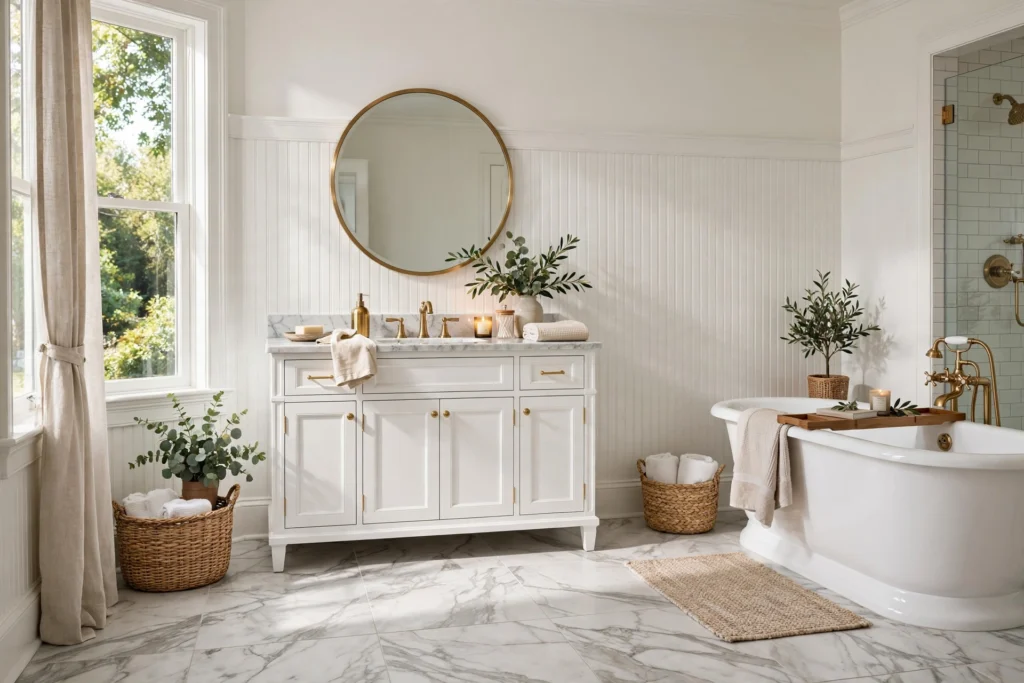
Pairing beadboard with marble-look porcelain tile gives you cottage texture plus luxury surfaces. The classic split: beadboard on the upper walls or wainscot, marble-look tile on the floor and in the shower. The veining of the tile and the fine grooves of the beadboard are both “busy” textures, so keep the beadboard white and let the tile be the pattern.
Use a large-format marble-look tile (12×24 inches) on the floor to minimize grout lines, and carry it up the shower walls. The transition between tile and beadboard should happen at a clean line — the top of the wainscot cap or a schluter edge at the shower opening. Caulk, don’t grout, the seam where the two materials meet.
This combination reads high-end without the maintenance of real marble. Porcelain never needs sealing, and white beadboard wipes clean — the whole room is practical as well as pretty.
12. Distressed and Antiqued Beadboard
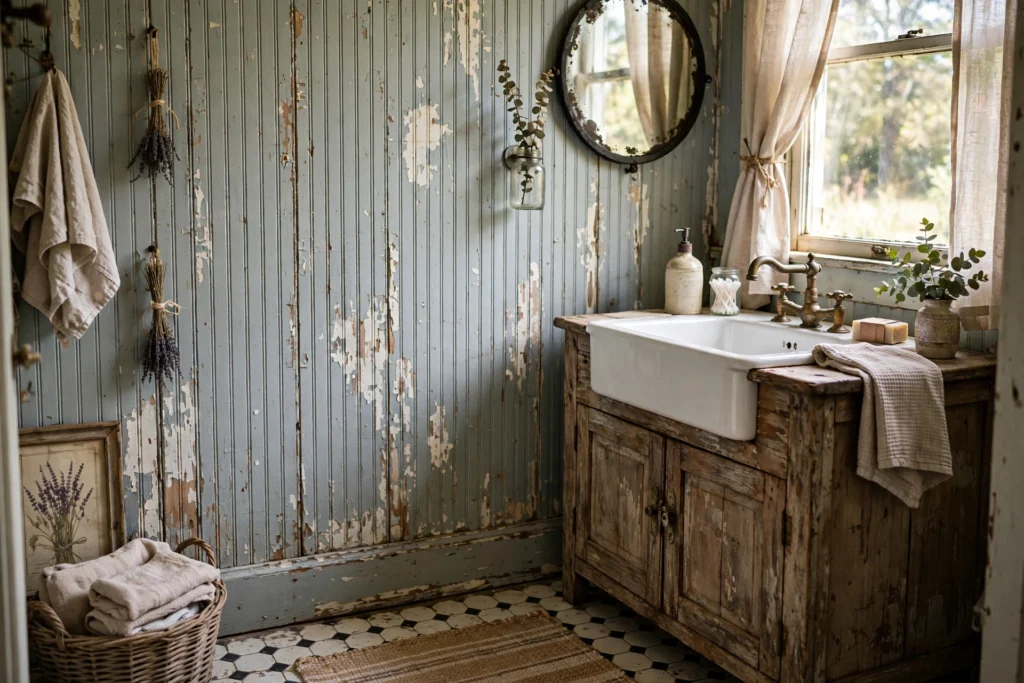
For a farmhouse or vintage bathroom, distress beadboard to look a century old. After painting your base color, rub the edges and beads with 120-grit sandpaper to reveal wood (or the layer beneath), focusing on corners and areas that would naturally wear. Then apply a dark antiquing glaze, wiping it back so it settles into the grooves.
Work in small sections — glaze dries fast. A 50/50 mix of dark brown glaze and clear glaze gives you working time. Seal the whole thing with a clear matte sealer so the distressed finish does not continue to wear in real life. This technique works best on real wood beadboard; PVC does not distress convincingly since there is no wood beneath.
Distressed beadboard suits a clawfoot tub, vintage-look fixtures, and a chippy-paint mirror. Keep everything else simple — the wall is the patina, and competing vintage pieces can tip the room from charming to cluttered.
13. Beadboard Half Wall in a Kids’ Bathroom
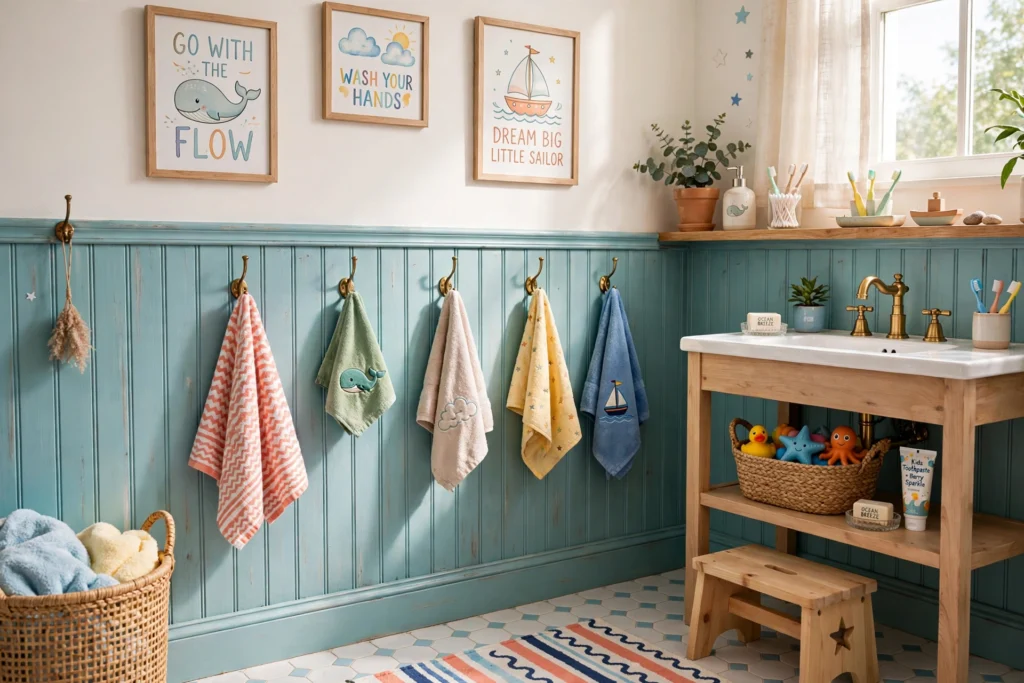
A beadboard wainscot in a kids’ bathroom takes abuse beautifully. The lower wall gets kicked, splashed, and bumped; semi-gloss beadboard wipes clean while painted drywall chips. Stop the beadboard at 42 inches — slightly above standard chair-rail height — so it clears the backs of small chairs and step stools.
Paint it a cheerful, forgiving color: soft aqua, sunny yellow, or a classic white that hides nothing but cleans easily. Use PVC beadboard if the kids’ bathroom has a tub-shower combo; the splash zone extends further than you think. Caulk the top cap thoroughly.
Hang hooks on the beadboard for kids’ towels and robes — hooks screwed into the boards (into studs where possible) hold better than adhesive hooks on paint. The beadboard gives you a sturdy, good-looking surface for all the hardware a kids’ bathroom demands.
14. Beadboard With Open Shelving
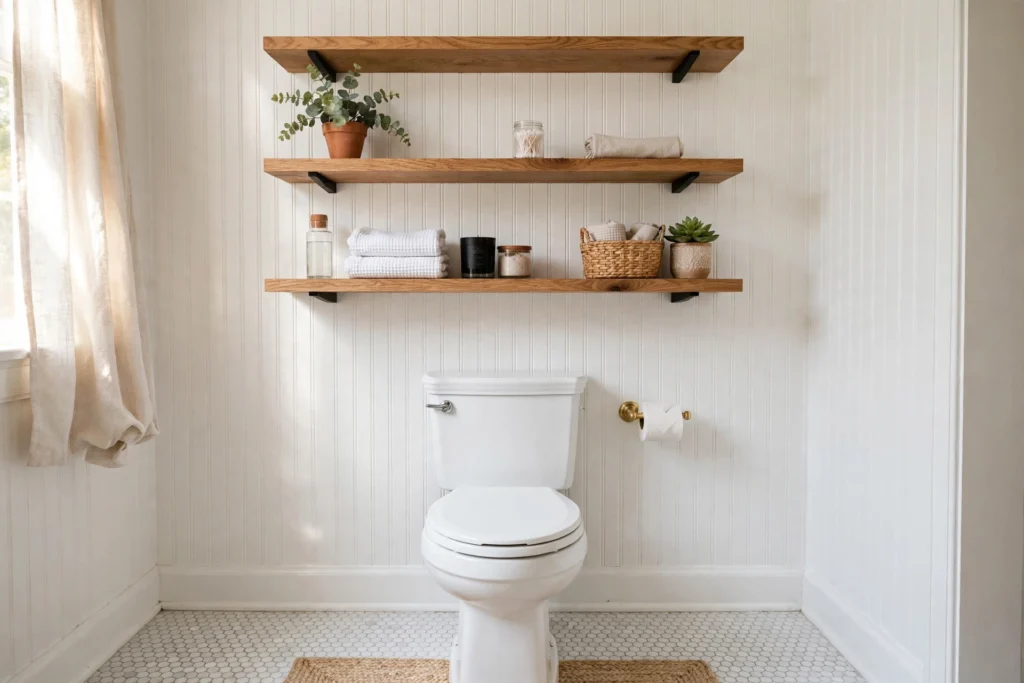
Mounting open shelves directly onto beadboard walls creates a layered, collected look. The shelves’ brackets need solid anchoring: drive screws through the beadboard into studs, or install a horizontal ledger board first and mount brackets to that. Standard beadboard alone is too thin to hold loaded shelves.
Style the shelves with folded towels, apothecary jars, and a small plant — the beadboard texture behind them adds depth that flat walls lack. Keep shelf depth to 8–10 inches so items do not crowd the narrow bathroom. White or wood shelves both work; wood warms up white beadboard, while white shelves disappear into it for a cleaner look.
This combination is ideal above a toilet or beside a vanity, where shallow storage is most useful. Just keep paper products and anything moisture-sensitive in closed containers — open shelves in a steamy bathroom are for display and towels, not for storing toilet paper.
15. Peel-and-Stick Beadboard Panels for Renters
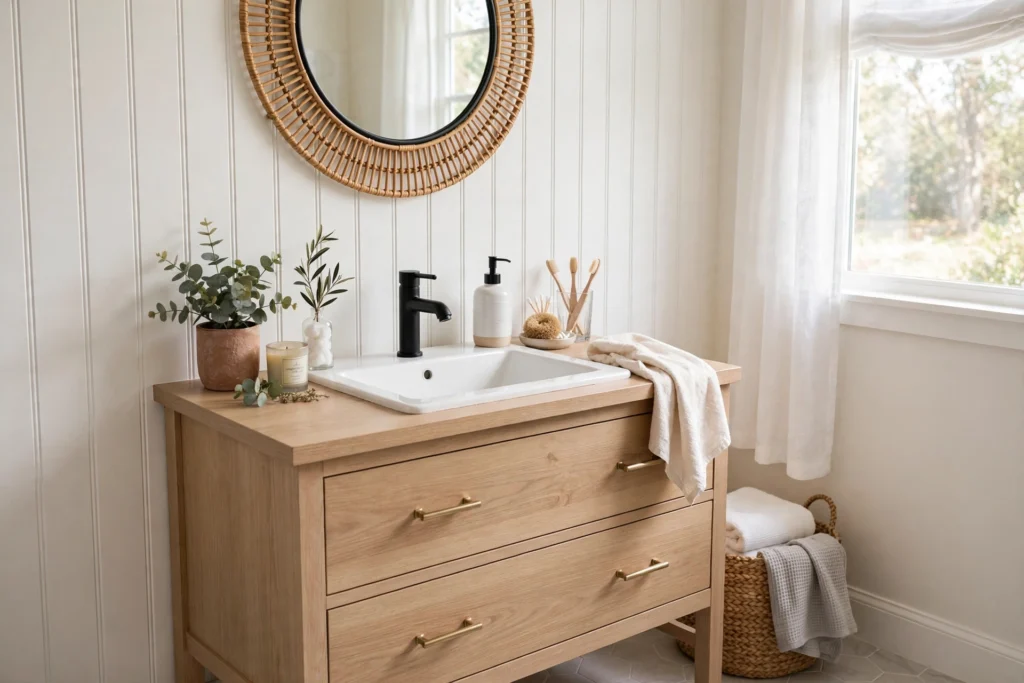
Renters can get the beadboard look with peel-and-stick panels — lightweight PVC or vinyl sheets with adhesive backing that apply over clean painted drywall and remove without damage. Look for panels explicitly rated for humid rooms; standard versions can peel at the edges in a steamy bathroom. Cost runs $2–$5 per square foot.
Prep the wall with rubbing alcohol and let it dry fully. Start at the most visible corner, press firmly with a J-roller, and butt seams tightly — the bead pattern disguises seams if you align the grooves. In a rental, a beadboard wainscot behind the toilet or vanity delivers the most impact for the least material.
When you move out, warm each panel with a hair dryer and peel slowly downward. The underlying paint should survive intact. It is the lowest-commitment way to test the beadboard look — and these bathroom beadboard ideas prove the style is worth testing. As the beadboard entry on Wikipedia notes, this grooved paneling has decorated homes for over a century, and the renter version keeps that tradition accessible.
Frequently Asked Questions
Is beadboard OK in a bathroom with a shower?
Yes, with the right material. PVC beadboard is impervious to moisture and the safest choice near a shower or tub; it looks identical to painted wood once installed. Real wood beadboard is fine on walls away from direct spray if sealed with semi-gloss bathroom paint and the room is ventilated, but never install wood or MDF beadboard inside the shower enclosure itself. For a detailed look at moisture-safe paneling options, see This Old House’s guide to installing beadboard in a bathroom.
What is the difference between beadboard and shiplap?
Beadboard is narrow vertical tongue-and-groove paneling (2.5–3 inch boards) with a small rounded bead between grooves, creating a fine, rhythmic texture. Shiplap is wider horizontal boards (5–7 inch exposed face) with overlapping rabbet joints and thin shadow lines. Beadboard reads as delicate and cottage-y; shiplap reads as bolder and more rustic. Both come in moisture-proof PVC versions suitable for bathrooms.
How much does it cost to install beadboard in a bathroom?
DIY beadboard on a single 8×8-foot wall costs roughly $120–$350. PVC 4×8 sheets run $30–$45 each (two sheets cover an 8×8 wall), plus $40–$60 for primer, paint, and caulk, and basic tools most DIYers own. Professional installation adds $3–$6 per square foot of labor. Individual tongue-and-groove boards cost more in both materials and labor time than sheets.
Should bathroom beadboard be painted with flat or glossy paint?
Always use satin or semi-gloss in a bathroom — never flat. Flat paint absorbs moisture, stains easily, and is nearly impossible to wipe clean in a steamy room. Semi-gloss is the most durable and highlights the bead profile beautifully; satin is a good compromise if you find semi-gloss too shiny. Use paint formulated for kitchens and bathrooms, which contains mildewcide.
Can you put beadboard over existing tile?
It is not recommended. Beadboard needs a flat, stable substrate to nail or glue to, and tile’s grout lines create an uneven surface that will telegraph through thin panels. The adhesive bond to glazed tile is also unreliable in humidity. If you want beadboard where tile exists, the tile should be removed first, or the beadboard should be installed on furring strips over the tile — which eats 1–1.5 inches of room depth and looks awkward at edges.
Keep Exploring
Beadboard brings a century of cottage charm to bathroom walls, and the PVC versions make it as practical as it is pretty. Whether you go full-height white, bold navy, or a simple wainscot, the fine grooves add a texture that flat walls cannot match. Start with the wall you see first when you walk in — it will change how the whole room feels.