

There is a reason mid-century modern never really left. The style’s clean lines, warm woods and honest materials were made for the way we work today: focused, calm and quietly stylish. A workspace built around teak, tapered legs and thoughtful geometry doesn’t just look good on a video call — it genuinely helps you settle into deep work.
Below, you’ll find 15 mid-century modern home office design ideas that bring vintage charm to a modern workday. Each one pairs a specific furniture choice or styling move with the practical detail that makes it work, so you can borrow a single idea or build the whole look from the ground up.
1. Start With a Teak Writing Desk
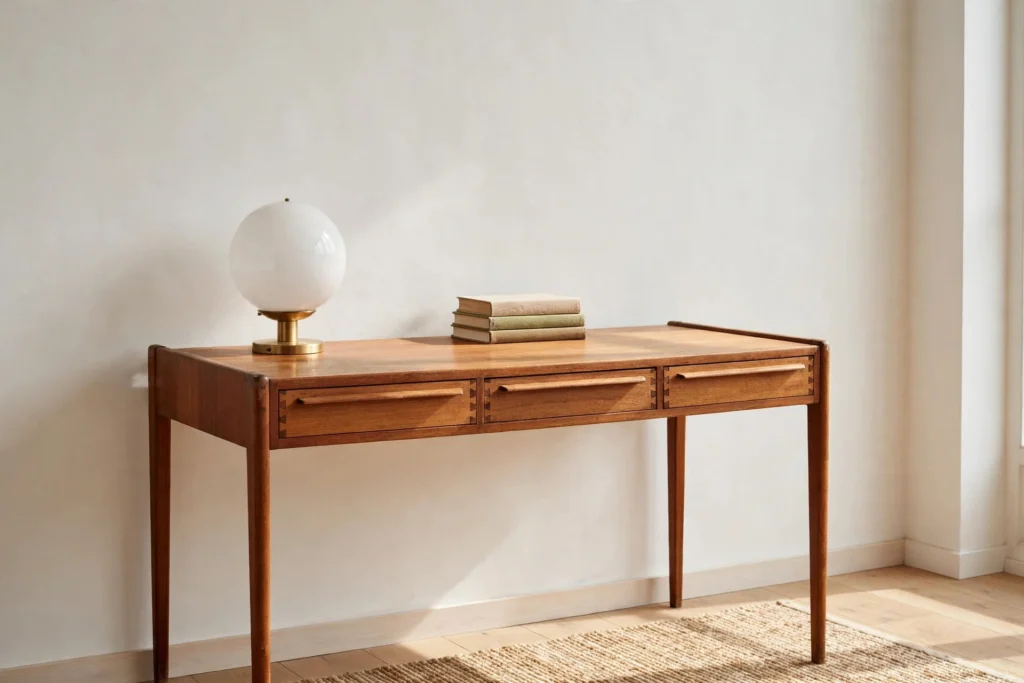
The single most important move in a mid-century modern office is the desk itself, and teak is the wood that defines the era. A vintage Danish teak writing desk with a slim profile, warm honey-brown grain and maybe a bank of shallow drawers gives you a work surface that doubles as the room’s hero piece. Look for pieces with dovetailed drawers and a solid edge — the kind of build quality that explains why these desks survive sixty years and still sell for real money.
Size the desk to your actual work: about 48 inches wide is the sweet spot for a laptop setup plus a notebook and lamp, while 60 inches suits a dual-monitor arrangement. Keep the desktop styled to a minimum — a globe lamp, a small stack of books and a pen cup — so the teak grain itself stays visible. If vintage prices scare you, mid-century-inspired reproductions in stained acacia or walnut veneer capture the look at a fraction of the cost.
2. Pair It With a Tapered-Leg Desk Chair
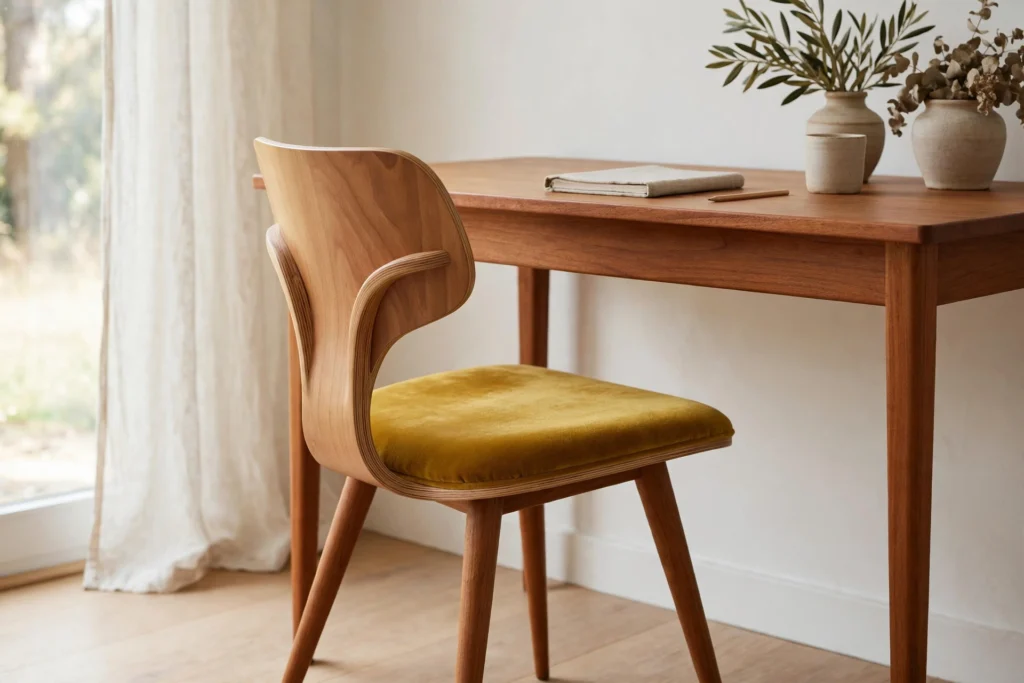
A mid-century office lives or dies on its silhouette, and nothing says the era like a chair with tapered, splayed wooden legs. Choose a desk chair with a sculpted plywood or molded fiberglass back — a design in the spirit of Eames or Danish lounge seating — upholstered in mustard, cognac or warm gray. The chair becomes a sculptural accent when you’re not sitting in it, which is half the point.
Comfort still matters, so test seat depth and lumbar support before committing; many vintage-style chairs look better than they sit. A cushion on the seat and a slight recline in the backrest make long work sessions manageable. Rolling office chairs rarely fit the aesthetic, so if mobility matters, add felt glides to the chair legs so it slides easily across a rug or hard floor without scratching.
3. Hang a Starburst Clock as Your Wall Anchor
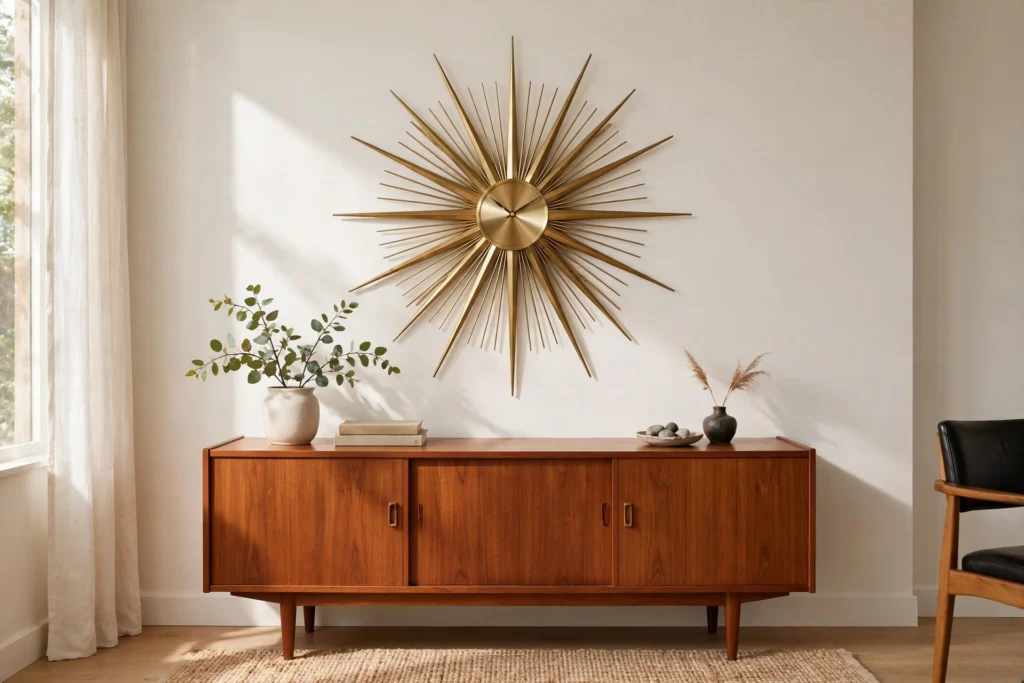
The starburst clock is the single fastest way to telegraph mid-century style. Its radiating brass or walnut rays over a clean clock face add movement and geometry to a blank wall without competing with the work happening below. Hang one large starburst piece — about 24 to 30 inches across — centered above the desk or a sideboard so it reads as intentional art rather than decoration.
Position it so you can actually read the time from your chair; that’s what makes it more than wall candy. Brass-finish starbursts warm up cooler wall colors like sage or soft gray, while walnut rays blend into wood-paneled walls for a subtler effect. If you’re sourcing vintage, check that the quartz movement still runs — most take a single AA battery and a replacement movement costs less than a lunch.
4. Add a Bold Abstract Print Above the Desk
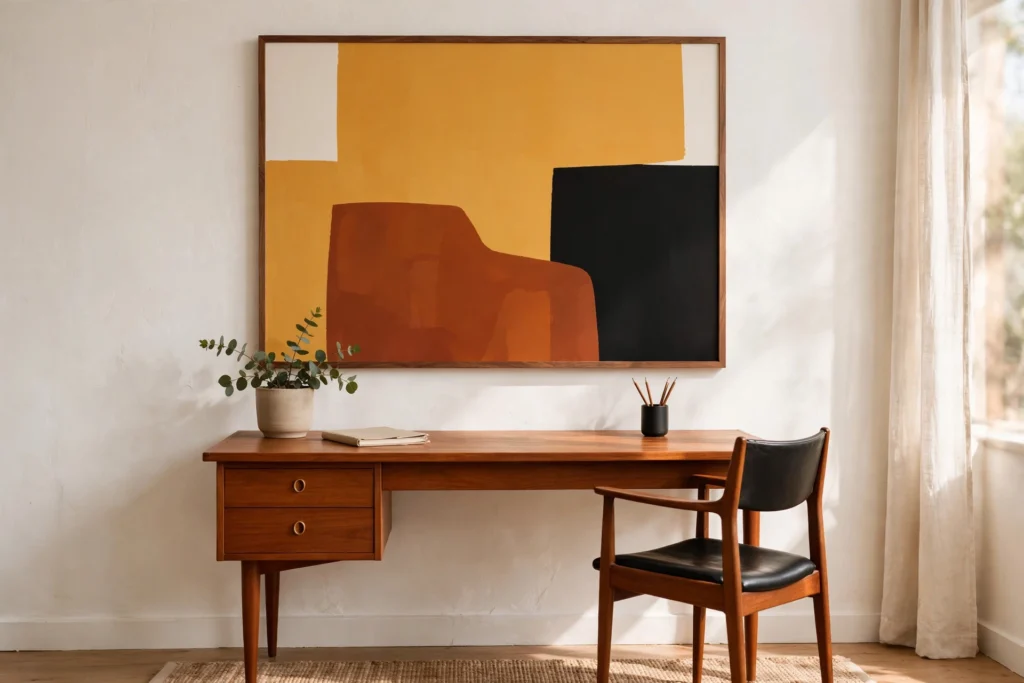
Mid-century modern interiors love confident, graphic art, and a bold abstract print above the desk gives your office a focal point that energizes the whole corner. Look for reproductions of the era’s giants — geometric Rothko-style color fields, Alexander Calder-style compositions, or simple mid-century color-block prints in ochre, rust, olive and black. A single large piece beats a gallery wall here; the style is about restraint.
Frame it in a thin natural-wood or black metal frame and hang it so the bottom edge sits about 8 to 10 inches above the desktop — low enough to feel connected to the workspace. Match one color from the print to an accent in the room, like a mustard cushion or a rust-toned rug, and the whole space will feel composed rather than collected by accident.
5. Layer in Mustard Accents
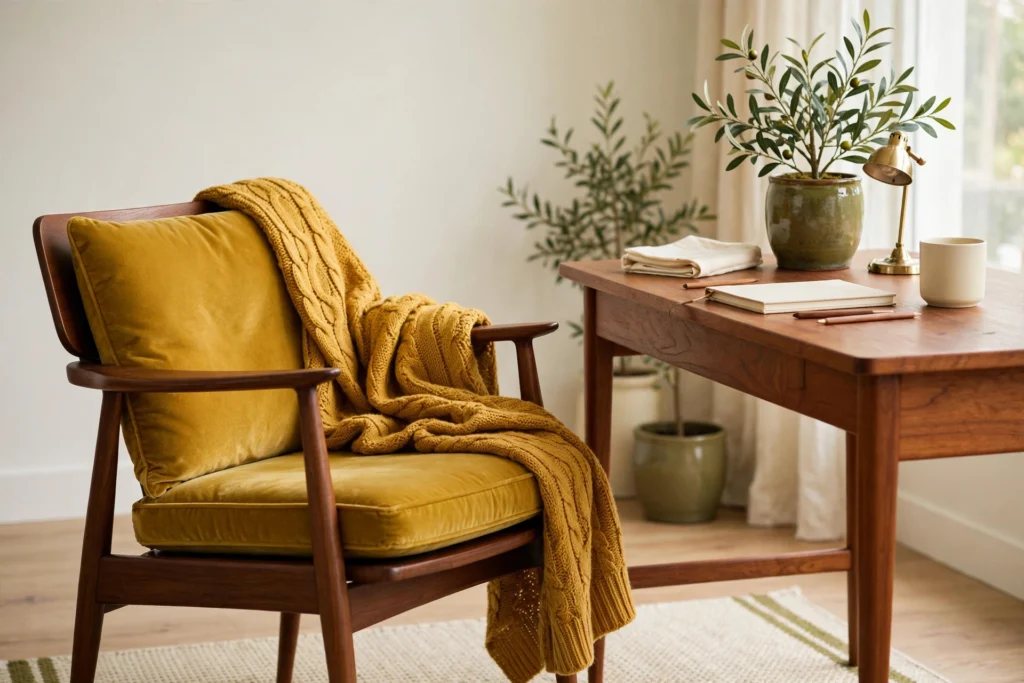
Mustard — that golden, turmeric-leaning yellow of the 1960s — is the era’s signature accent color, and it’s exactly what keeps a wood-heavy office from feeling flat. Introduce it in upholstery or textiles rather than walls: a mustard velvet desk chair, a knitted throw over the reading chair, or patterned cushions on a window seat. Against teak and walnut, mustard glows like sunlight.
Because it’s a strong color, ration it. Two to three mustard moments per room is the rule — a chair plus a throw plus maybe a book spine or a small ceramic — so the accent stays punchy instead of overwhelming. Pair mustard with deep olive, walnut brown and off-white walls for the authentic palette, and avoid adding a second loud color like teal unless you’re going for a deliberately bolder 1970s edge.
6. Light the Desk With a Globe Lamp
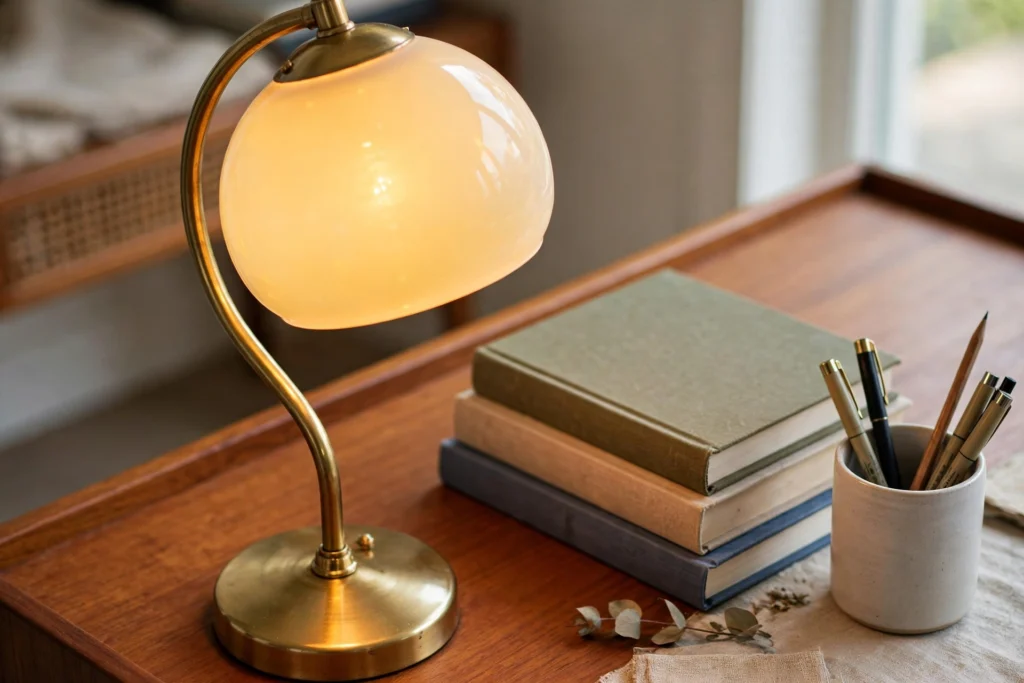
Mid-century lighting is sculptural, and a globe lamp — the classic opal-glass sphere on a brass or walnut stem — is the era’s most iconic desk accessory. It throws a soft, diffuse pool of light that flatters video calls and reduces eye strain, and when switched off it’s still a beautiful object. Place it at the back corner of the desk so it lights your work without bouncing glare off the screen.
Look for lamps with a dimmable warm LED bulb (2700K is ideal) so the light feels like the era’s incandescent glow without the heat. For a bigger statement, pair the desk globe with a matching arc floor lamp or a starburst pendant overhead — the repetition of round forms is a very mid-century move. Genuine 1960s globes turn up regularly at thrift stores; check the wiring before plugging one in.
7. Hide the Mess in a Danish Sideboard
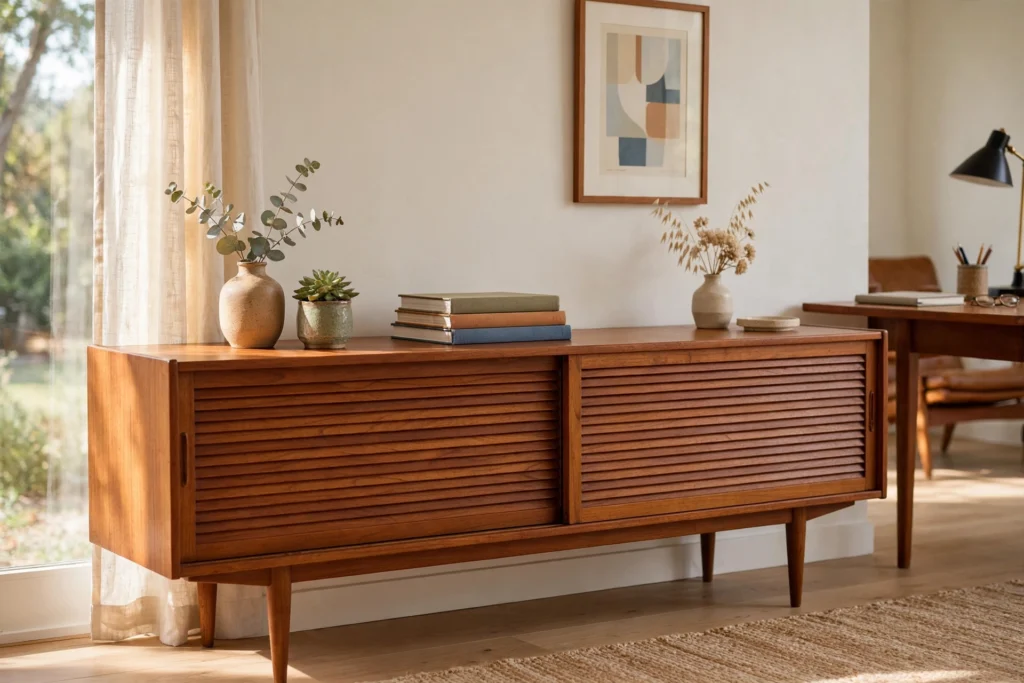
Paperwork, printers and chargers have no place in a curated vintage workspace, which is why a Danish teak sideboard is the office’s secret weapon. Its long, low profile with sliding doors swallows office clutter while its surface gives you a styling ledge for a stack of art books, a small plant and maybe that starburst clock. The piece’s tapered legs keep it visually light even at 72 inches wide.
Use the interior deliberately: label trays or shallow boxes for documents, one shelf for tech accessories, and a hidden corner for the printer with a cable port cut in the back panel. Position the sideboard along the wall behind or beside the desk so supplies stay within arm’s reach. Because these sideboards are collectible, buy the best condition you can afford — warped sliding doors are the one flaw that’s hard to live with.
8. Carve Out a Sculptural Reading Corner
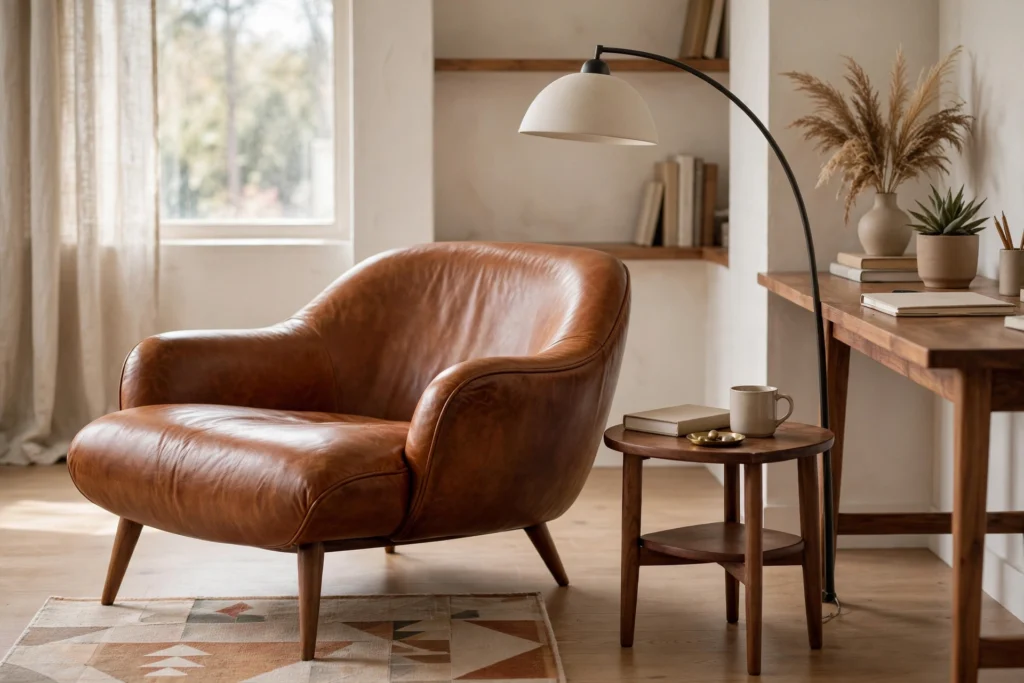
Mid-century modern is as much about the pauses as the work, so give yourself a reading corner anchored by a sculptural lounge chair — think a wishbone-style chair or a low-profile lounge chair in leather or boucle. Tuck it into an unused corner with a small walnut side table and a floor lamp, and suddenly the office has a spot for reading briefs, taking calls or just thinking.
Keep the footprint tight: a lounge chair, a 15-inch side table and a lamp fit in about four square feet. Layer a small geometric rug under the chair to define the zone, and hang a single framed print at eye level from the seated position. This corner also does double duty on video calls — angled into frame behind you, it makes a far more interesting backdrop than a blank wall.
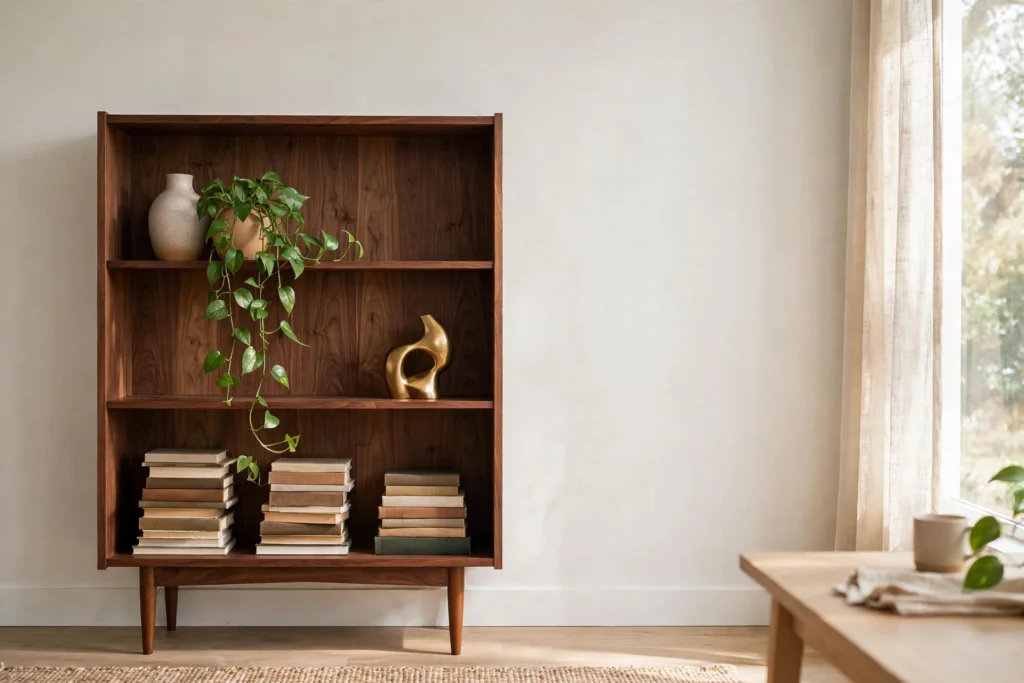
9. Style a Walnut Bookcase With Breathing Room
A walnut bookcase is the backbone of a mid-century office, but the styling is what makes it look curated instead of cramped. Arrange books in uneven stacks — some vertical, some horizontal — and leave about a third of each shelf empty for negative space. Fill the gaps with one object per shelf: a ceramic vase, a small brass sculpture, a trailing plant, a framed vintage photograph.
Group books by color or size rather than topic for a calmer, more graphic look; the spines become texture instead of visual noise. If your bookcase has a record of tall shelves, break the height with a leaning piece of art on one shelf or a small stack topped with a globe lamp. The rule is restraint: every object should earn its shelf, and anything that doesn’t gets relocated to the sideboard.
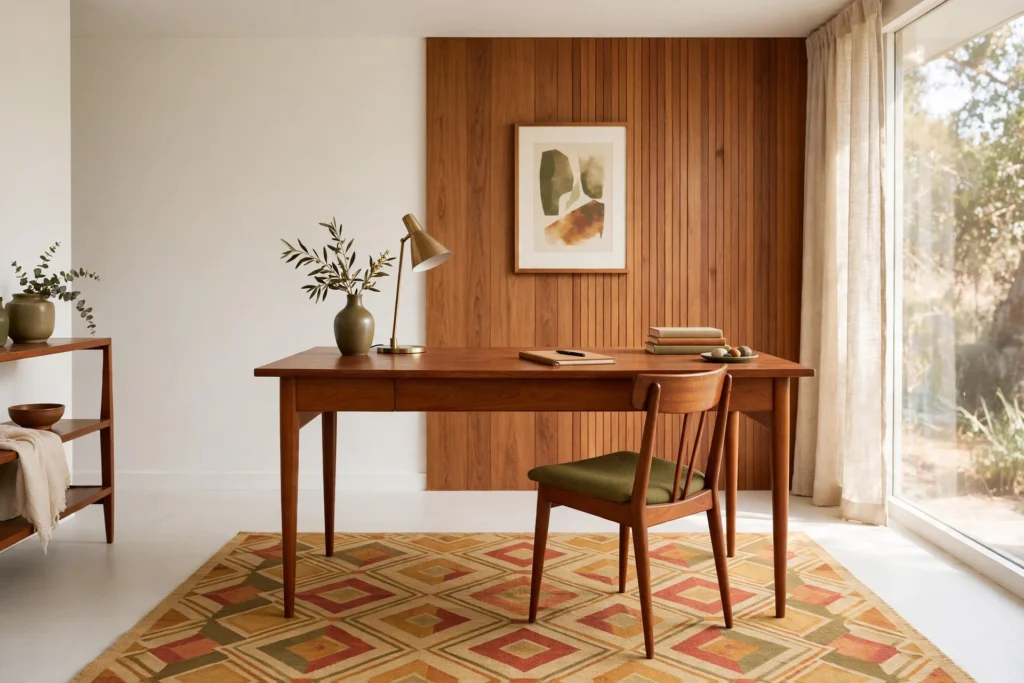
10. Ground the Room With a Warm Geometric Rug
A mid-century office floats on a good rug. Choose a low-pile geometric pattern in warm tones — ochre, rust, terracotta, olive — that picks up the wood tones of the desk and sideboard. A 5×8 rug under the desk area is the standard size: it anchors the desk and chair legs while leaving the sideboard on the bare floor, which keeps the layout from feeling carpeted over.
Low pile is a practical choice, not just an aesthetic one — desk chair legs slide cleanly and casters don’t snag. Flatweave wool or a wool-cotton blend holds up best to daily use and cleans easily. Position the rug so the front two legs of the desk chair sit on it even when pushed back; that little detail is what makes the rug feel connected to the furniture instead of randomly dropped.
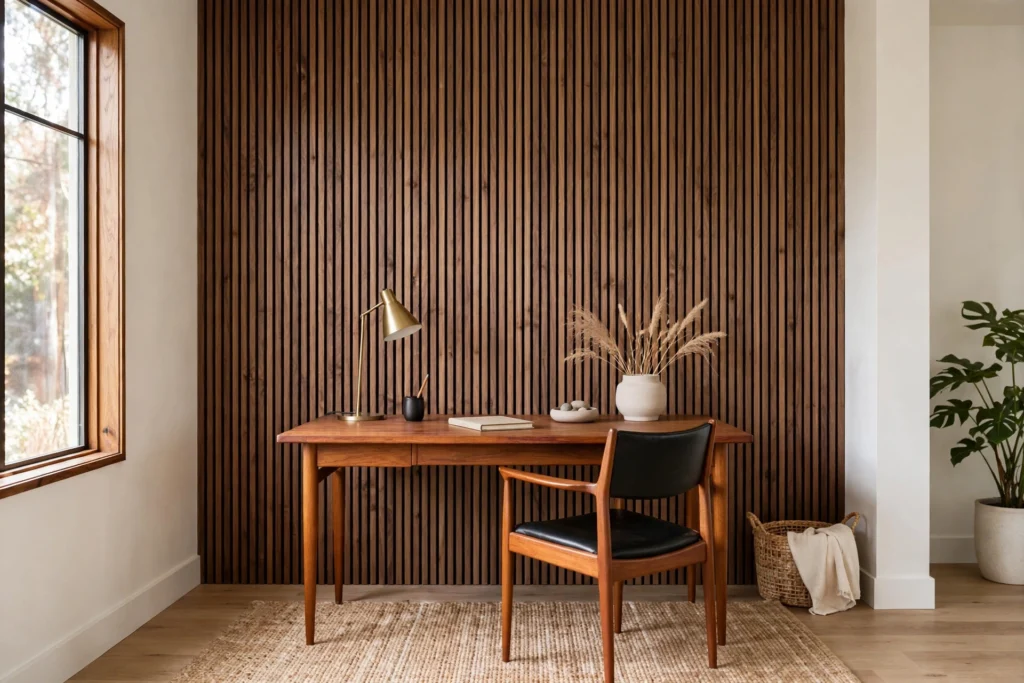
11. Warm Up the Walls With Wood Paneling
Nothing says vintage mid-century like warm wood on the walls. If full paneling feels like too much commitment, try a single wood-slat accent wall behind the desk — walnut or teak-look slats spaced about half an inch apart give you the era’s texture without darkening the room. The vertical lines draw the eye up, which makes modest offices feel taller and more deliberate.
For renters or the commitment-shy, walnut-look peel-and-stick panels or a large walnut-veneer room divider achieve most of the effect with zero demolition. Balance the wood with plenty of off-white or warm-gray wall elsewhere so the room stays light; mid-century interiors were never cave-dark. This wall becomes the natural backdrop for your video calls, so plan it like a stage set.
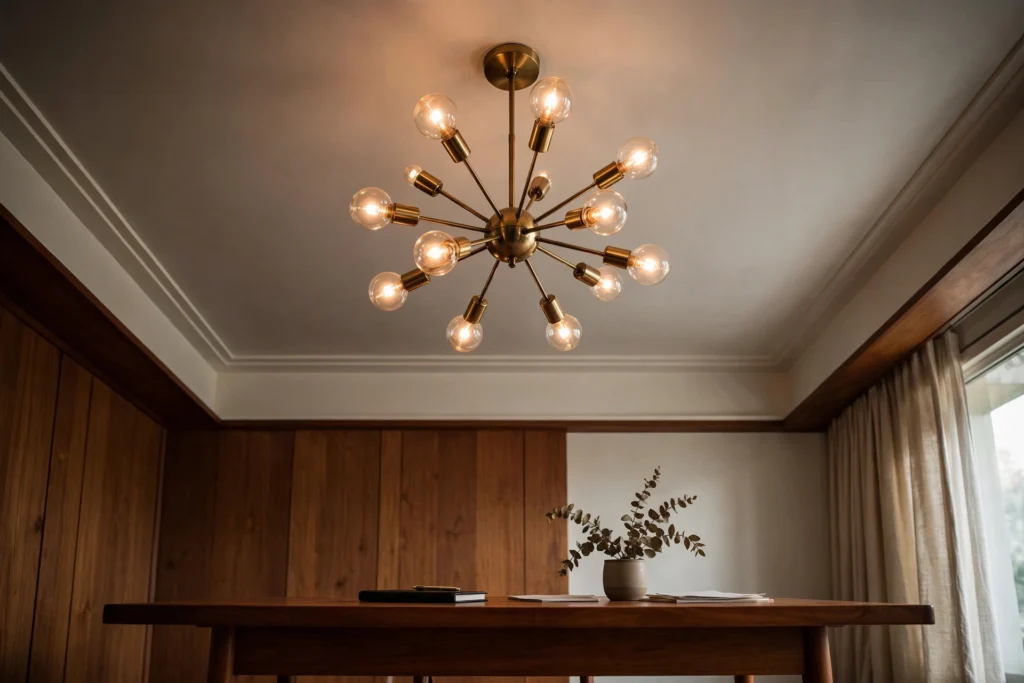
12. Make a Statement With a Sputnik Chandelier
Overhead lighting is where mid-century modern shows off, and a sputnik chandelier — the exploding-star fixture of brass rods and globe bulbs — is its crown jewel. Hung centered over the desk or the middle of the room at about 30 inches above the desktop, it fills the ceiling’s dead space and throws an even, starry light across the workspace. Scale it to the room: a 20-inch fixture suits a small office, while larger rooms can take 30 inches or more.
Modern reproductions with integrated LED bulbs solve the era’s heat and dimmer problems — just make sure it’s dimmable, because a sputnik at full blast can feel clinical. If the ceiling fixture feels like too much, a sculptural pendant with a single large globe gives a similar mid-century note with less visual weight. Either way, the fixture should be visible in your video-call background; it’s instant character.
13. Accessorize With Honest Vintage Objects
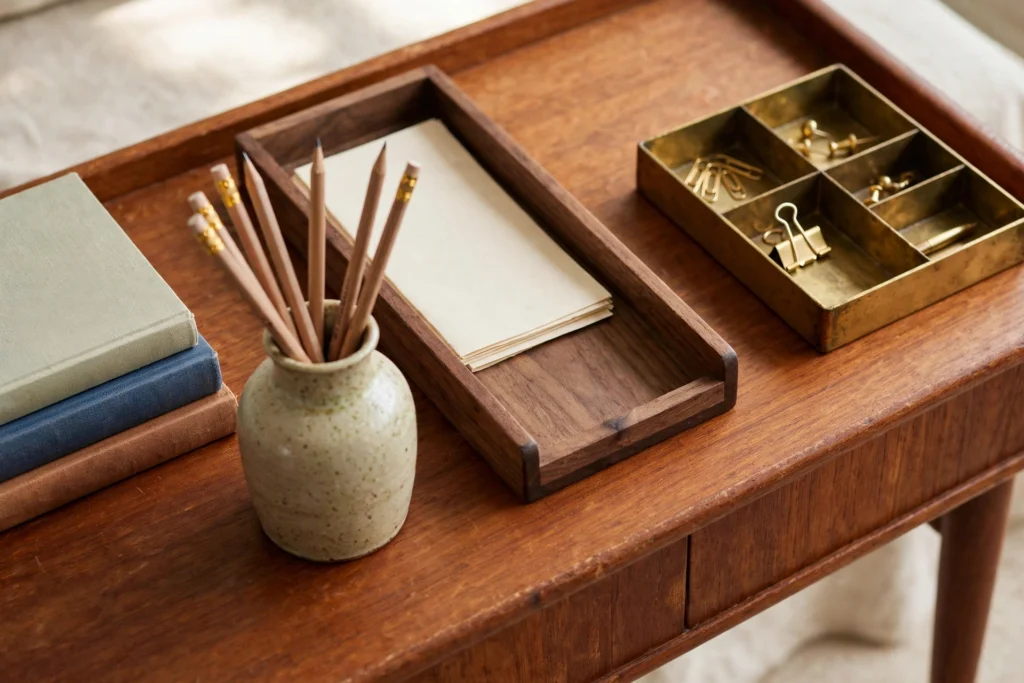
Mid-century modern rewards objects with a job to do. Hunt for accessories that are both decorative and useful: a brass desk organizer, a walnut letter tray, a rotary phone repurposed as a pen holder, a 1960s ceramic vase holding your pencils. Each piece adds patina and story without turning the desk into a display case.
Thrift stores, estate sales and flea markets are the real sourcing strategy — arrive early, check drawers for dovetails and look for maker’s stamps on the underside. But cap the collection: five to seven accessories across the whole office is plenty. When everything is vintage, nothing stands out; mix the genuine finds with clean modern basics so the room feels lived-in rather than like a museum set.
14. Soften the Geometry With an Indoor Plant
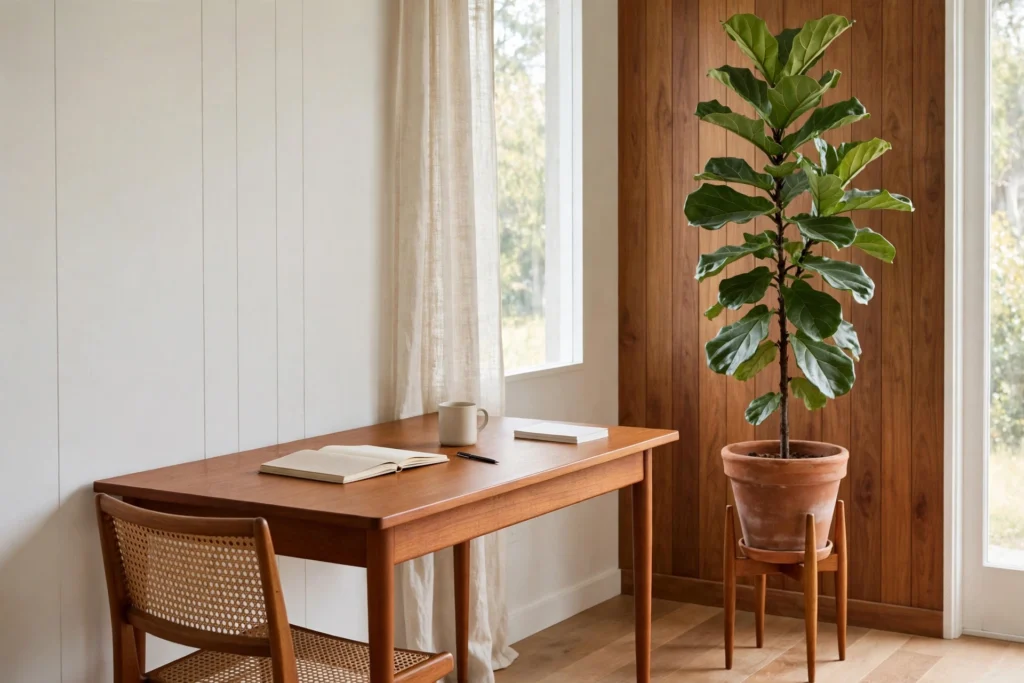
All that geometry — starbursts, geometric rugs, angular furniture — needs a soft, organic counterpoint, and a plant is the easiest way to provide it. A fiddle-leaf fig or a bird of paradise echoes the mid-century love of large, architectural leaves, while a trailing pothos draped from the bookcase softens straight shelf lines. The greenery also genuinely improves the room: studies consistently link visible plants to lower stress during focused work.
Choose the plant to match your light. A bright corner near the window suits the fiddle-leaf; a darker shelf suits a snake plant or ZZ. Pot it in a terracotta or cream ceramic planter — never a plastic nursery pot left visible — and sit it on a small wooden plant stand with tapered legs to keep the era’s silhouette consistent. One large plant beats five small ones in a mid-century scheme.
15. Bridge Eras With Warm Retro-Modem Tech
The final trick is making modern technology feel at home among vintage pieces. Choose tech accessories in warm materials — a walnut monitor stand, a brass desk lamp with USB charging, a leather cable tray, a mechanical keyboard with warm beige keycaps. Hide the rest: run cables through a teak cable box or behind the sideboard, and park the printer inside that sideboard we talked about.
A monitor on an arm clamped to the desk’s back edge frees the teak surface and looks intentional rather than bolted-on. Even your router can disappear — tuck it behind the bookcase or inside a louvered walnut box so its blinking lights don’t puncture the vintage spell. The goal is a workspace that feels like 1965 but performs like today.

Frequently Asked Questions
What are the defining features of mid-century modern home office design?
The core elements are warm woods like teak and walnut, clean straight lines, tapered and splayed legs, and functional sculptural forms. The palette leans on mustard, olive, rust and warm neutrals, while lighting — globe lamps, starburst pendants, sputnik chandeliers — acts as decor. Furniture is low-profile and uncluttered, every piece earning its place, which is why the style translates so well to focused work.
How do I decorate a mid-century modern home office on a budget?
Focus your money on the desk — a solid mid-century-inspired desk in walnut or teak-look finish anchors everything else. Save by thrifting the iconic accessories: starburst clocks, globe lamps and ceramic vases turn up cheap at estate sales. Use geometric low-pile rugs and bold abstract prints in simple frames for big visual impact at low cost, and let one statement piece (like a sculptural chair) carry the vintage feel.
What colors work best in a mid-century modern office?
Start with warm woods and off-white or warm-gray walls, then layer the era’s signature accents: mustard, olive green, burnt orange or rust, and touches of black. Keep accent colors to two or three per room so the space feels curated rather than loud. Mustard pairs especially well with teak and walnut, while olive softens the scheme if you want a calmer, more neutral vintage office.
Can I mix mid-century modern with contemporary office furniture?
Yes — the best mid-century modern home office design ideas actually blend eras. Keep the vintage character in the statement pieces (desk, chair, lighting, art) and let contemporary items handle the invisible work: an ergonomic monitor arm, a slim laptop stand, hidden cable management. Choosing modern tech accessories in warm materials like walnut and brass makes the mix feel deliberate instead of mismatched.
Keep Exploring
A mid-century modern office is never really finished — it’s a style that rewards the slow hunt, the weekend flea-market trip, the perfectly thrifted globe lamp. Start with the desk and the light, layer in your mustard accents and vintage finds one at a time, and let the room earn its character the way the originals did: gradually, honestly and built to last.
Keep exploring: mid-century modern living room ideas, Japandi home office ideas, and Scandinavian home office ideas for more vintage inspiration.





[…] will spend hours in your office chair, so comfort comes first — but a vintage wooden chair with a good cushion delivers both comfort and farmhouse character. Look for a sturdy oak desk […]
[…] mahogany, or a deep espresso-stained piece — a partners desk, a campaign-style writing desk, or a vintage library table with drawers. A leather inlay top is the classic dark academia touch, and it doubles as a writing […]
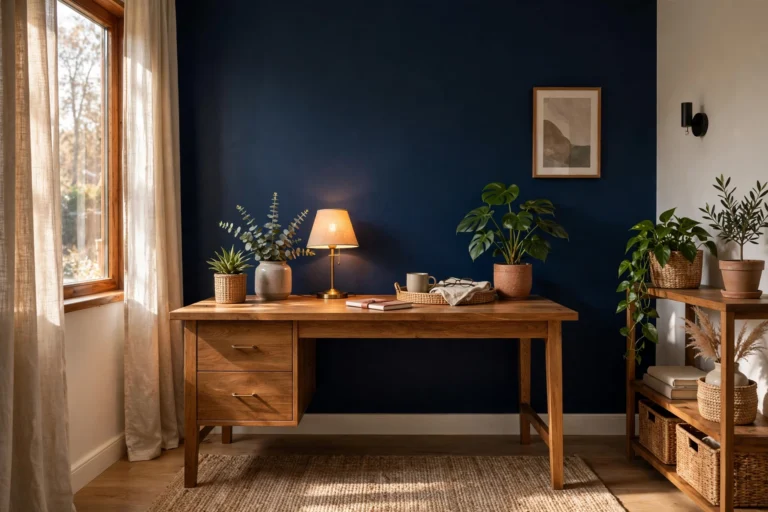
[…] the lit desk and the shadowed room is the whole effect. For a related take on period lighting, our 15 Mid-Century Modern Home Office Design Ideas With Vintage Style shows how globe lamps and brass fixtures carry the same warm […]