
Your hallway is the first thing guests see and the last thing they remember — yet it is the room most of us treat like an afterthought. A bare passage wastes some of the most walked-through square footage in the house, but the best hallway design ideas prove that even a narrow corridor can be beautiful, functional, and full of personality. With the right mix of color, texture, light, and smart storage, a plain pass-through becomes a destination in its own right.
From layered runner rugs and gallery walls to built-in storage and statement lighting, these fifteen hallway design ideas cover every style and budget. Whether your hallway is long and narrow, dark and windowless, or wide enough to work a little harder, there is a move here that will make the most of your passage — without a renovation-sized investment.
1. Lay a Runner Rug That Leads the Eye
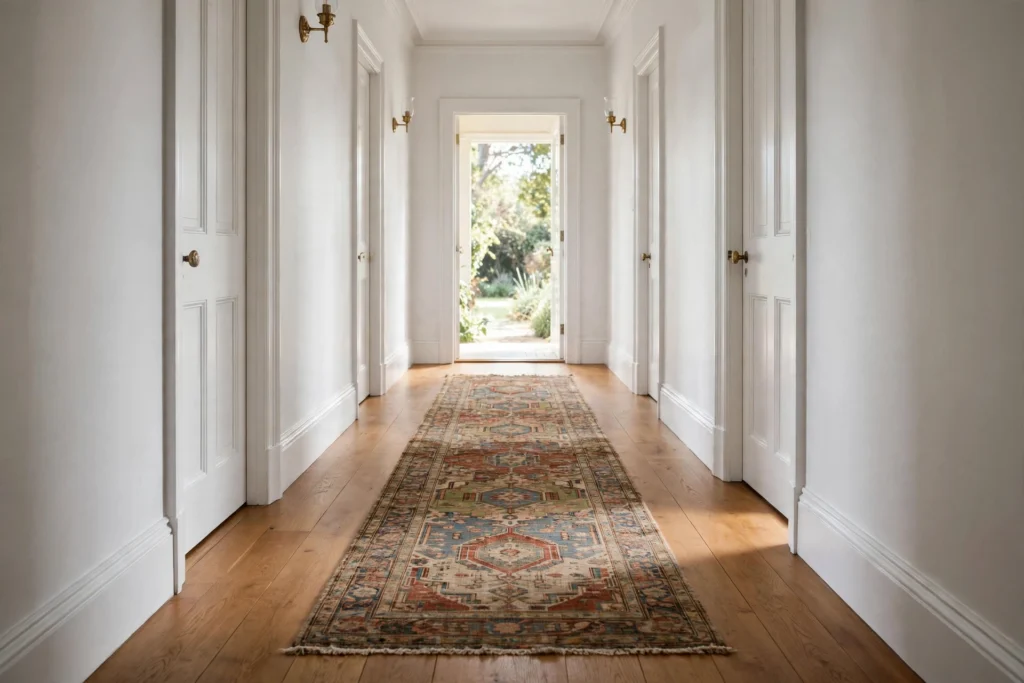
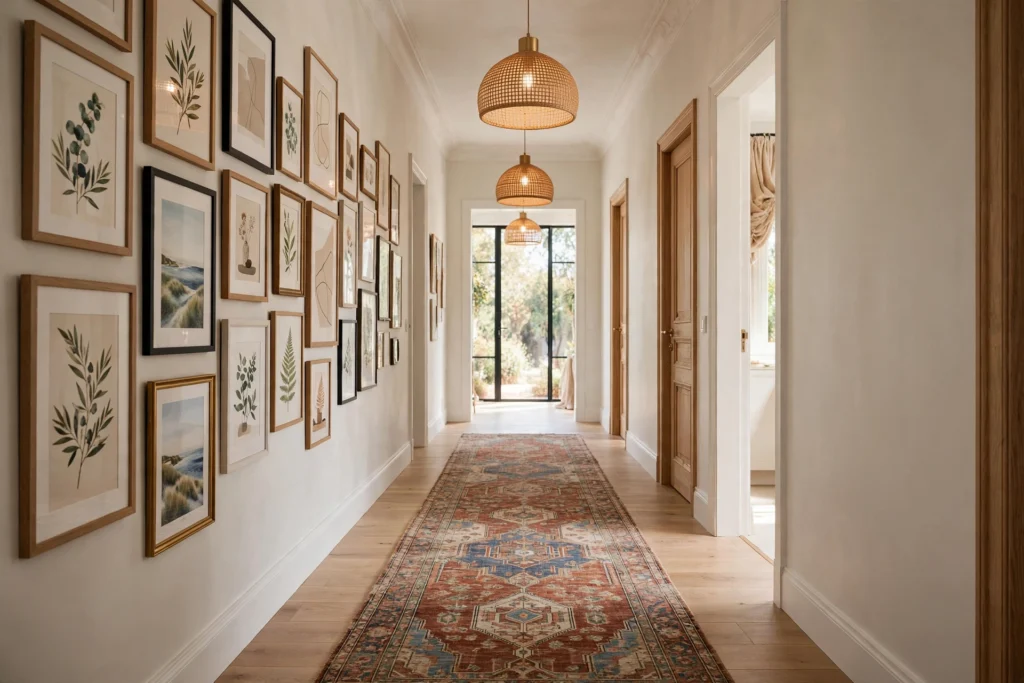
A runner is the single fastest way to transform a bare hallway. It softens hard floors, muffles footsteps, and visually guides visitors from one end of the passage to the other, making the whole corridor feel intentional rather than accidental. Choose a runner that spans nearly the full length of the hallway, leaving just a few inches of floor visible at each end — a rug that is too short chops the space up and makes it feel choppier than it is.
Pattern matters in a hard-working corridor. A busy vintage-style pattern hides footprints and everyday dirt far better than a flat weave in a pale color, which is why washable runners have become a hallway staple. For a cohesive look, pull one color from the runner into your wall paint or artwork. And if your hallway is especially narrow, keep the runner centered with a bit of floor showing on each side; wall-to-wall coverage in a tight space can make the passage feel even narrower.
2. Build a Gallery Wall That Tells a Story
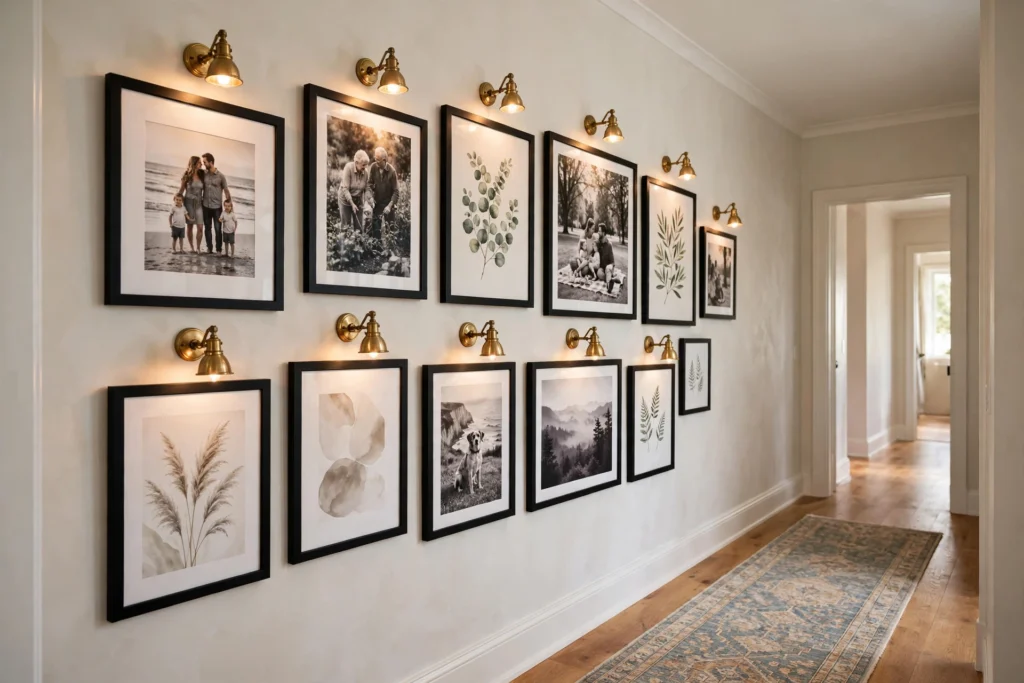
A gallery wall turns a blank corridor into a personal exhibition. Because hallways are viewed at close range and in motion, they are actually the ideal spot for a curated mix of art, photography, and keepsakes — people slow down to look. Start by laying your arrangement on the floor first, playing with spacing until the rhythm feels right, then transfer it to the wall one frame at a time. Keeping frames within a consistent palette — all black, all natural wood, or all brass — gives even a very eclectic mix a pulled-together feel.
Hang the center of your arrangement at eye level, roughly 57 inches from the floor, so it reads naturally as you walk past. Mix frame sizes but keep the gaps between them even, around two to three inches. If you rent or dislike patching holes, picture ledges let you lean art and swap pieces with the seasons. The result is a hallway that feels collected over time rather than decorated in a weekend.
3. Add Wainscoting for Instant Architecture
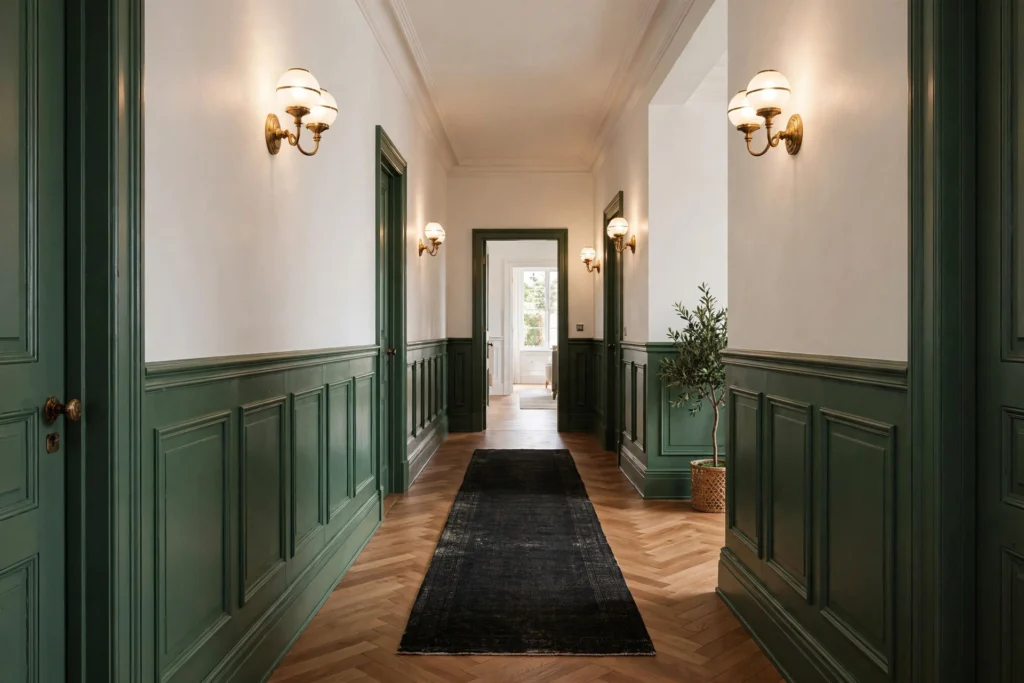
Wainscoting is one of those hallway design ideas that adds instant character to an otherwise forgettable corridor. Board-and-batten, beadboard, or simple picture-frame molding breaks up long expanses of blank wall, adds shadow lines that create depth, and makes even a builder-basic hallway feel finished and deliberate. It is also a practical choice: the lower portion of hallway walls takes the most abuse, and wainscoting in a durable, scrubbable paint stands up to scuffs far better than plain drywall.
Paint the wainscoting a different color from the upper wall for maximum impact — a deep green or navy below with warm white above is a classic pairing that never feels dated. Alternatively, color-drench the whole hallway in one rich shade for a moody, cocooning effect that works beautifully in windowless passages. The Spruce’s roundup of narrow hallway ideas also highlights wainscoting as a smart way to pair pattern with paint — run wallpaper on the upper wall and wainscoting below to get the patterned look for less. Read more at The Spruce’s 30 narrow hallway ideas.
4. Go Bold With Color, Even in a Small Passage
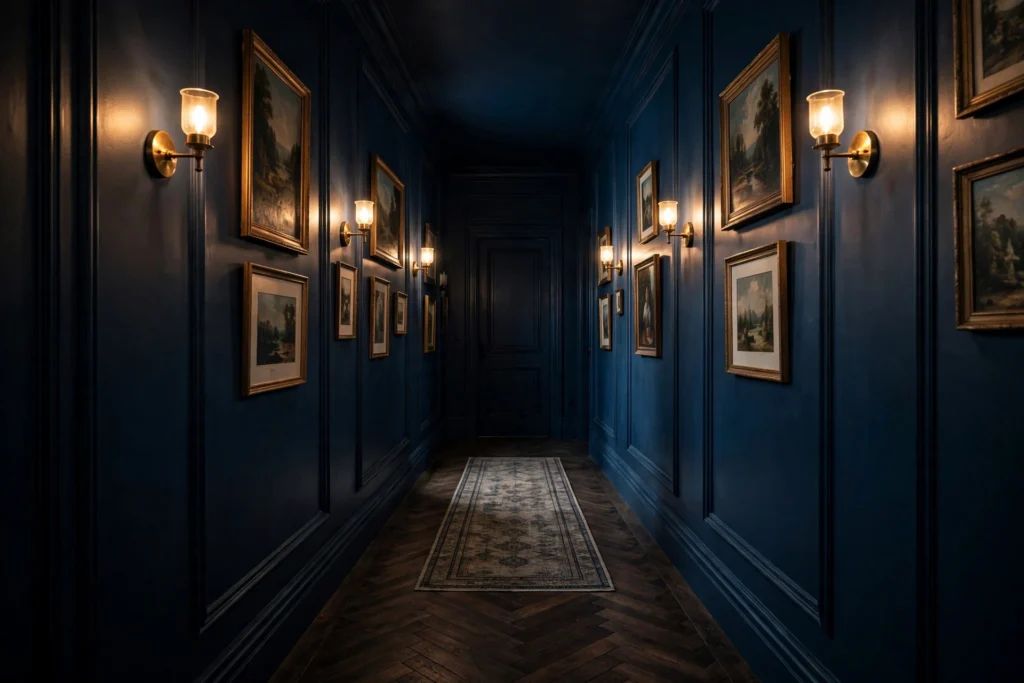
Conventional wisdom says small spaces need white walls, but a hallway with no windows and white paint can feel flat and gloomy rather than airy. Embracing a bold color — inky blue, forest green, terracotta, or even near-black — turns a dark passage into a deliberate, dramatic moment instead of a failed bright one. Dark walls also make artwork and mirrors pop and give lighting a warm, gallery-like glow in the evening.
If full saturation feels like a leap, try the two-tone trick: paint the lower third or half of the wall in your bold color and keep the upper portion light, separated by a simple chair rail or even just a clean painted line. You can also test a bold shade on the far end wall only, which draws the eye forward and makes the hallway feel longer. For more ways to set the tone at the threshold, see our 15 entryway decor ideas for a warm, welcoming entrance.
5. Hang a Statement Pendant or a Row of Sconces
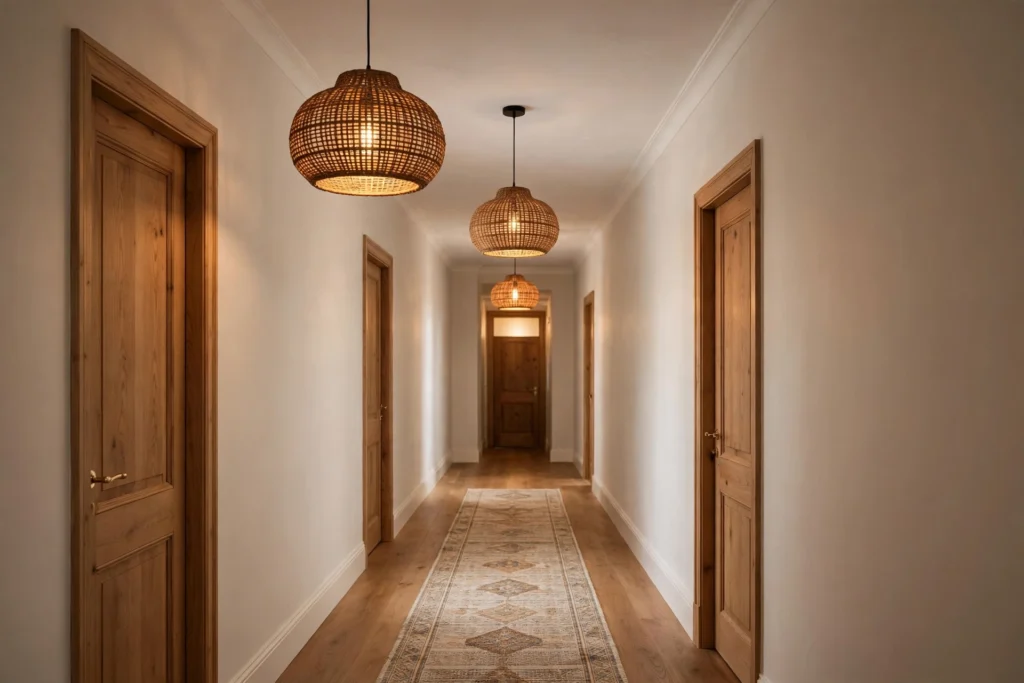
Hallway lighting is often a single sad flush-mount in the middle of the ceiling — functional, but hardly inspiring. Swapping it for a statement pendant instantly gives the corridor a focal point and sets the design tone for the whole home. In a long hallway, hang two or three smaller pendants in a row at even intervals to create rhythm and pull the eye down the passage; in a short hall, one sculptural pendant is all you need.
Wall sconces are the other secret weapon. They wash the walls with flattering, glare-free light and double as decor, especially in fluted glass or aged brass finishes. Space them evenly along the corridor and keep them at roughly the same height — about 60 to 66 inches from the floor. Wherever possible, put hallway lighting on a dimmer so you can shift from bright daytime function to a soft evening glow that makes the whole house feel calmer.
6. Use Mirrors to Double the Space Visually
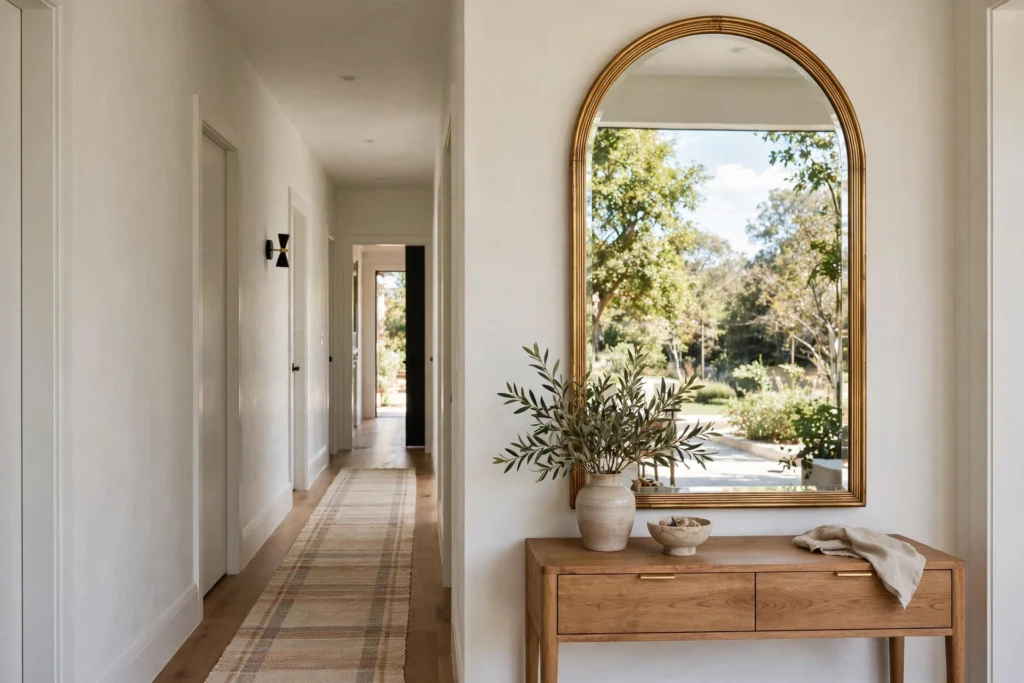
A well-placed mirror is the oldest trick in the small-space playbook, and hallways benefit more than almost any room. Hung opposite a window or a light source, a mirror bounces daylight deep into a windowless corridor and makes the walls feel twice as far apart. A full-length mirror is especially effective: it reflects the full run of the passage, which visually extends the hallway and gives you a last-look spot before heading out the door.
Choose a mirror with a frame that echoes your decor — arched brass for a soft traditional look, thin black metal for modern minimalism, or reclaimed wood for rustic warmth. In a very narrow hall, skip the floor-leaning option and hang the mirror flat to keep the walking path clear. A series of small round mirrors clustered together can achieve a similar brightening effect with more personality than one large rectangle.
7. Style a Slim Console Table
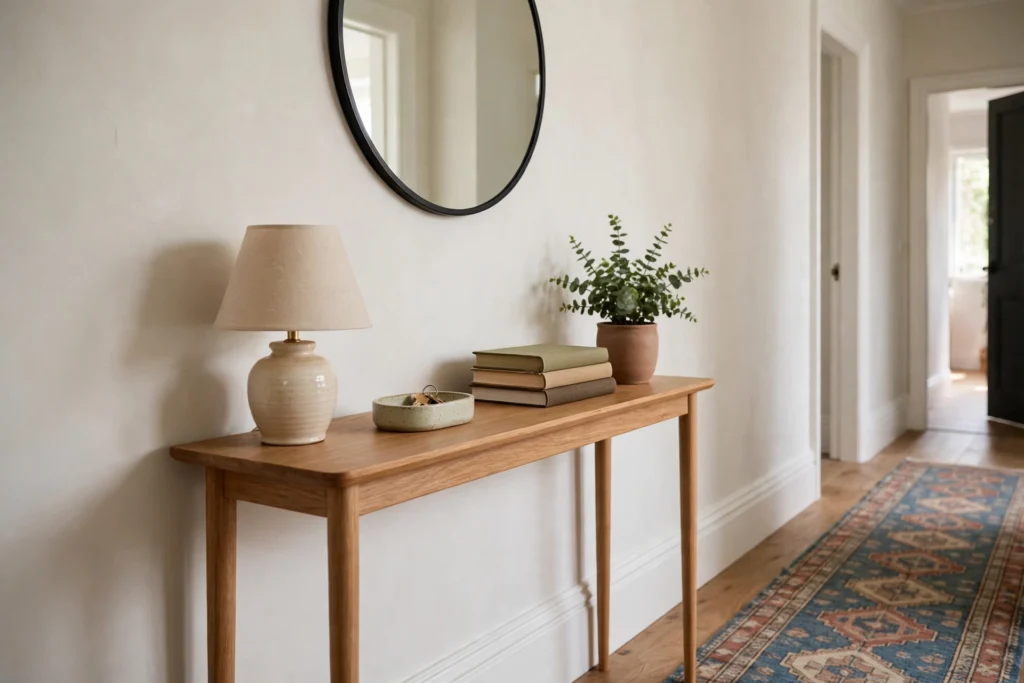
A slim console table gives a hallway a landing zone without blocking traffic. The key word is slim: look for tables 10 to 12 inches deep so they hug the wall and leave a comfortable walking path. On top, create a simple vignette — a small lamp or candle, a catch-all tray for keys, a stack of two or three books, and something living like a small plant or fresh stems. Corral the little things in the tray so the surface reads styled rather than cluttered.
If your hallway is truly narrow, consider a floating shelf or a wall-mounted ledge instead of legs; you get the styling surface with zero footprint. For renters, a narrow console on felt pads is easy to move and leaves no marks. Whatever you choose, resist the urge to fill every inch — negative space is what keeps a small console feeling elegant rather than crowded.
8. Build in Storage Without Stealing Inches
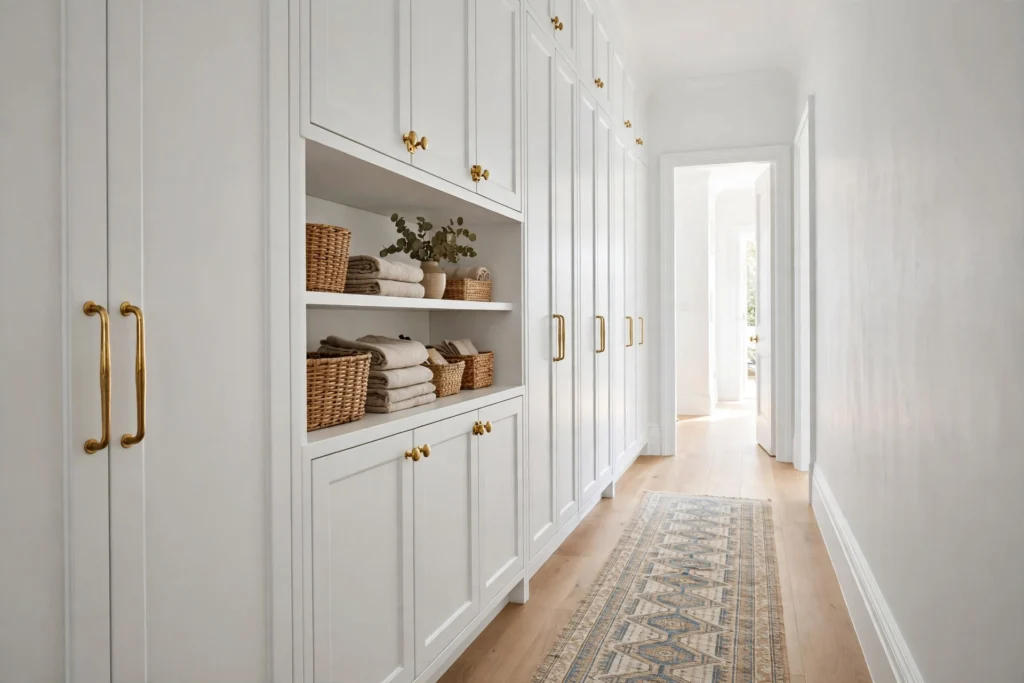
Hallways are prime real estate for storage that serves the rooms around them, but bulky furniture will choke a narrow passage. The trick is to build up and in rather than out. Floor-to-ceiling built-in cabinets painted the same color as the walls virtually disappear while swallowing linens, cleaning supplies, board games, and seasonal overflow. Even a shallow 12-inch-deep built-in holds an impressive amount when it runs wall to wall.
No budget for custom joinery? A tall, narrow bookcase or a pair of matching wardrobes at the dead end of a hallway works almost as well. Use the space above doorways too — a single shelf spanning a door frame is perfect for books or baskets you reach for rarely. And if your hallway connects bedrooms, dedicating one built-in section to bedding and towels turns the passage into a hard-working linen hub for the whole floor.
9. Dress the Walls in Pattern With Wallpaper
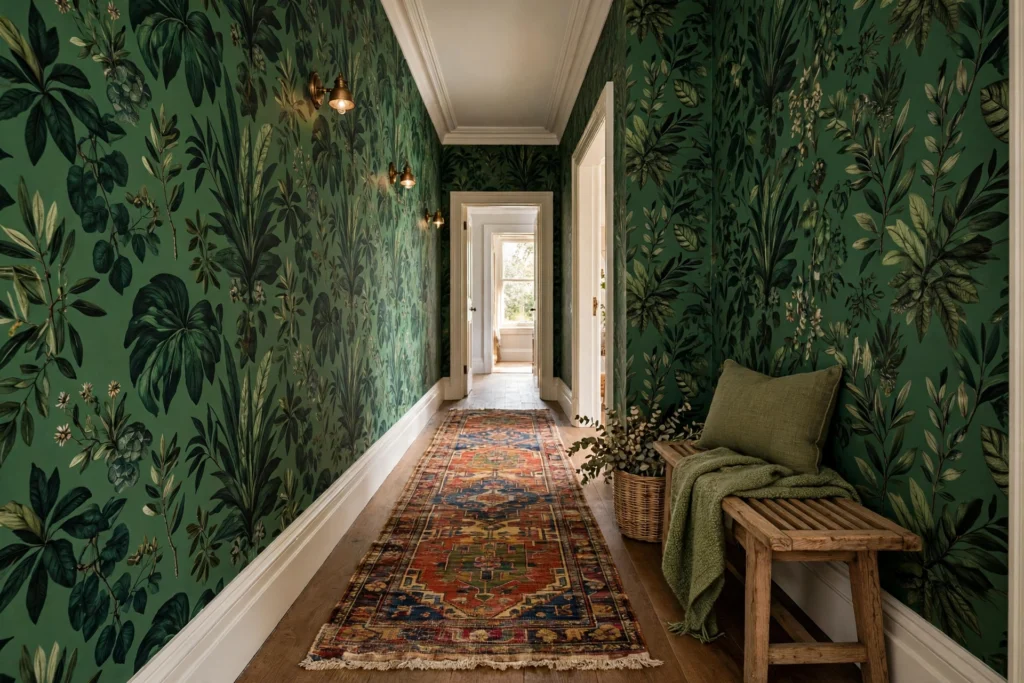
Wallpaper is a hallway’s best friend. Because corridors have little furniture competing for attention, pattern gets to be the star — and because the square footage is small, even a premium paper stays affordable. A bold botanical, a classic stripe, or a moody mural can turn the most boring pass-through into the most photographed spot in the house. Stripes running vertically make low ceilings feel taller, while a large-scale print adds drama without shrinking the space the way people fear.
Peel-and-stick wallpaper has made this an easy weekend project, especially for renters. Apply it to all four walls for full immersion, or try it on just the far end wall to create a destination that draws you forward. Pair a busy paper with simple, quiet floors and minimal furniture so the walls carry the whole look. For a coordinated approach that starts at the front door, our 15 mudroom design ideas that make every entryway work harder pair beautifully with a patterned hall.
10. Treat the Ceiling Like a Fifth Wall
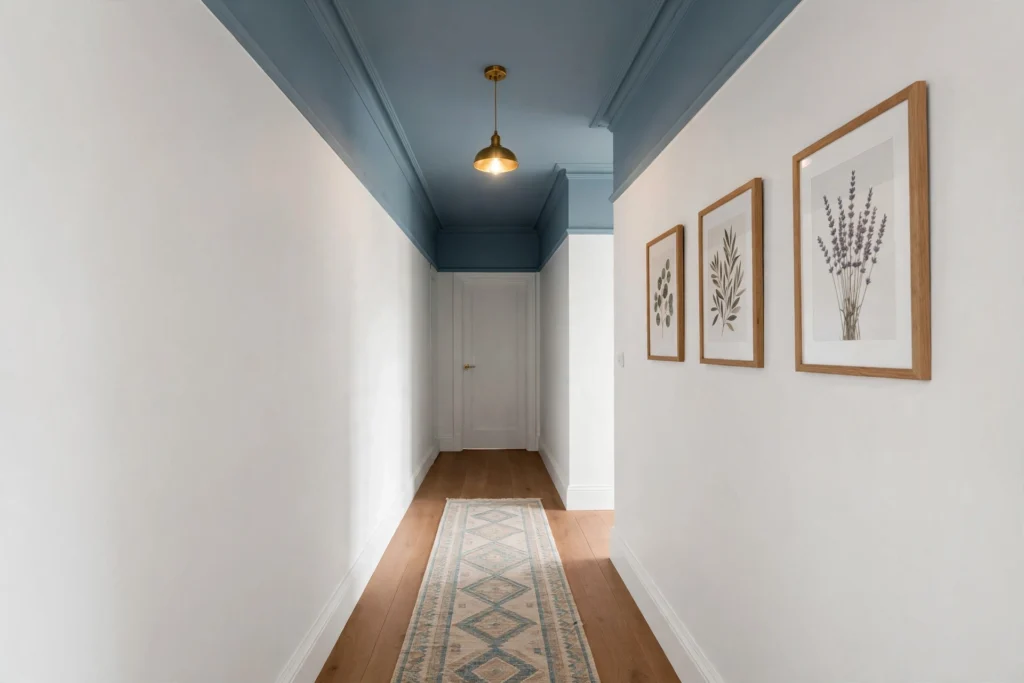
Almost everyone decorates four walls and ignores the fifth — but in a hallway, the ceiling is prime design territory because it is always in your sightline as you walk. Painting the ceiling a contrasting color is the simplest move: a soft blue, warm terracotta, or even the same bold shade as the walls draws the eye up and makes the corridor feel taller and more considered. In a long, tunnel-like hall, a ceiling color slightly darker than the walls can actually make the space feel cozier rather than more cramped.
For more commitment, try wallpaper on the ceiling, exposed or faux beams for rustic character, or a simple painted stripe running the length of the passage to emphasize its direction. Even swapping a plain ceiling for a subtle grasscloth or textured finish adds a layer of richness you feel more than see. However you treat it, a finished ceiling signals that no surface in the home was an afterthought.
11. Frame the Passage With an Archway
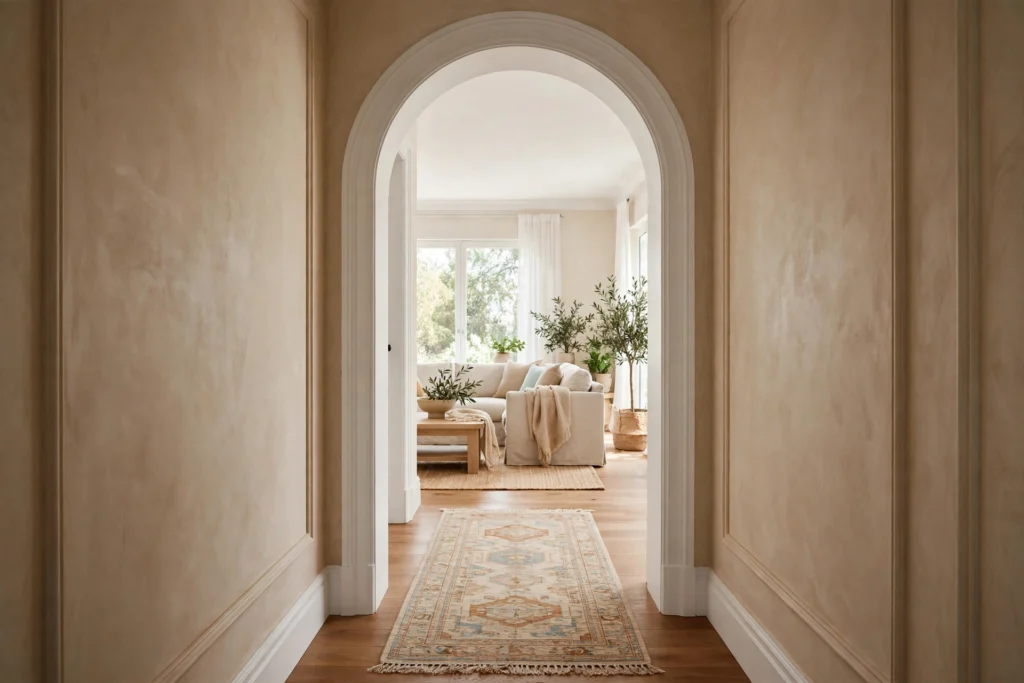
If your hallway opens into other rooms through plain rectangular doorways, adding an arch changes the entire feel of the passage. Arches soften the hard lines of a corridor, create graceful transitions between spaces, and add architectural interest that no amount of decor can fake. A simple arched cased opening between the hallway and living room makes both spaces feel more intentional and connected.
You do not need structural work to get the look. A painted arch directly on the wall — framing a console vignette, a mirror, or a piece of art — delivers the same soft geometry for the cost of a tester pot. Arched mirrors and arched door-shaped wall decals are renter-friendly shortcuts with real impact. For wider openings, a shallow arch built from flexible trim and drywall is a manageable weekend project that pays off every time you walk through it.
12. Add a Bench That Works Hard
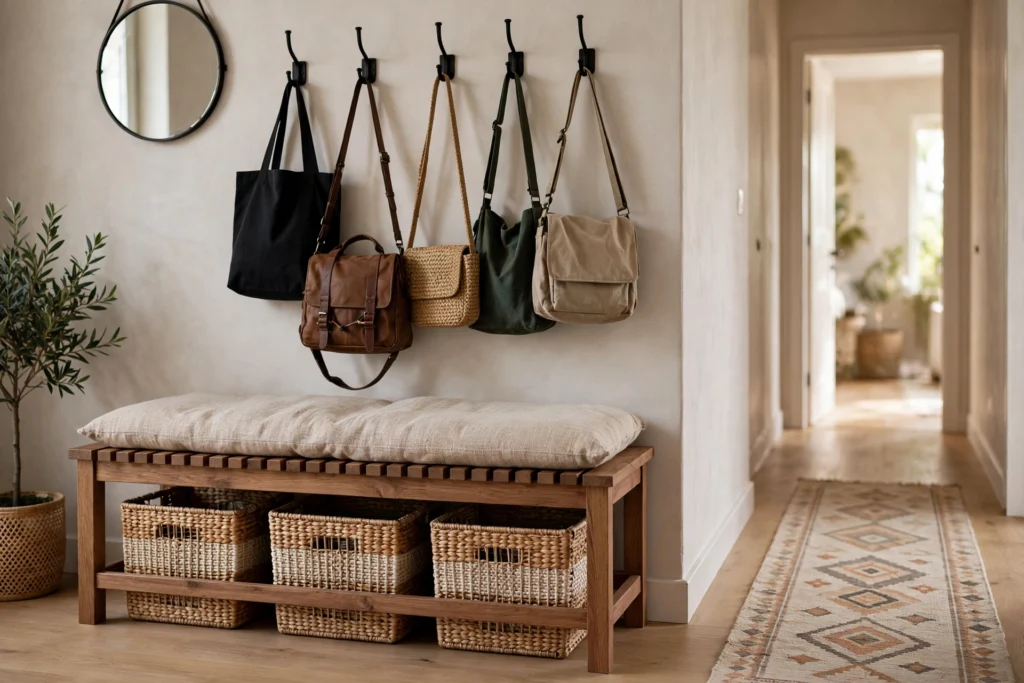
A hallway bench earns its place by doing at least two jobs: seating and storage. A slim bench with a lift-up seat or open cubbies underneath gives you somewhere to sit while pulling on shoes and somewhere to stash them afterward. Position it near the front door or at a natural pause point in the corridor, and top it with one or two cushions in a washable fabric — hallway seating takes real daily wear.
Style the wall above the bench to complete the moment: a row of hooks for coats and bags, a mirror for last looks, or a small piece of art. Keep the bench itself low and visually light — legs rather than a solid base — so it does not block the sense of flow. In a hallway that doubles as a mudroom-style drop zone, a bench with baskets underneath keeps the daily clutter of a busy household neatly contained and out of the walkway.
13. Bring the Hallway to Life With Plants
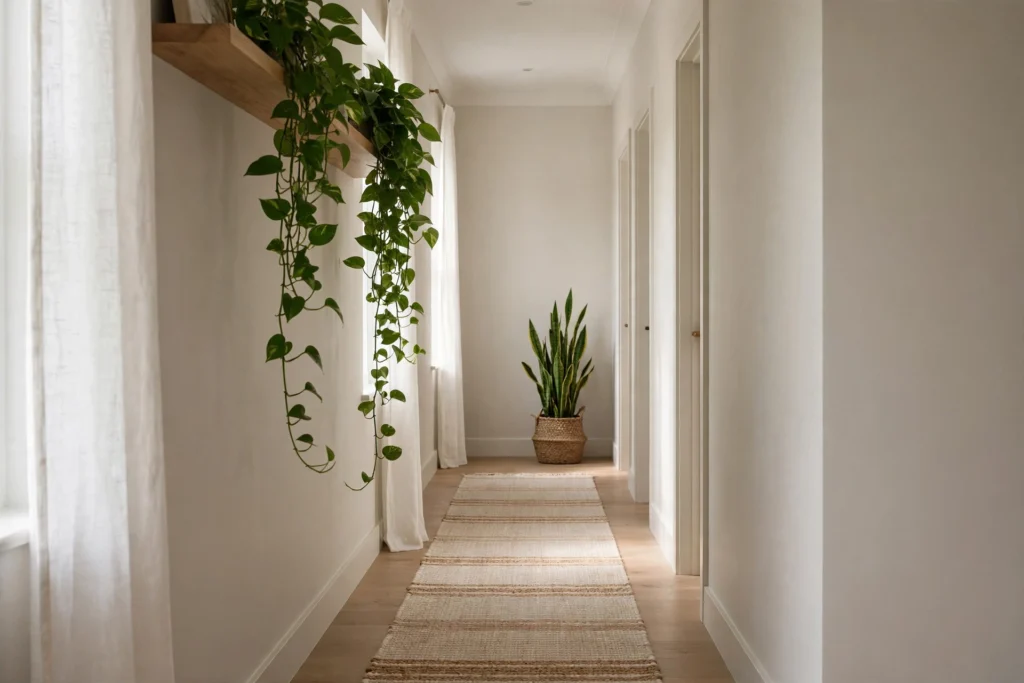
Hallways are often the last place people think to put plants, which is a shame — greenery softens hard corridor lines and makes a pass-through feel alive. Low-light tolerant plants like snake plants, pothos, and ZZ plants thrive in the indirect light most hallways offer, and they ask for almost nothing in return. A tall snake plant in a woven basket at the end of a hall creates a natural focal point; trailing pothos on a high shelf draws the eye up and adds movement.
No natural light at all? High-quality faux stems in a beautiful vase still deliver the softness and color, and nobody will inspect them in a dim corridor. Alternatively, mount small planters on the wall to keep the floor clear — a row of wall-mounted pots with trailing plants turns a blank stretch of hallway wall into a living installation. Just keep watering simple: choose plants with similar needs and group them so care becomes a one-stop routine.
14. Light Your Artwork Like a Gallery
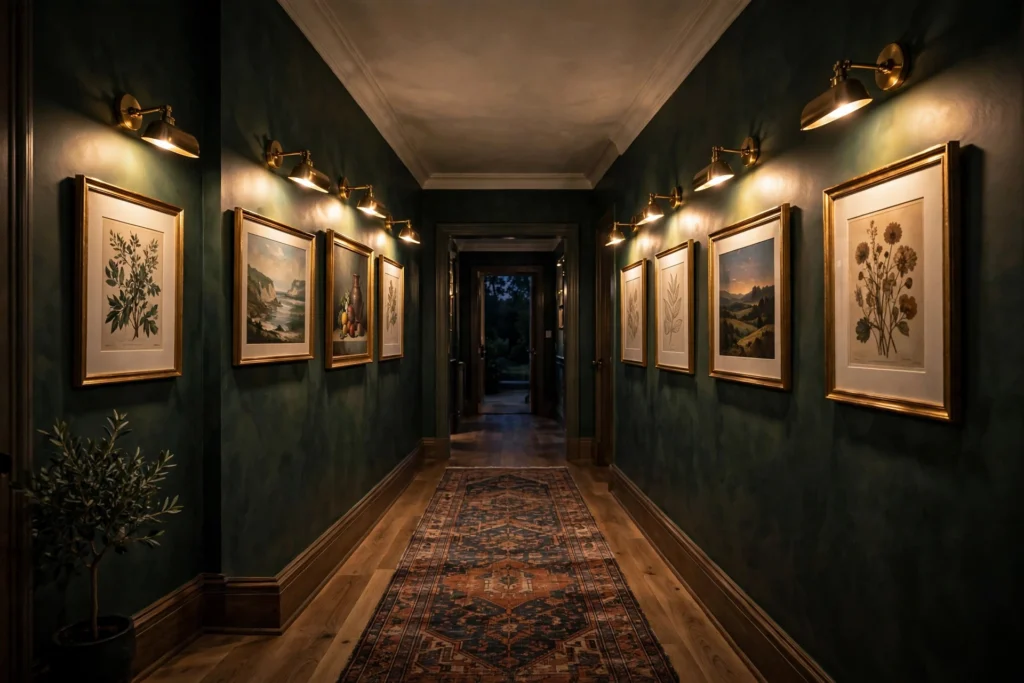
If you have hung art in your hallway, light it like you mean it. Picture lights — those slim brass or black bars mounted above frames — instantly elevate a gallery wall from casual to curated, and they cast a warm, focused glow that makes colors richer in the evening. Battery-operated versions mean no electrician is required; many are remote-controlled and rechargeable via USB.
For a bigger statement, aim adjustable wall washers or small spotlights at a large piece at the end of the hall. The lit artwork becomes a beacon that draws you forward and gives the corridor a clear destination. Keep the color temperature warm, around 2700K, so the light feels cozy rather than commercial. Apartment Therapy’s hallway roundup notes how well-placed lighting can set the tone the moment someone enters — see their 35 smart entryway and hallway decorating ideas for more inspiration.
15. End the Hall With a Focal Point Worth Walking Toward
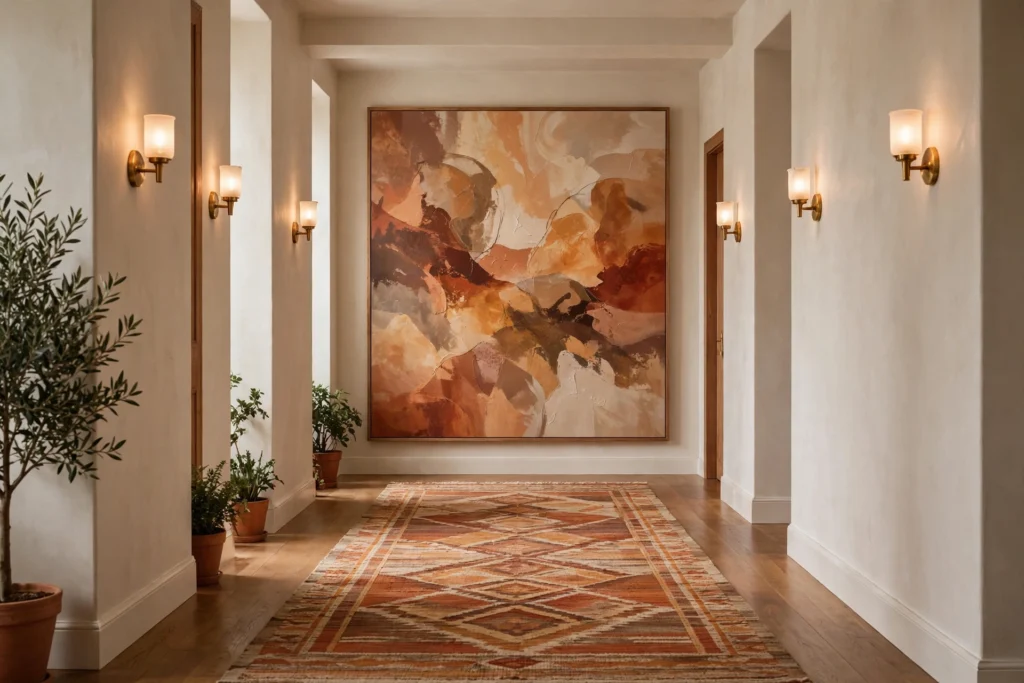
Every hallway needs a reason to walk to the end of it. A strong focal point — a bold piece of art, a beautiful mirror, a small console with a lamp, or an accent wall in a rich color — gives the corridor a destination and makes the whole passage feel purposeful. Without one, even a well-decorated hallway can feel like it just stops. The end wall is also the perfect spot for your bravest choice, since it is seen head-on from the entrance.
Scale matters here: the piece should be large enough to hold its own when viewed from the far end of the hall. A single oversized canvas, a tall mirror, or a painted arch framing a vignette all work beautifully. If your hallway ends in a window, treat the view as the art — keep the dressing minimal with a simple roman shade and let the daylight do the work. This same principle of giving long, narrow rooms a visual anchor applies beyond the hallway; see our long narrow living room design ideas for how to pull the eye through other tricky spaces.
Frequently Asked Questions
What is the best color for a dark hallway?
There is no single best color, but the most reliable approach is to commit rather than compromise. A dark hallway painted white often looks flat and shadowy, while a rich, saturated color — deep green, navy, charcoal, or warm terracotta — makes the darkness feel intentional and cozy. If you want to stay light, choose a warm white with creamy undertones rather than a stark cool white, and add plenty of layered lighting with warm bulbs.
How do you decorate a long narrow hallway?
Start with a runner that spans most of the length to create flow, then break the tunnel feeling with rhythm: evenly spaced sconces or pendants, a gallery wall on one side, and a focal point at the far end. Keep furniture slim or wall-mounted so the walking path stays clear, and use mirrors to bounce light. Painting the far end wall a bolder color than the side walls visually shortens the corridor and gives it a destination.
Should a hallway runner go wall to wall?
No — leave a few inches of floor visible on each side of the runner and a small margin at each end. A runner that fits nearly edge to edge makes a narrow hallway feel tighter, while a bit of breathing room around it makes the floor look wider. As a rule of thumb, choose a runner two to four inches narrower than the hallway on each side, and long enough to cover most of the walking path without bunching at doorways.
How can I add storage to a hallway without making it feel cramped?
Build up and in rather than out into the walkway. Floor-to-ceiling built-ins painted the same color as the walls add huge capacity while visually disappearing. Shallow wall-mounted cabinets, floating shelves, hooks instead of coat racks, and a bench with hidden storage all add function without stealing floor space. Keep the walking path at least 36 inches clear — anything less will make the hallway feel pinched no matter how pretty the storage is.
What lighting works best in a hallway with no windows?
Layer at least two types of light: ambient light from ceiling fixtures or a row of pendants for overall brightness, plus accent light from wall sconces or picture lights to add warmth and depth. Warm white bulbs around 2700K keep the space feeling cozy rather than clinical. Put the lights on a dimmer so you can lower them in the evening, and add mirrors opposite the fixtures to multiply the glow.
Keep Exploring
Your hallway may be the smallest design project in your home, but it is the one you and your guests experience most often — every single day, on the way in and on the way out. Start with one or two of these hallway design ideas, live with the change for a week, and let the corridor tell you what it needs next. A runner this weekend, a gallery wall the next, and before long the passage you used to rush through becomes a part of the home you actually love.