
Scandinavian dining rooms have a way of making every meal feel calmer. Born from long Nordic winters and a deep respect for natural light, these scandinavian dining room design ideas pair clean-lined furniture with warm textures so a room stays bright without ever feeling cold. It is functional beauty at its most inviting — a table built for daily breakfasts and long holiday dinners alike.
These scandinavian dining room design ideas show how to capture that balance of light, warmth, and simplicity in your own home. From light oak tables and iconic chairs to layered sheepskins and candlelit hygge, here are fifteen ways to build a dining room that feels like a deep breath.
1. Start with a Light Oak Table
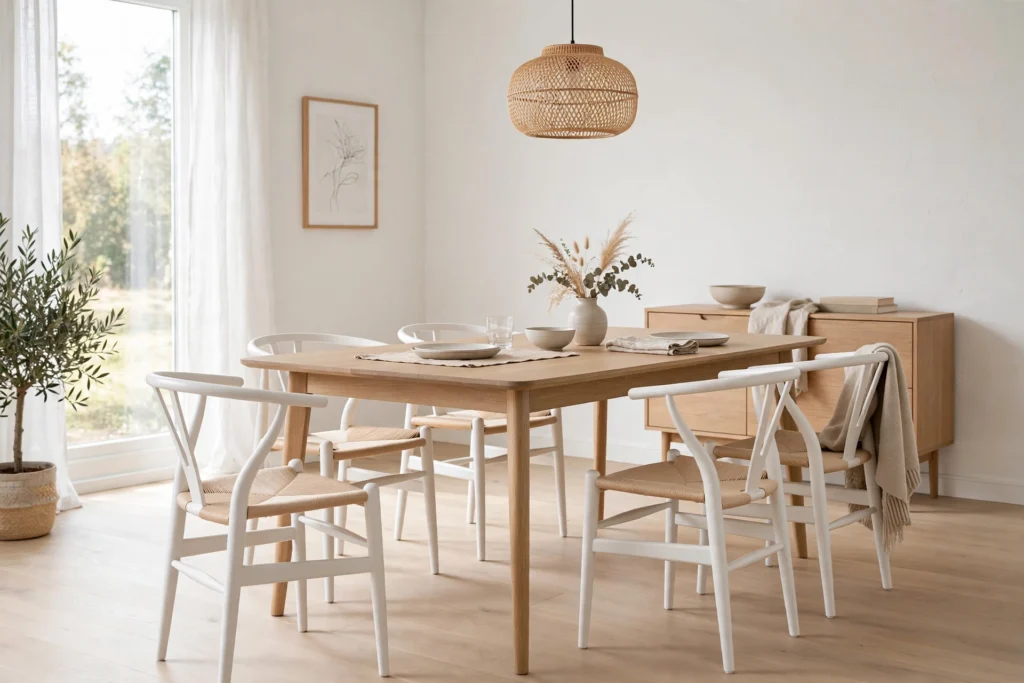
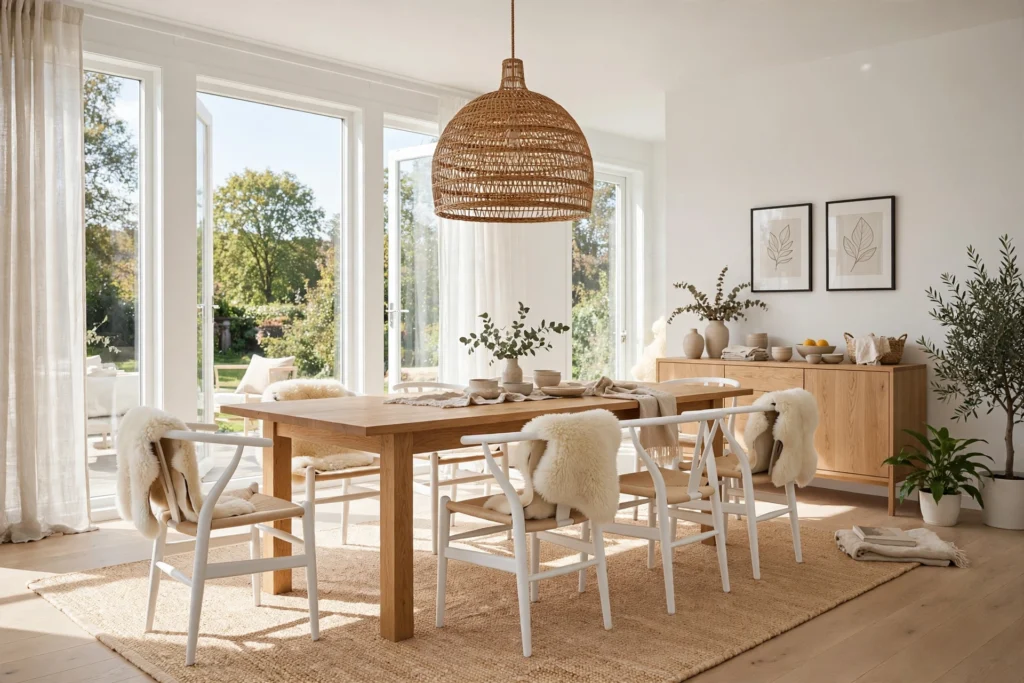
The dining table is the heart of any Scandinavian dining room, and light oak is the wood of choice. Its pale honey tone keeps the room feeling airy while adding the natural warmth that defines Nordic design. Choose a table with clean lines and slightly tapered legs — no heavy carving, no ornate details, just honest craftsmanship.
Size it for real life, not just dinner parties. An extendable table is the classic Scandi solution: compact for Tuesday breakfasts, generous when friends come over. Leave the wood’s grain visible with a matte oil finish rather than glossy lacquer, so the surface feels soft and ages gracefully. A well-chosen oak table can anchor the room for decades, which is exactly the point — Scandinavian design favors buying once and buying well.
2. Choose Iconic Wishbone-Style Chairs
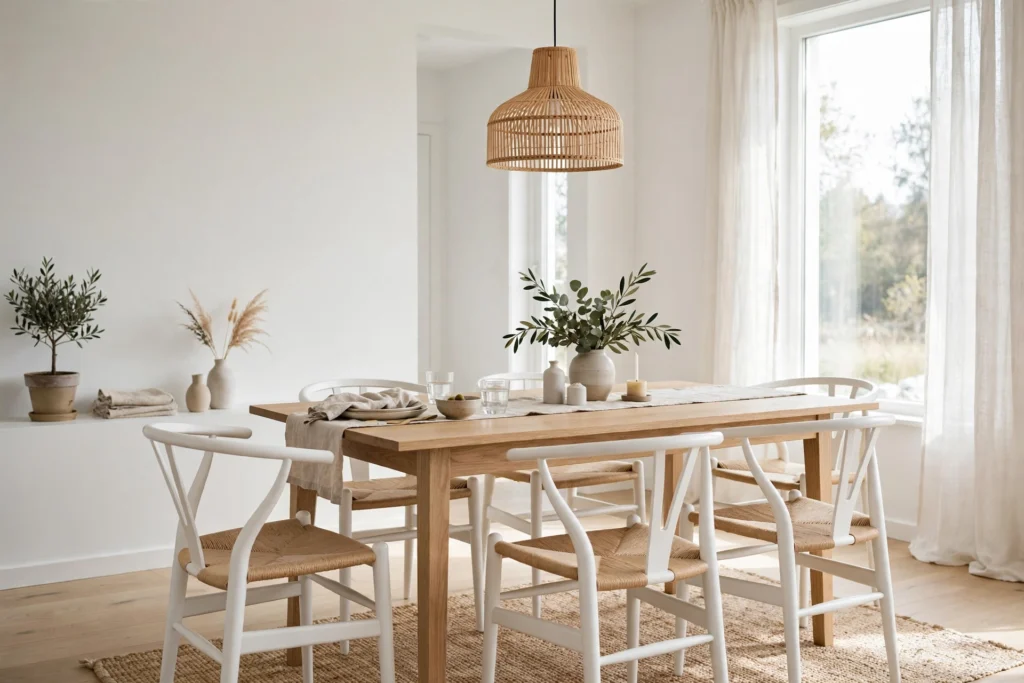
No chair says Scandinavian dining quite like the wishbone chair — Hans Wegner’s 1949 classic with its steam-bent back and woven paper-cord seat. Even faithful reproductions capture the look: light wood frames, sculptural curves, and a seat that is somehow both elegant and deeply comfortable.
You do not need a full matching set to get the effect. Four wishbone chairs around the table’s sides with two upholstered host chairs at the ends creates a collected, designer feel. If wishbones are beyond budget, look for any dining chair with the same DNA: light wood, clean lines, and a gently curved back. Our Scandinavian living room ideas use the same iconic-piece strategy to give a whole room instant character.
3. Keep Walls White and Bright
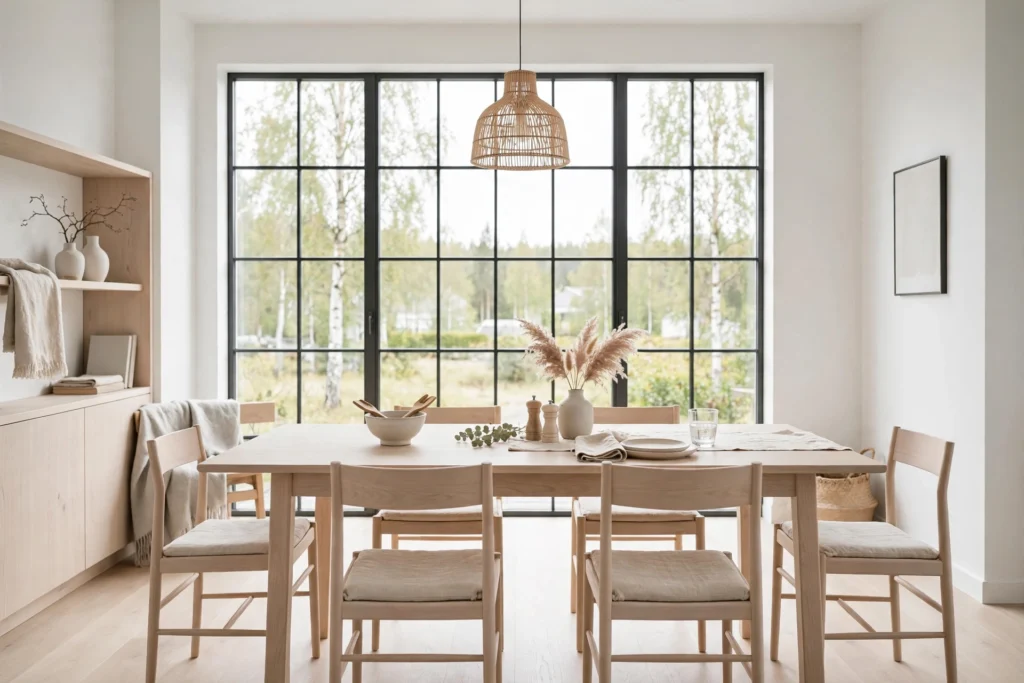
White walls are the non-negotiable foundation of Scandinavian style. In the Nordic countries, where winter daylight is scarce, white walls bounce every available ray around the room. The result is a dining room that glows even on gray afternoons.
Choose a warm white rather than a stark blue-white — shades with a whisper of cream keep the room from feeling clinical. If pure white feels flat, try a barely-there greige on one wall. The Spruce’s guide to what Scandinavian style really means puts it well: neutral colors, natural materials, and light are the three pillars, and the white walls are what let the other two shine.
4. Layer Sheepskins and Wool Throws
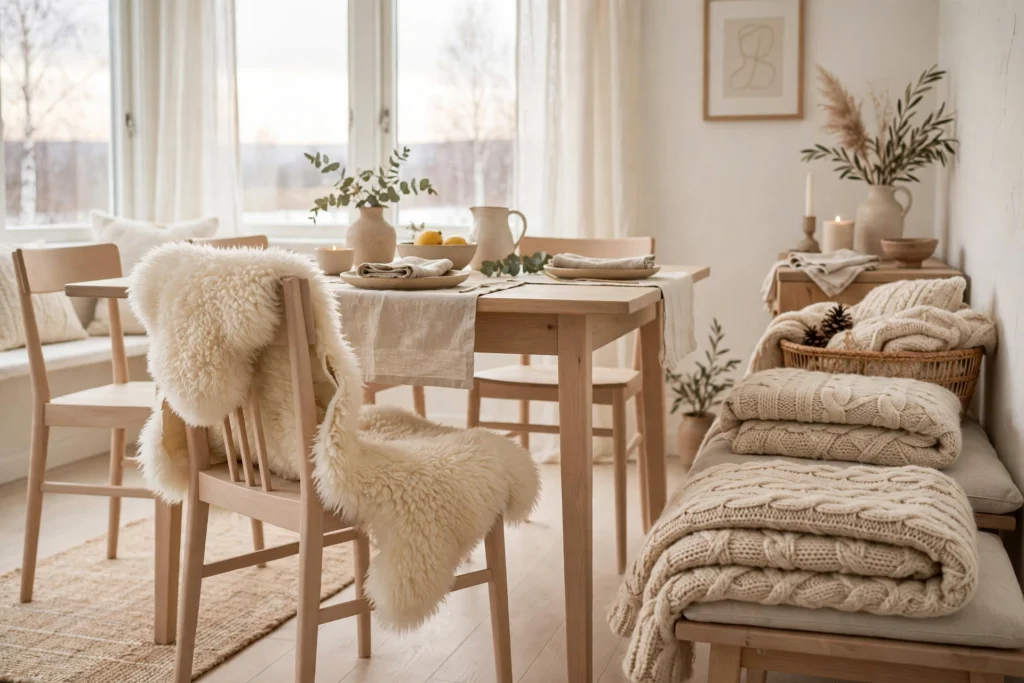
Here is where Scandinavian dining rooms get their soul. A sheepskin draped over a dining chair, a chunky wool throw folded on the bench, a sheepskin rug underfoot — these soft layers add the warmth and tactility that keep a bright room from feeling sterile.
Stick to natural tones: ivory, oatmeal, soft gray, warm beige. The textures do the talking, not the colors. Drape casually rather than arranging perfectly — Scandinavian styling favors the look of real life over showroom polish. In winter, these layers make the dining room the coziest seat in the house; in summer, they add softness without weight.
5. Hang a Simple Paper or Rattan Pendant
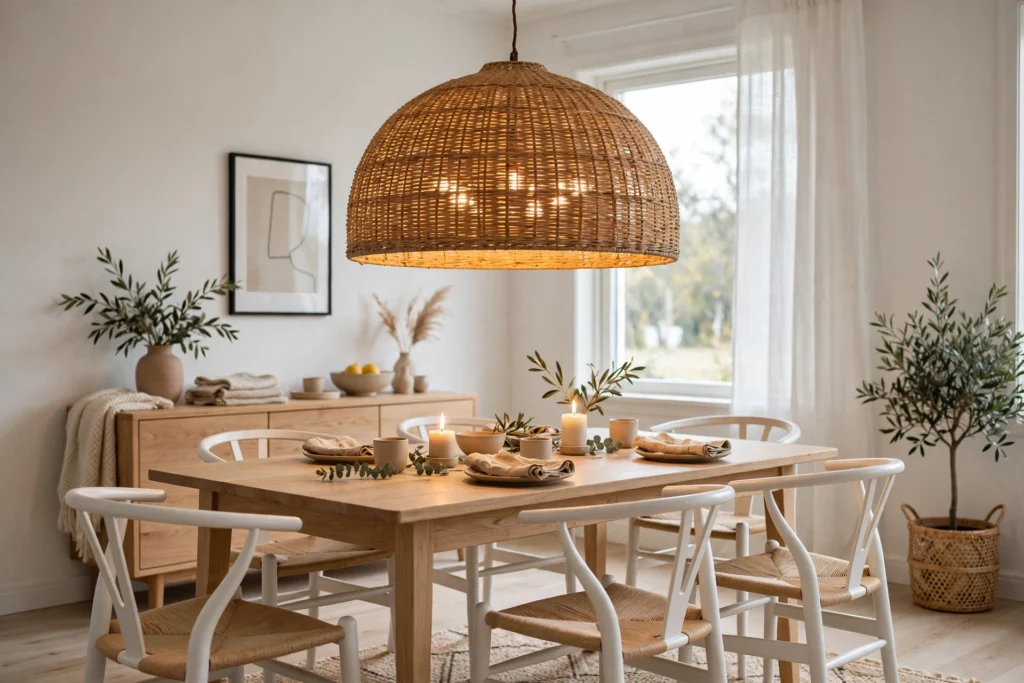
Overhead, keep it sculptural but simple. A large paper lantern pendant, a woven rattan shade, or a clean-lined white pendant in the spirit of Louis Poulsen’s classics — any of these brings soft, diffused light and an unmistakable Nordic feel. Hang it low, about 28 to 32 inches above the tabletop, so it defines the dining zone.
Scale matters: one generous pendant beats three small ones in most dining rooms. For long tables, two identical pendants spaced evenly create rhythm without clutter. Keep the bulb warm (2700K) — Scandinavian rooms live in golden light once the sun goes down, and a cool bulb would undo all that warmth in an instant.
6. Add Greenery in Simple Pots
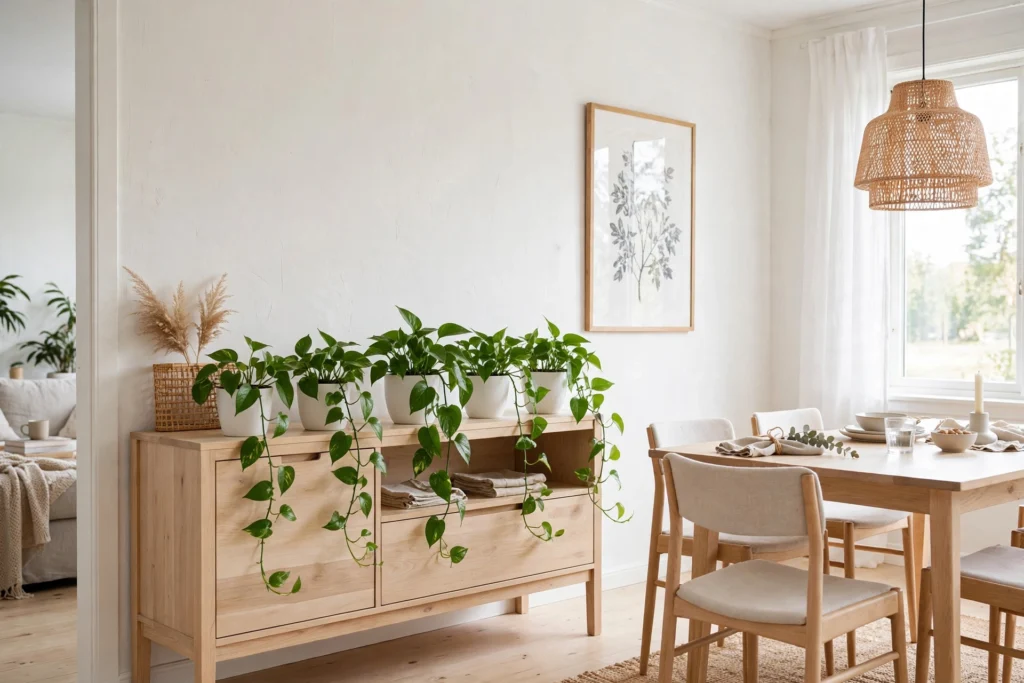
Plants are the living accent every Scandinavian dining room needs. A tall olive tree or fiddle-leaf fig in the corner, a trailing pothos on the sideboard, a small eucalyptus in a white ceramic pot on the table — greenery adds life and color without breaking the calm palette.
Keep the pots simple: white ceramic, raw terracotta, light wood, or clear glass. The plant is the star; the pot should disappear. Even one well-placed plant changes the room’s energy completely, softening all those clean lines with something alive. If your dining room gets limited light, snake plants and ZZ plants survive happily and still deliver the look.
7. Use a Pale Jute or Wool Rug
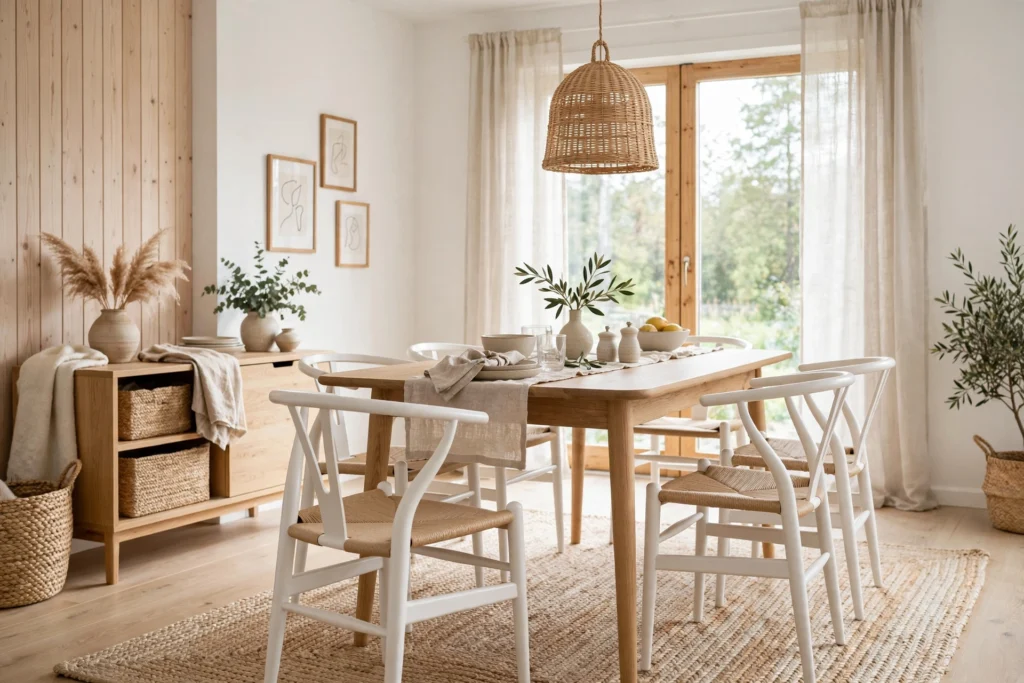
A rug under the dining table anchors the whole arrangement and adds the textile warmth Scandinavian rooms are known for. Choose natural fibers — jute, sisal, or a flat-weave wool in ivory or oatmeal — for texture that reads as calm rather than busy.
Size it generously: the rug should extend at least 24 inches beyond the table on all sides so chairs stay on it when pulled out. Low-pile or flatweave is essential under dining chairs — anything plush makes chairs hard to move and traps crumbs. A pale rug also bounces light upward, quietly doubling the brightness of the room.
8. Style a Minimal Sideboard
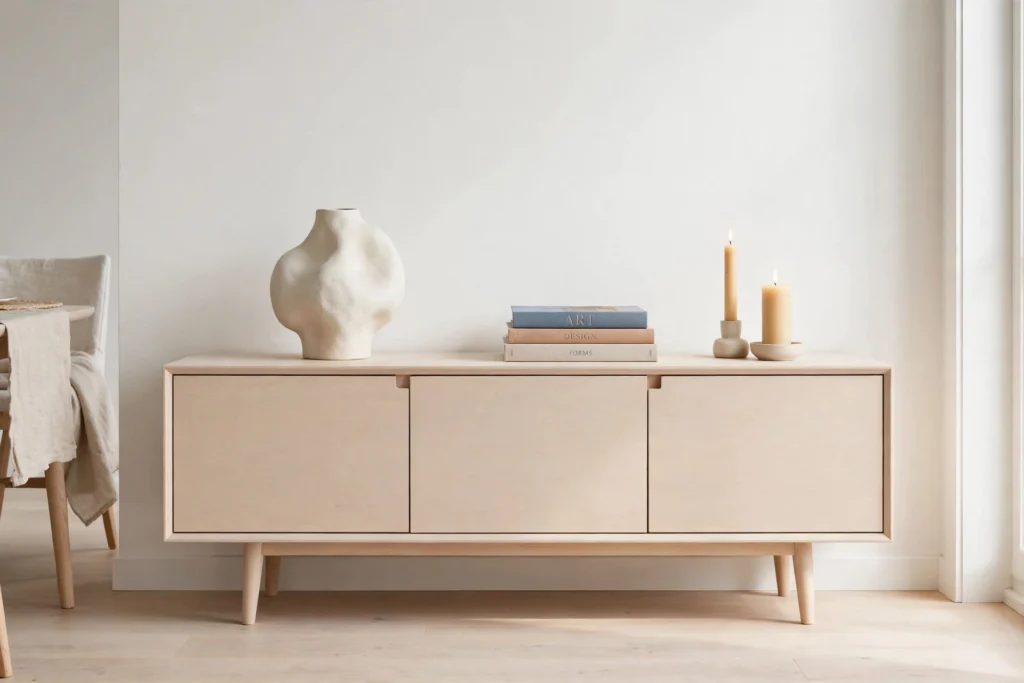
A low, light-wood sideboard gives the dining room its storage and its styling moment in one piece. Look for clean lines, tapered legs, and sliding or push-to-open doors — mid-century Danish pieces are the reference, and there are excellent modern reproductions at every price point.
Style the top with restraint: a small stack of art books, one sculptural vase, a candle or two, and breathing room between them. Inside, corral the table linens, serving pieces, and candles so the table itself can stay clear. A sideboard keeps the room’s surfaces calm, which is the whole philosophy — everything beautiful, everything in its place.
9. Let in Maximum Natural Light
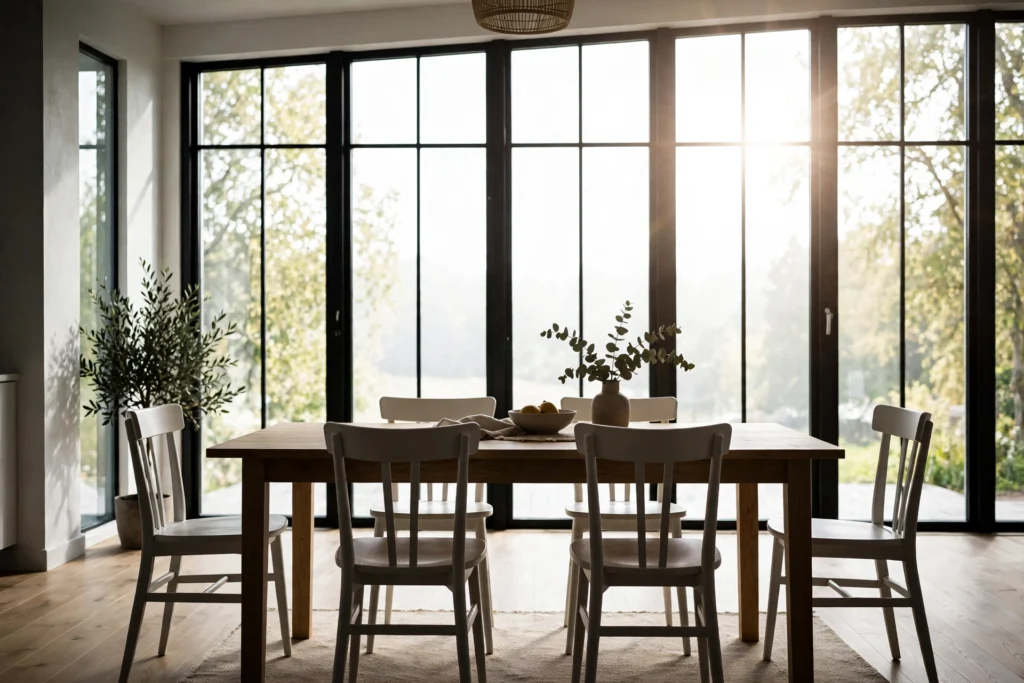
Scandinavian design is, at its core, a love letter to daylight. Keep window treatments minimal or skip them entirely where privacy allows. Bare windows with simple white frames let light flood in and connect the dining room to the outdoors — a connection to nature is central to the Nordic aesthetic.
If you need coverage, choose sheer white linen panels that filter light rather than blocking it, hung high and wide so the window looks as large as possible. Clean the glass inside and out twice a year; it sounds fussy, but in a style built around light, sparkling windows are genuinely transformative.
10. Mix Black Accents for Contrast
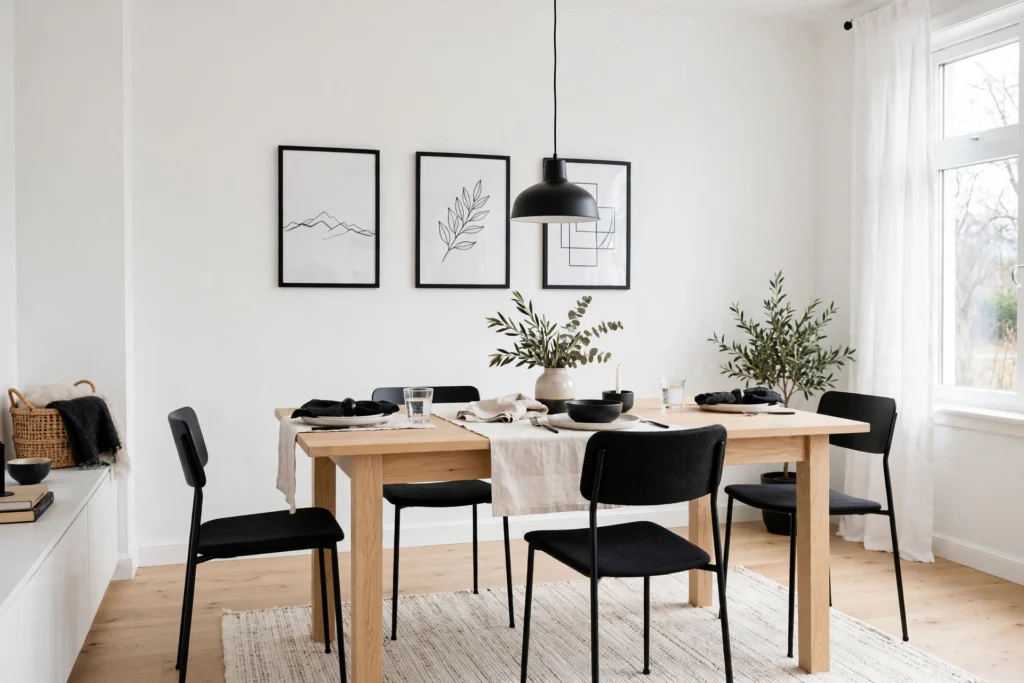
An all-white, all-pale room can drift toward bland — black accents are the Scandinavian designer’s secret for adding definition. Black pendant cords, slim black chair legs, a black-framed mirror or piece of art, matte black candleholders: these small dark notes give the eye somewhere to land.
Keep it to about ten percent of the room’s visual weight. The contrast should feel like punctuation, not a second color scheme. This trick works beautifully in small dining rooms too, where a few black accents add depth without shrinking the space.
11. Create a Cozy Breakfast Nook Corner
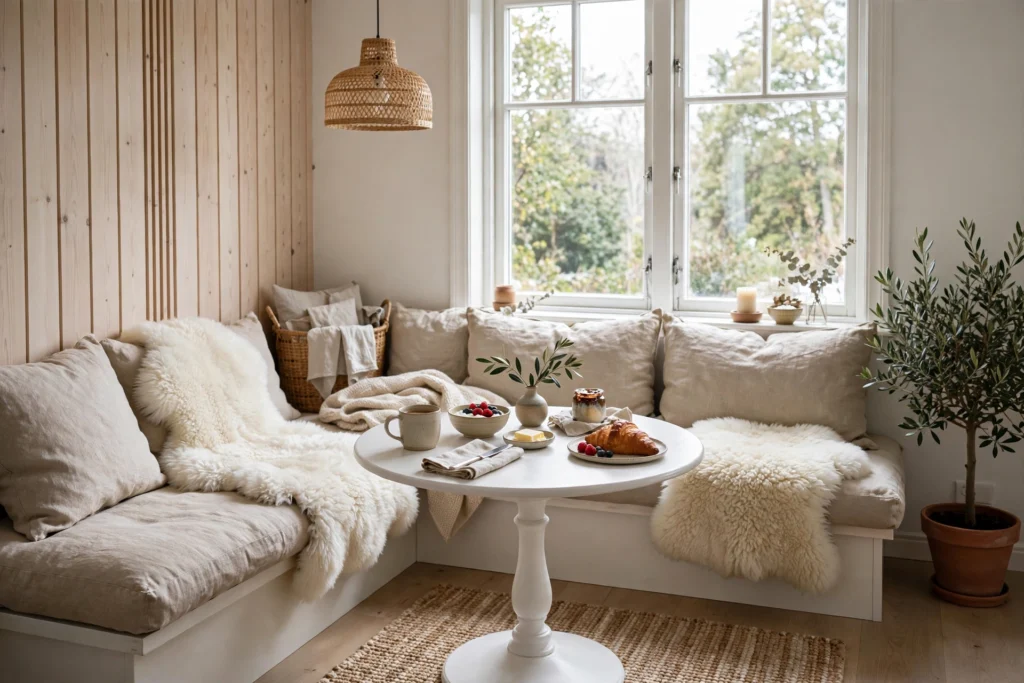
If your dining area includes a corner, turn it into a breakfast nook — the coziest expression of Scandinavian dining. A simple L-shaped bench with a thick cushion in natural linen, a round pedestal table, and a couple of sheepskins creates a spot made for slow weekend mornings.
Built-in-look benches with storage underneath are the practical Scandi move: lift the seat for tablecloths, board games, and seasonal decor. Add a small pendant or wall sconce above for evening glow. A nook seats more people in less space than chairs, which makes it perfect for families who actually use their dining room every day.
12. Keep Table Styling Simple
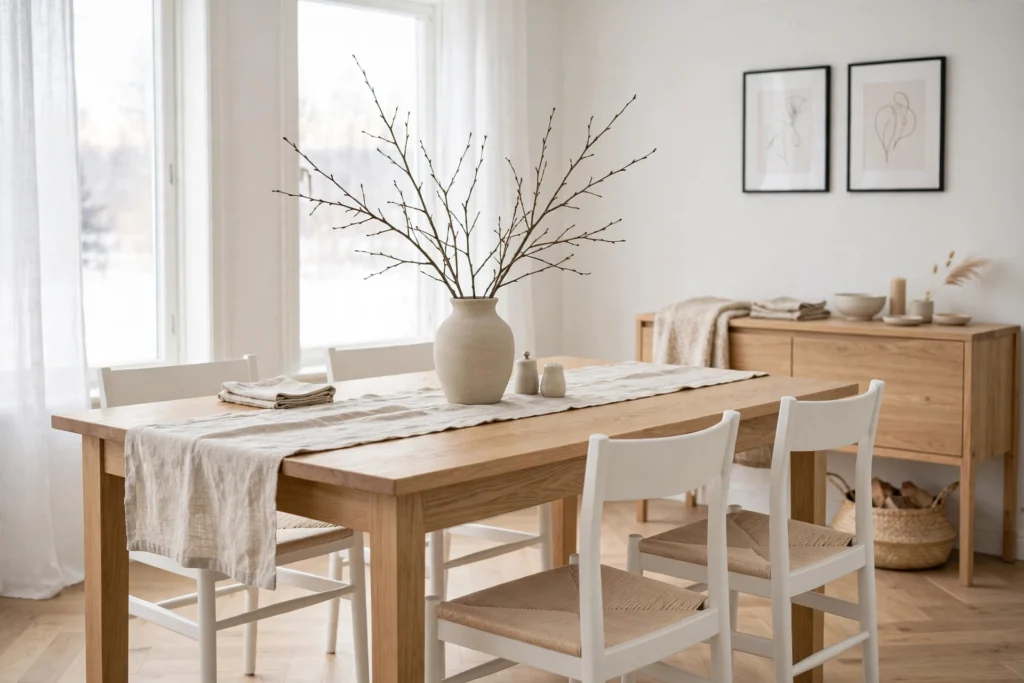
Scandinavian table styling is the art of restraint: a low runner in natural linen, one beautiful object — a ceramic vase with a few branches, a bowl of fruit, a cluster of candles — and space to breathe. The table should look ready for dinner, not decorated for a magazine shoot.
Rotate one element with the seasons rather than redecorating: bare branches in winter, tulips in spring, wildflowers in summer, dried grasses in autumn. Apartment Therapy’s roundup of the coziest dining rooms celebrates exactly this kind of organic, Scandi-inspired simplicity — natural materials and a few well-chosen pieces that make guests want to linger.
13. Add Warm Candlelight for Hygge
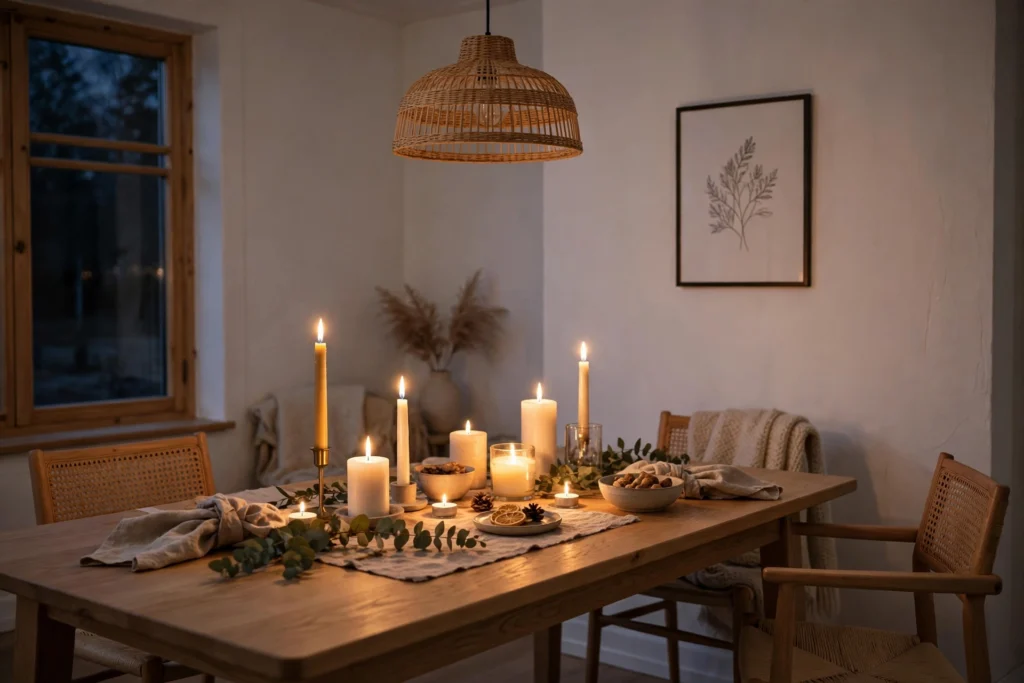
Hygge — the Danish art of cozy contentment — lives in candlelight. No Scandinavian dining room is complete without candles: pillar candles of varying heights on the sideboard, tea lights in simple glass holders on the table, a lantern or two in the corner. In the dark Nordic winter, candlelight is not decoration; it is atmosphere itself.
Cluster candles in odd numbers for a natural look, and choose unscented or subtly scented varieties — the goal is glow, not perfume. Battery-operated candles with a realistic flicker work beautifully for everyday use. Light them at dinner even on ordinary Tuesdays; hygge is a daily practice, not a special occasion.
14. Choose Light, Airy Curtains or None
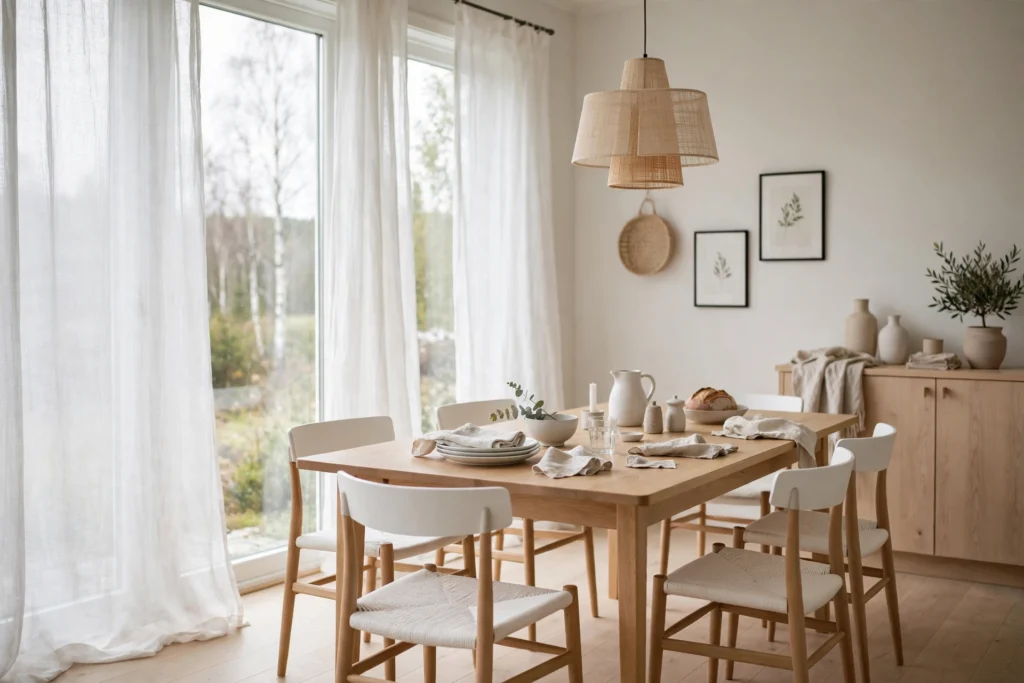
If bare windows are not an option, keep curtains as light as the rest of the room. Sheer white or ivory linen panels, hung from a slim rod mounted near the ceiling, filter daylight softly while preserving privacy. They should feel like a whisper of fabric, not a statement.
Avoid heavy drapes, bold patterns, and dark colors — all three fight the bright simplicity you are building. In a dining room that opens to a garden or balcony, consider skipping curtains on the glass doors entirely and using a simple roller blind that disappears when raised. Light first, always.
15. Keep Clutter Out of Sight
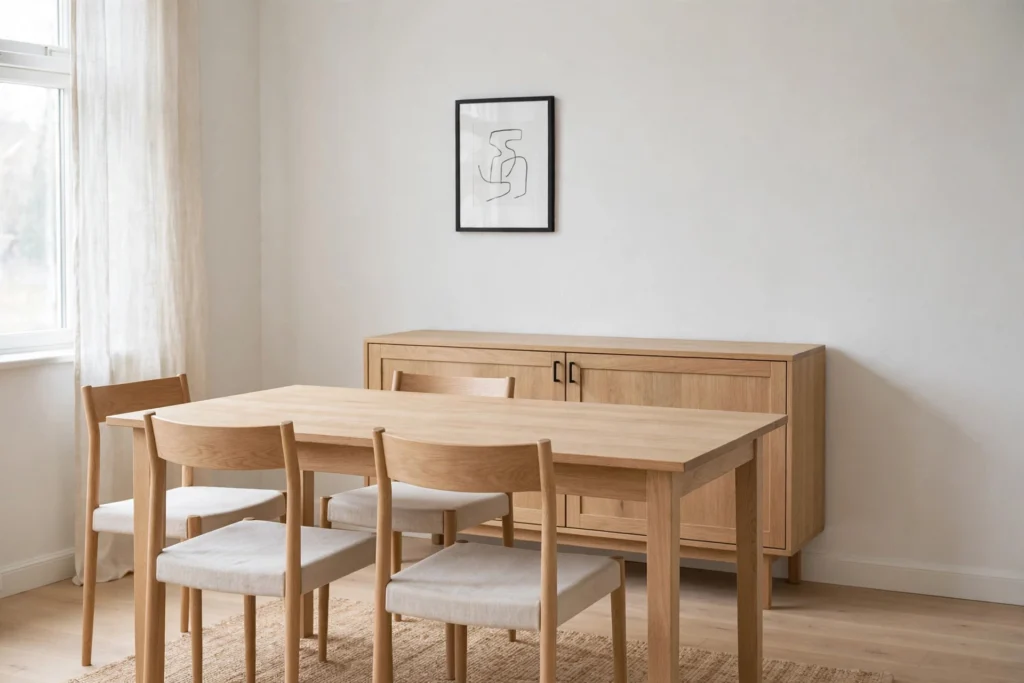
The final Scandinavian principle is also the hardest: restraint. Every object in the dining room should earn its place through beauty or function — preferably both. Mail, chargers, random clutter, and the collection of things that migrate to the table all need homes elsewhere.
Build the habit into the room: a drawer in the sideboard for the bits and pieces, a nightly two-minute reset, and a one-in-one-out rule for decor. The same everything-has-a-home discipline runs through our Scandinavian kitchen ideas — calm is a whole-home project, and the dining room is where it shows most. A clear table in a bright room is the quiet luxury Scandinavian design promises.
Frequently Asked Questions
What makes a dining room Scandinavian?
Light walls, pale wood furniture with clean lines, a restrained neutral palette, natural materials (wood, wool, linen, leather), and layers of cozy texture — sheepskins, candles, greenery. It balances minimalism with warmth: bright and simple, never cold or stark.
What color walls work best in a Scandinavian dining room?
Warm whites are the classic choice — they maximize natural light, which is the heart of the style. If you want subtle variation, try a pale warm gray or greige on one wall. Avoid anything dark or saturated on large surfaces; save deeper tones for small accents.
How do I make a Scandinavian dining room feel cozy, not cold?
Layer textures: sheepskins on chairs, a wool rug under the table, linen curtains, and candlelight everywhere. Add greenery and warm wood tones. Coziness in Scandi design comes from tactile natural materials and warm light, not from filling the room with stuff.
What kind of table suits a Scandinavian dining room?
A light oak or ash table with clean lines and tapered legs — extendable if you entertain. Keep the finish matte and natural so the wood grain shows. Round tables work beautifully in smaller spaces; rectangular tables suit larger rooms and bigger gatherings.
Can I mix Scandinavian style with other styles?
Absolutely — Scandi blends beautifully with japandi, mid-century modern, and soft minimalism since they share the same DNA of clean lines and natural materials. Keep the light palette and restraint as your foundation, and let one or two pieces from another style add personality.
Keep Exploring
A Scandinavian dining room is a promise of calm — bright mornings, unhurried dinners, and a table that always feels welcoming. Start with the light oak table and white walls, layer in the sheepskins and candlelight, and let simplicity do the heavy lifting.
For more Nordic inspiration, our Scandinavian living room ideas carry the same bright, cozy thinking into the main gathering space. And if you love the clean-lined look across the whole home, our Scandinavian kitchen ideas show how the palette flows beautifully from room to room.