
Elegance in a bathroom is something you feel before you consciously analyse it. It’s the quality of light on a marble surface. The cool weight of a brass tap in your hand. The way a well-proportioned mirror sits above a beautifully considered vanity. The absence of anything unnecessary, and the presence of everything chosen with genuine care.
It is not, despite what many assume, primarily a function of budget. Elegance comes from proportion, restraint, material quality, and the kind of quiet confidence that says every decision in this room was made deliberately. An elegant bathroom can be achieved at a range of price points — what it cannot be achieved without is thoughtfulness.
These 13 elegant bathroom design ideas will show you exactly how to create that quality of thoughtfulness in your own bathroom — whether you’re starting from scratch with a full renovation or refining what you already have. True elegance is within reach. Let’s find it together.
━━━━━━━━━━━━━━━━━━━━━━━━━━━━━━━━━━━━━━━━
1. Choose Marble — or a Marble That Earns Its Place
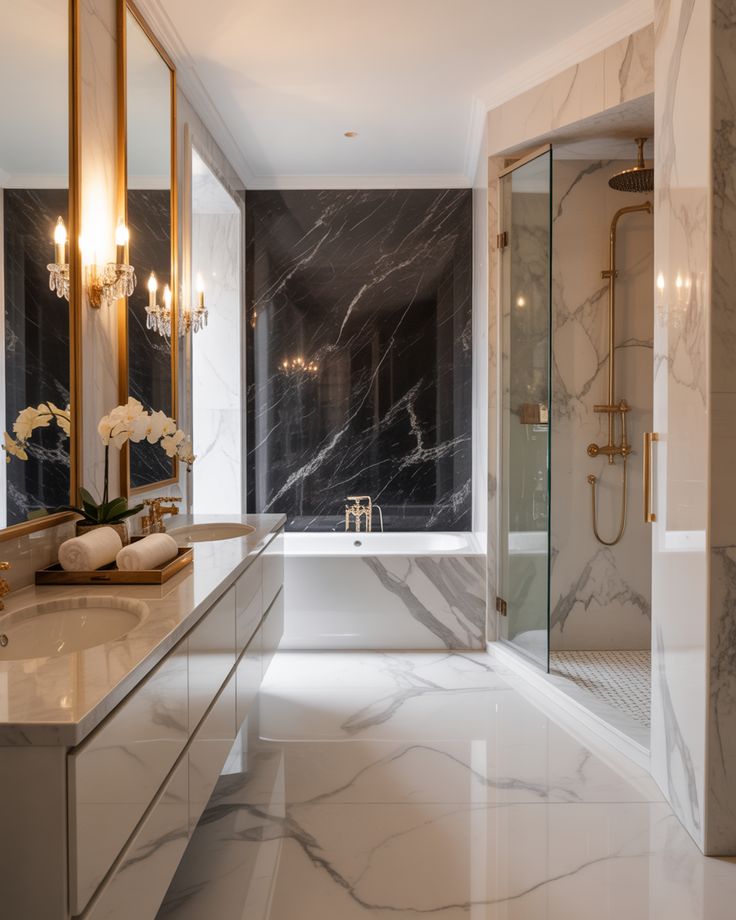
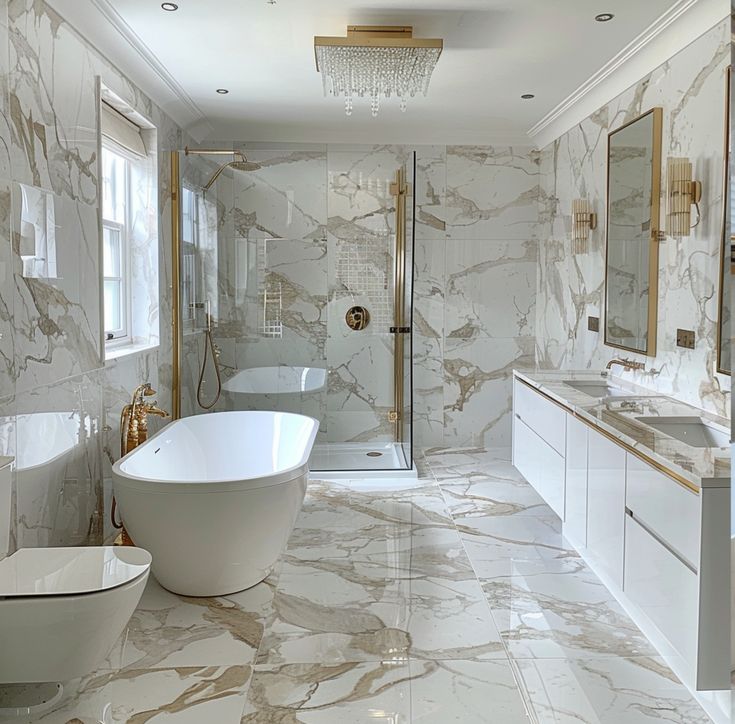
Marble has been the material of elegant bathrooms since antiquity — and for good reason. No manufactured material replicates the depth of veining, the cool luminous surface, and the organic complexity of natural marble. In a bathroom, marble communicates refinement instinctively — it is the material that says, without words, that someone cared deeply about this space.
The most elegant marble choices for bathrooms are the classics: Calacatta (white with bold gold-grey veining), Statuario (cooler white with dramatic grey veining), Bardiglio (soft grey with subtle movement), and Emperador (rich brown with white veining). If natural marble’s maintenance requirements concern you, the best quality marble-effect porcelain slabs now replicate the look with extraordinary fidelity. Use marble where it will be most noticed and most appreciated: the vanity countertop, the shower walls, and the floor.
2. Select Brushed Gold or Aged Brass Hardware
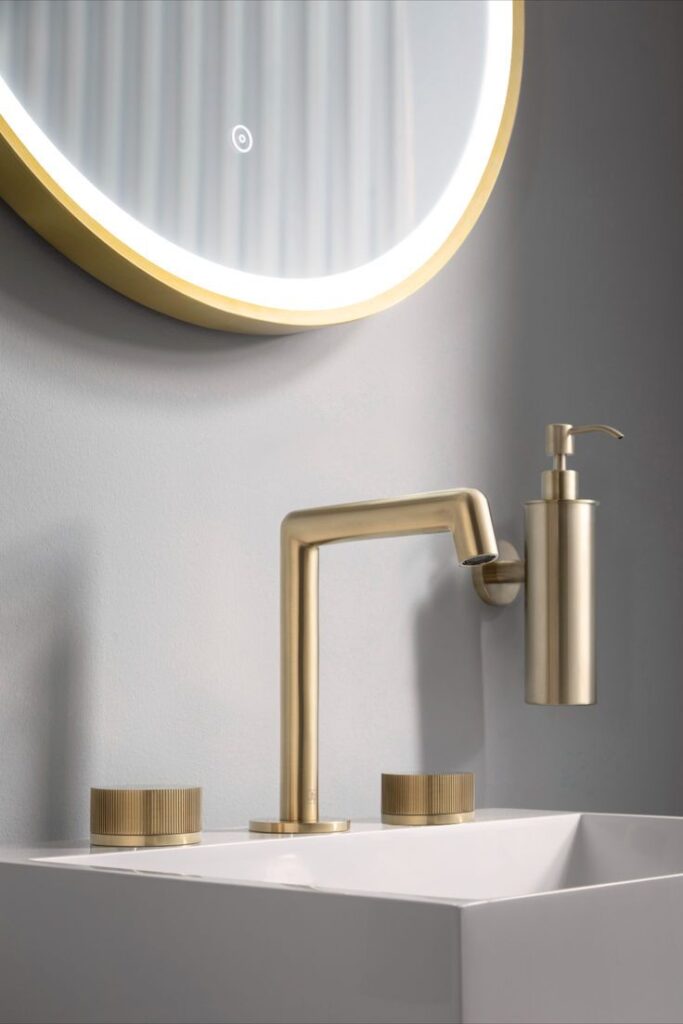
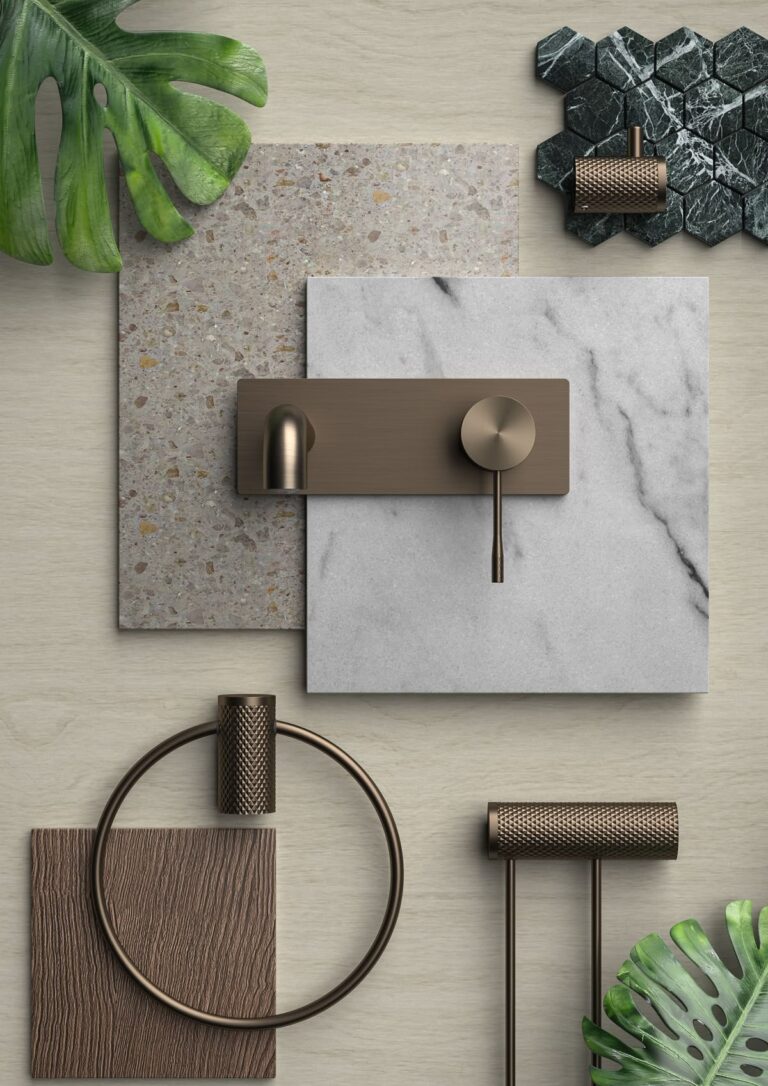
The choice of hardware finish is one of the most powerful and most affordable ways to elevate a bathroom’s elegance — and nothing elevates it more reliably than brushed gold or aged brass. Where chrome reads as utilitarian and matte black reads as contemporary-cool, brushed gold reads as classically refined. It has warmth. It has depth. It ages gracefully. It pairs beautifully with marble, natural stone, and neutral palettes.
Apply brushed gold or aged brass consistently across every piece of hardware in the bathroom: basin taps, bath filler, towel rail, shower fittings, mirror frame, toilet flush plate, hooks, and cabinet handles. Consistency is what transforms hardware selection from a series of individual choices into a cohesive design language. Mixed hardware finishes read as accidental; a single warm metallic finish, applied throughout, reads as a deliberate and confident design decision.
3. Embrace a Warm Neutral Colour Palette
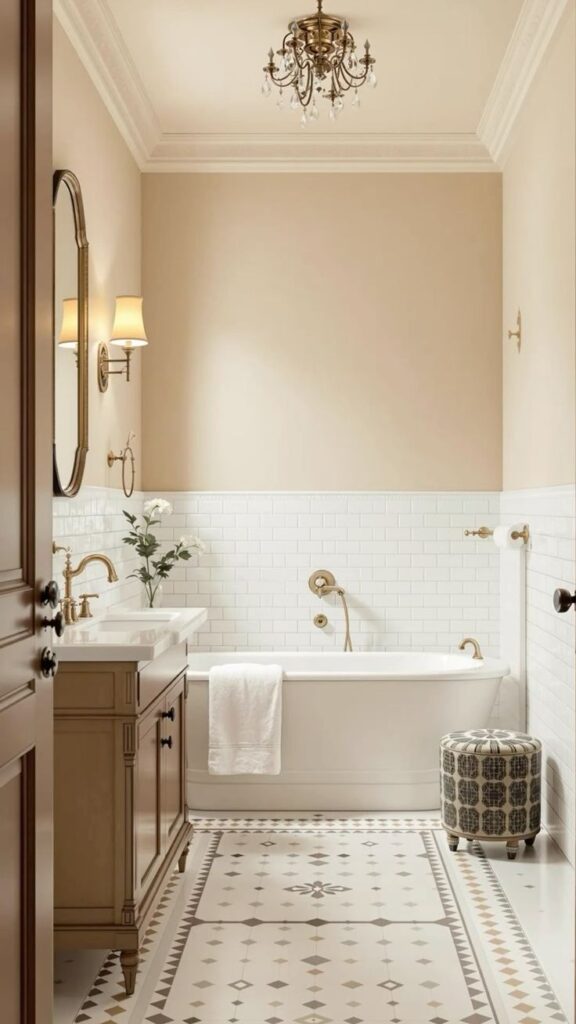
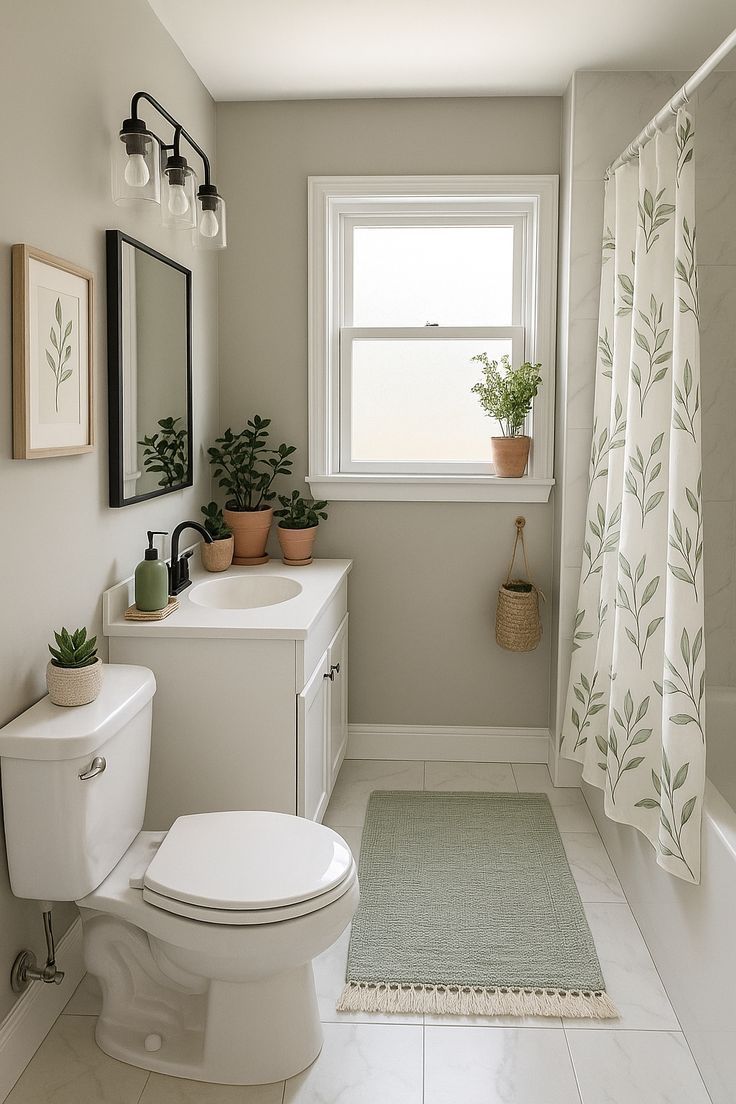
Elegant bathrooms are almost never bold in colour — and that restraint is not a limitation but a defining quality. The most timelessly beautiful bathrooms use warm neutrals: ivory, warm white, pale stone, soft blush, warm greige, and muted sage. These are the colours of natural materials — of marble, limestone, plaster, linen, and cream — and they create rooms that feel serene, harmonious, and deeply, quietly beautiful.
Avoid cool greys, pure brilliant whites, and stark contrasts in an elegant bathroom — these tend toward the contemporary-clinical rather than the warmly refined. Instead, layer warm tones: a wall colour with a warm undertone, stone tiles with cream and taupe variation, accessories in ivory and natural linen. The result is a room that feels bathed in warmth at every time of day, in every lighting condition — the hallmark of truly elegant interior design.
4. Design a Vanity That Functions as Beautiful Furniture
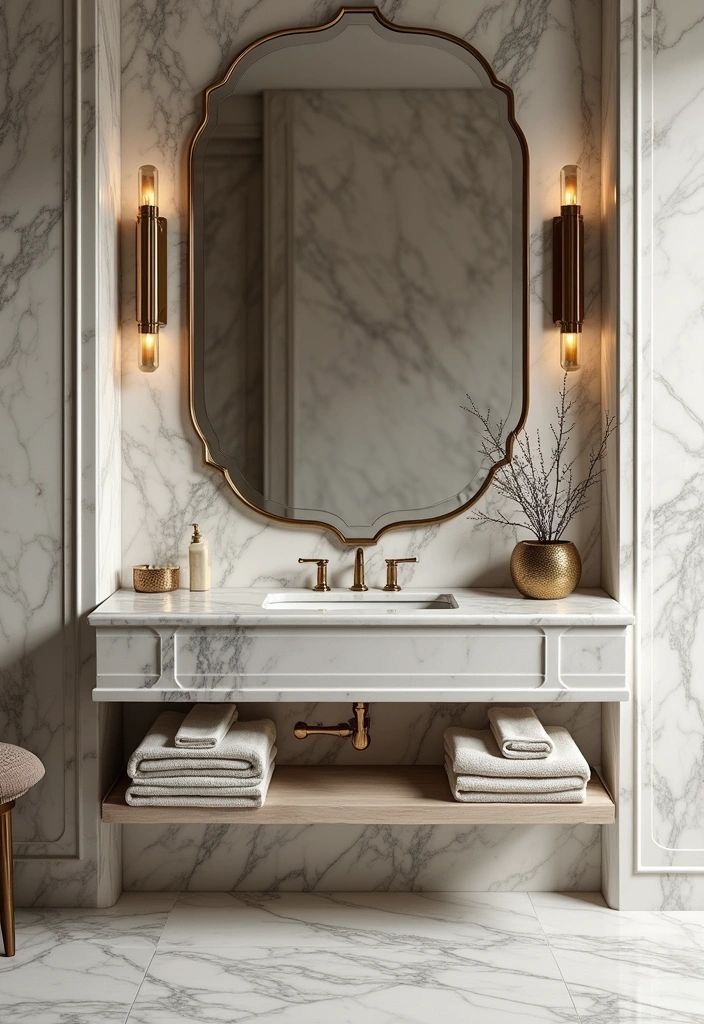
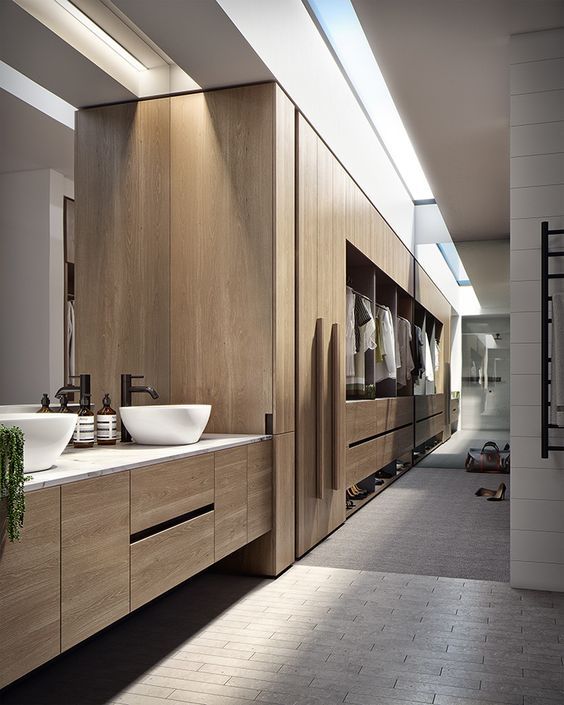
In an elegant bathroom, the vanity is not a bathroom fitting — it is a piece of furniture. And the distinction matters enormously. A furniture-style vanity has the quality, the craftsmanship, and the visual presence of a piece you might find in a beautiful dressing room or a classic French hotel: carved legs, a painted or veneered finish, a marble top, and a sense of permanence that mass-produced cabinetry rarely achieves.
Even if a fully custom or antique vanity is beyond budget, choosing a vanity with furniture-like qualities — shaped legs, a quality painted finish, a solid countertop material — makes a significant difference to the bathroom’s overall register of elegance. Pair it with a large, beautifully framed mirror, wall-mounted sconces in your chosen hardware finish, and a carefully composed surface display. The vanity is the room’s centrepiece. Treat it accordingly.
5. Install Full-Height Panelling or Wainscoting
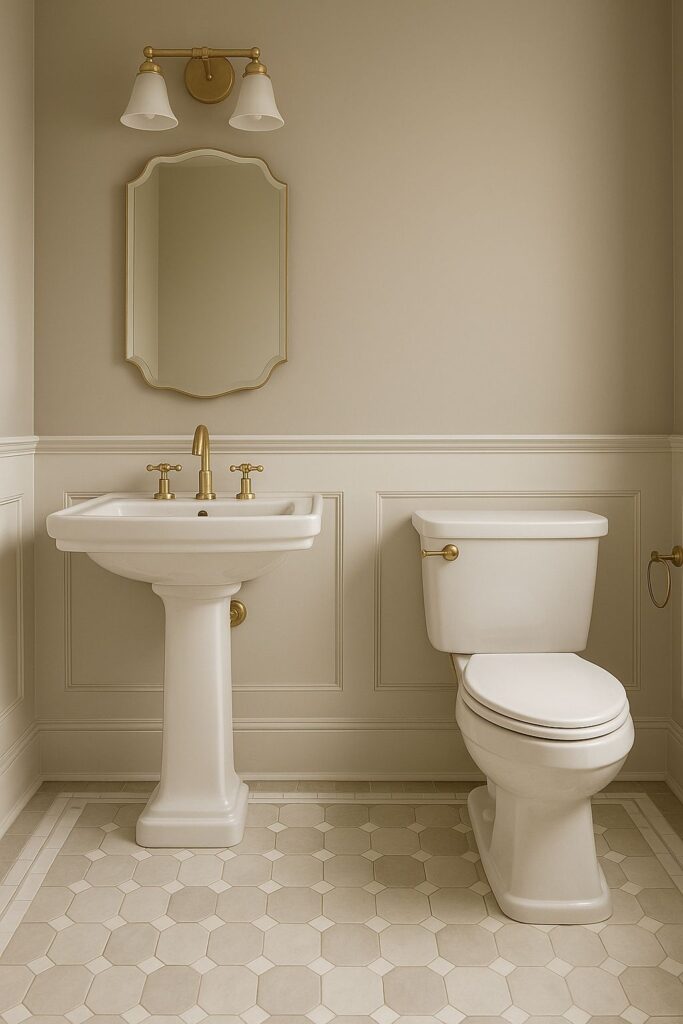
Wall panelling is one of the most classically elegant architectural details a bathroom can have — and it’s achievable at a range of price points, from full bespoke joinery to painted MDF tongue-and-groove. Panelling adds depth, texture, and an architectural quality to bathroom walls that flat paint or tile alone cannot replicate. In a traditional or transitional elegant bathroom, it is close to indispensable.
Full-height panelling painted in a warm white or soft neutral tone creates the most classical, refined result. Tongue-and-groove (also called beadboard or wainscoting) in the lower half of the room with a smooth plastered wall above creates a beautifully proportioned dado effect that suits both traditional and contemporary interpretations of elegance. Add a decorative moulding at the transition point between panel and wall for a detail that reads immediately as considered and well-made.
6. Choose Large-Format Tiles in a Timeless Pattern or Stone
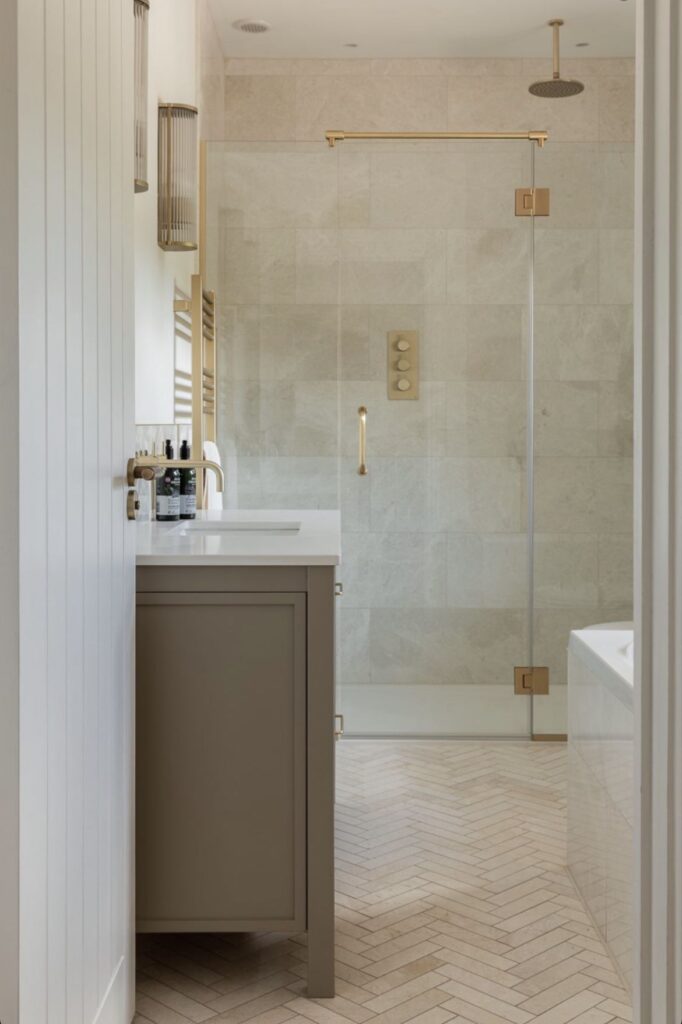
Tile choice is fundamental to a bathroom’s elegance — and the most elegant tiles share two qualities: they are large in format (fewer grout lines, more seamless visual quality) and they are made from or closely mimic natural materials. Large-format limestone, travertine, or marble-effect porcelain in warm neutral tones creates a floor and wall surface that reads as genuinely luxurious and architecturally resolved.
For an added layer of elegance, consider a herringbone or chevron layout for the floor: the directional quality of these patterns adds movement and visual interest without introducing colour or pattern in the conventional sense. The pattern comes from the layout rather than the tile’s surface, which keeps the room calm while giving it architectural interest. Tone-matched grout (colour-matched to the tile) maintains the seamless, minimal-grout-line quality that large-format tiles are chosen for.
7. Design Lighting for Flattery and Atmosphere
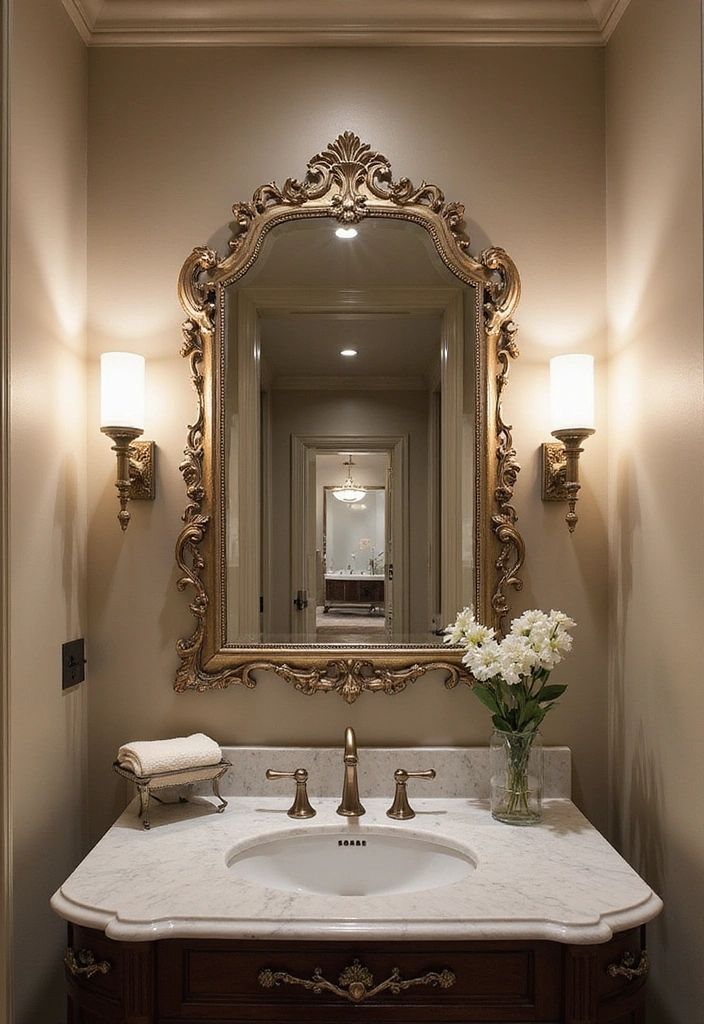
Elegant bathroom lighting is designed first for flattery and second for function — which is precisely the opposite of most bathrooms’ lighting priorities. In a truly elegant bathroom, the quality of light is curated as carefully as the tile selection: warm, layered, and designed to make every person who stands in front of the mirror feel at their best.
Wall sconces flanking the vanity mirror (rather than overhead lighting) provide the most flattering task light — it illuminates the face evenly from both sides, eliminating the harsh shadows that overhead light creates. A small chandelier or decorative pendant over the soaking tub adds a jewellery-box detail that transforms the bath into an atmospheric evening ritual. Candles on the bath ledge and beside the mirror complete the picture. Every source of light in an elegant bathroom should feel warm, considered, and slightly romantic.
8. Add an Antique or Ornate Mirror as a Focal Point
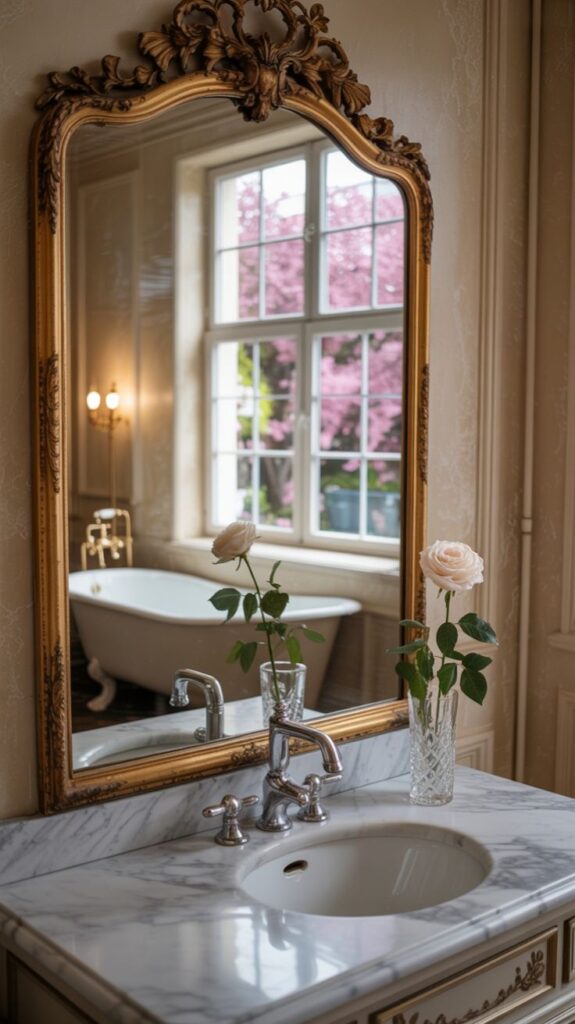
In an elegant bathroom, the mirror is not merely a functional object — it is a decorative focal point with the authority of a piece of art. An antique or ornate mirror with a beautifully detailed frame in aged gold, carved wood, or tortoiseshell pattern changes the entire register of a bathroom: it brings history, craftsmanship, and the sense of accumulated refinement that is the essence of true elegance.
Antique mirrors can be found at specialist dealers, antique fairs, and online vintage markets — and because they’re simply wall-hung rather than plumbed, they can be moved and replaced relatively easily. Look for frames in aged gilt, carved walnut, or elaborately moulded plaster. A generous scale is important: an elegant mirror should be noticeable. It should command the wall it occupies and be the first thing the eye is drawn to when the bathroom door opens.
9. Include a Clawfoot or Period-Style Bath
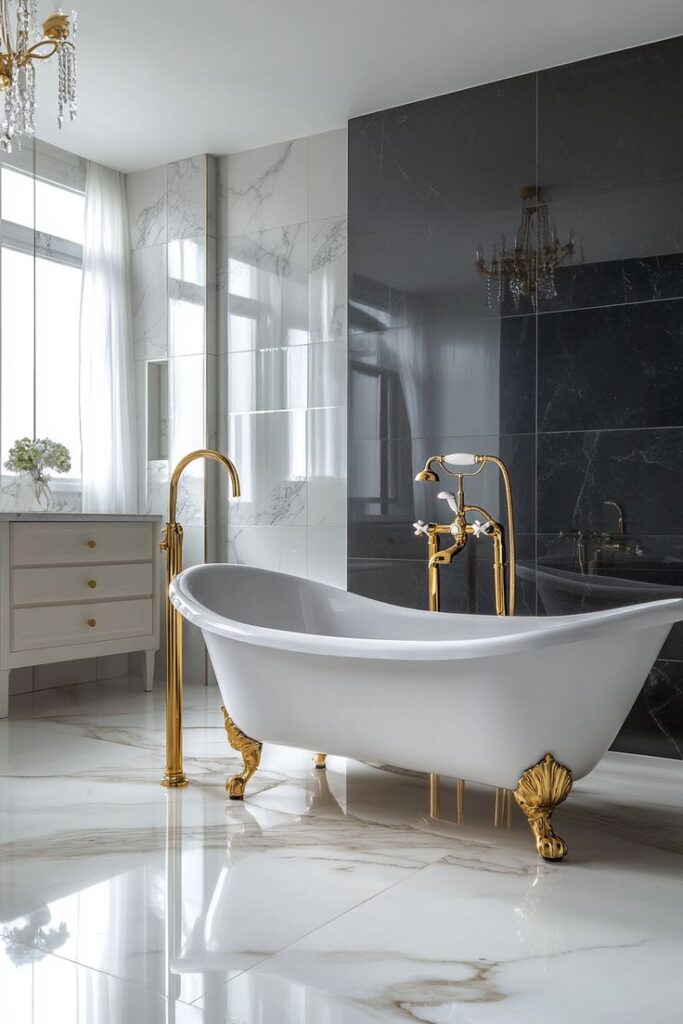
Few bathroom elements communicate classical elegance as immediately and powerfully as a period-style freestanding bath — particularly a cast iron roll-top on claw feet. This bath design has been making bathrooms beautiful for over 150 years, and its enduring appeal speaks to a quality that genuinely transcends trend: it is simply a beautiful object, perfectly proportioned, deeply functional, and resonant with the history of bathing culture.
Original Victorian cast iron roll-top baths are available through reclamation yards and specialist dealers at a range of price points depending on condition and finish. High-quality reproductions in both cast iron and acrylic are also widely available. Position the bath where it receives the most beautiful natural light — beside a large window, beneath a skylight, or where morning sun can reach it. Pair with gold or silver pillar taps and a simple bath rack in a complementary material. The result is a bathroom centrepiece that never dates.
10. Use Symmetry to Create Calm and Proportion
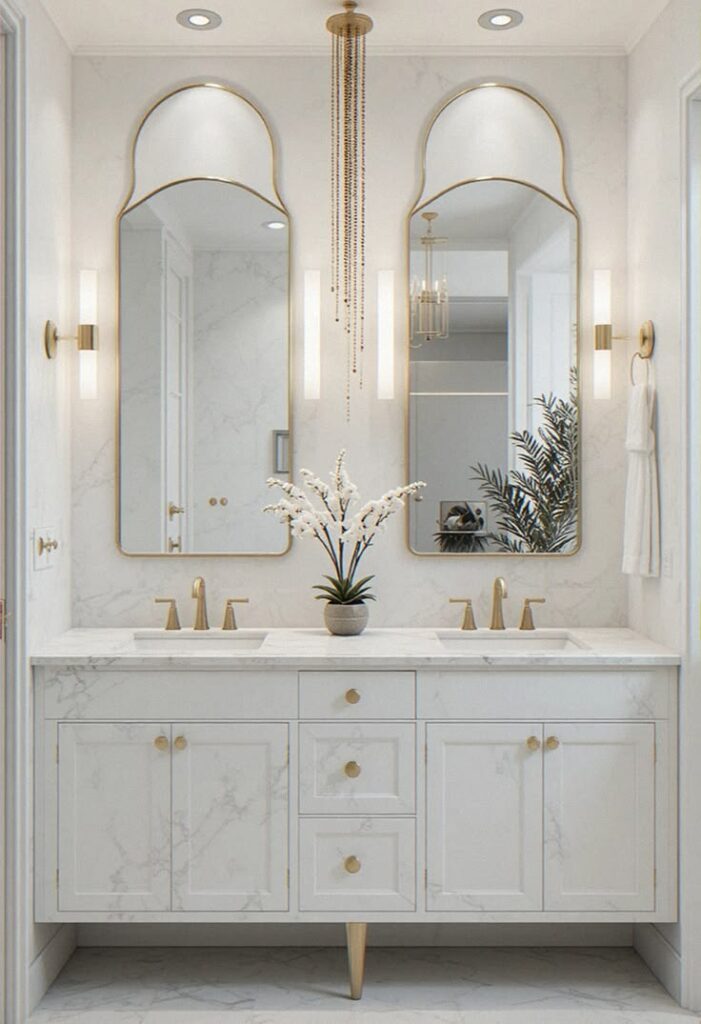
Symmetry is one of the most reliable tools in the elegant designer’s kit — and in a bathroom, it creates an immediate sense of calm, order, and architectural intentionality that asymmetric arrangements rarely achieve. When the vanity, mirror, and lighting are perfectly symmetrical, the room feels resolved and purposeful. When accessories and objects are mirrored on either side of a central axis, the composition reads as genuinely considered.
In a double-vanity bathroom, symmetry is naturally available: two basins, two mirrors (or one wide centred mirror), two sconces, two sets of accessories on either side of the countertop. In a single-vanity bathroom, create symmetry through centred placement of the mirror and balanced sconces on either side. Symmetrical display objects on the vanity surface — a matching pair of vessels, two small plants of the same species — reinforce the composition. Symmetry does not need to be rigid; it needs to feel balanced.
11. Layer Luxurious Textiles Throughout
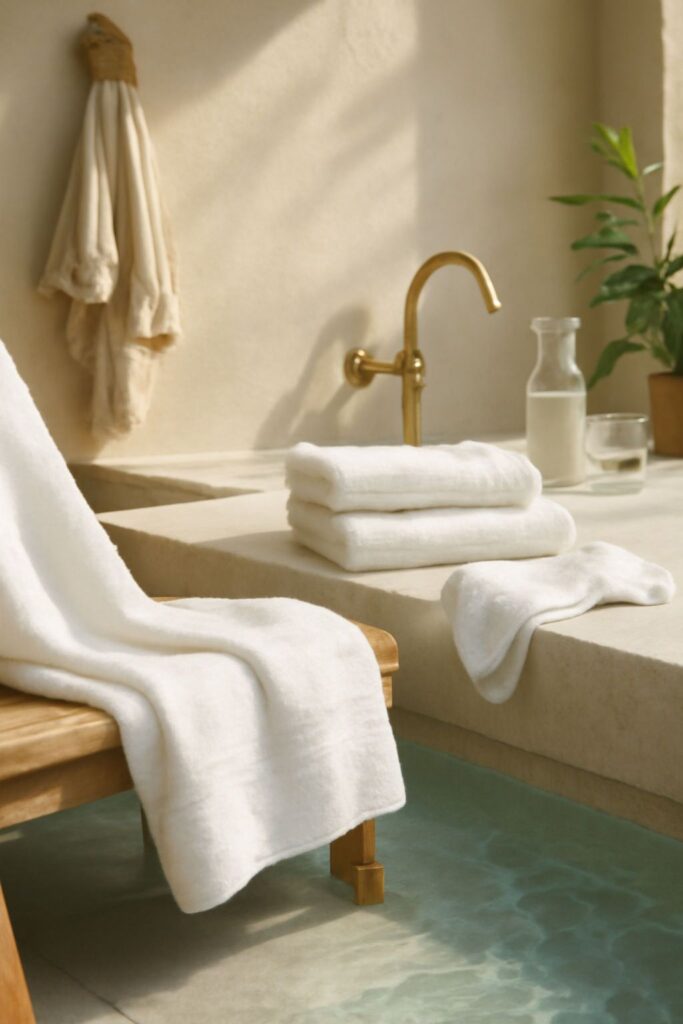
Textiles in a bathroom do something that no tile or fixture can: they introduce softness, warmth, and a deeply human quality that makes a beautifully designed bathroom feel like a place to actually inhabit, not just admire. In an elegant bathroom, the quality, colour, and presentation of textiles is part of the design — not an afterthought.
Invest in genuinely good towels: thick, heavy, beautifully white Egyptian or Turkish cotton that are displayed with care — folded over a heated brass rail, rolled in a beautiful basket, or stacked on an open shelf with a dried botanical tucked into the fold. A plush bath mat in the same white or cream tone as the towels creates continuity. A linen Roman blind at the window adds architectural softness. Each textile element should feel like it was chosen rather than bought in haste — quality that can be felt as well as seen.
12. Edit the Accessories to Only What Is Beautiful
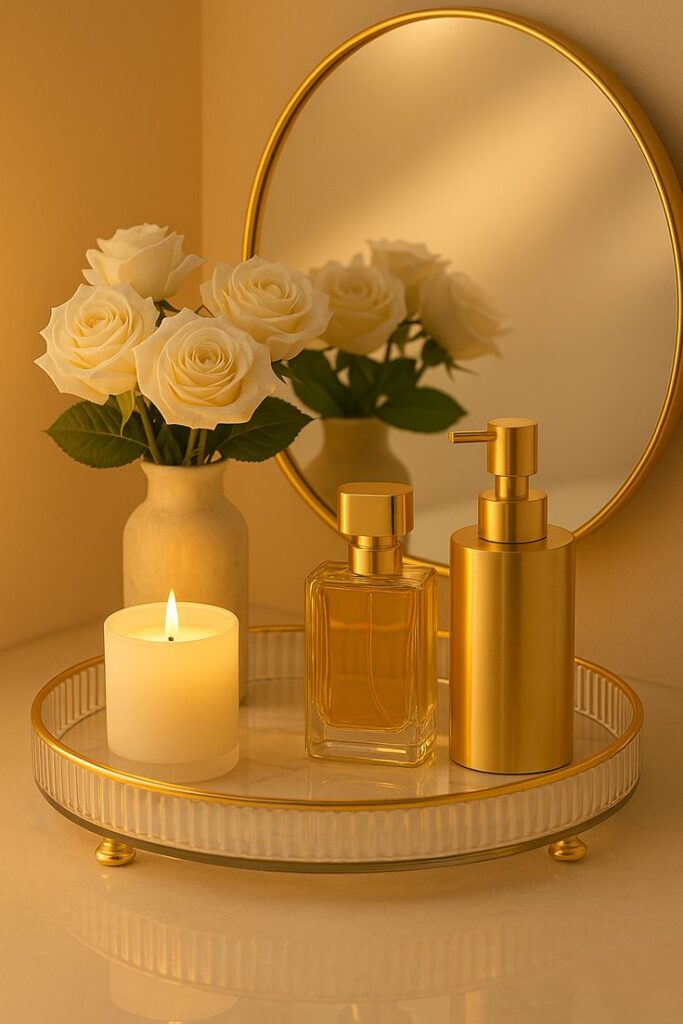
Elegance and accumulation are incompatible. The elegant bathroom has fewer objects than most bathrooms — and every one of those objects has been chosen with genuine care. There is no half-used product on the countertop, no plastic packaging, no random accumulation of things kept out of habit. Every visible surface contains only what is beautiful, used, or both.
Edit your bathroom accessories with a designer’s discipline: remove everything from all surfaces, then return only the objects that are genuinely beautiful and genuinely used. A favourite soap in a beautiful dish. One perfume. A candle you will light. A small crystal or ceramic object with meaning. Everything else goes behind closed doors. The clarity of a well-edited bathroom surface — the generous expanse of marble with just a few carefully chosen objects — is one of the most immediately readable signals of genuine elegance. Restraint is the most sophisticated design choice.
13. Get the Proportions Right — They Underpin Everything
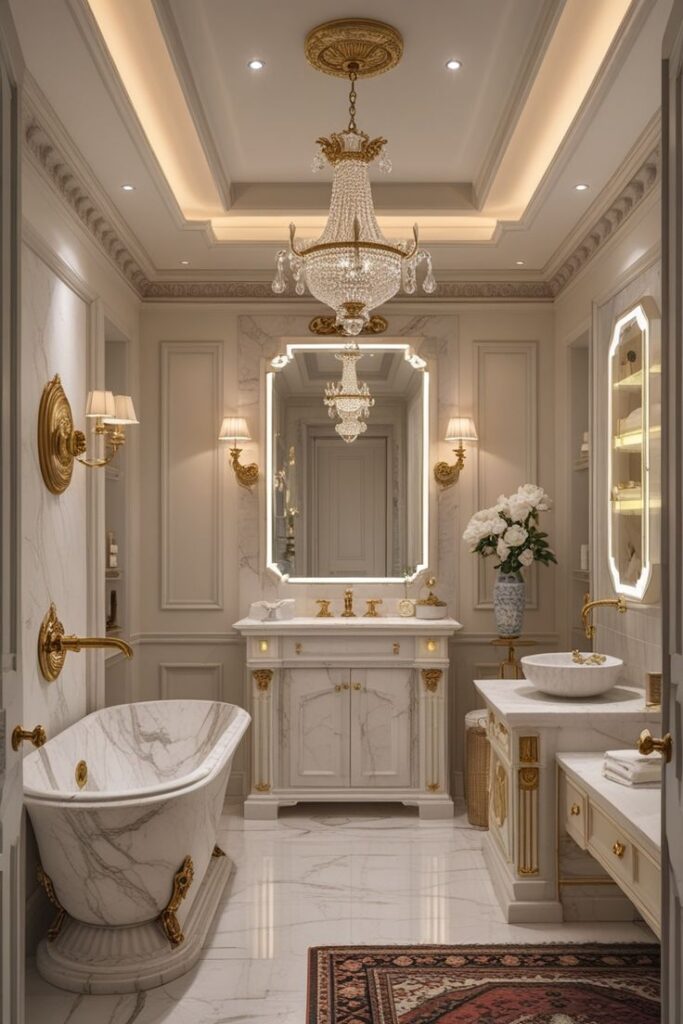
Proportion is the invisible foundation of all elegant design — and in a bathroom, getting the proportions right is what separates a room that looks expensive but somehow off from one that looks effortlessly, timelessly beautiful. Proportion is about the relationship between elements: the mirror in relation to the vanity, the sconces in relation to the mirror, the tile scale in relation to the floor area, the ceiling height in relation to the room’s footprint.
A few proportion guidelines for elegant bathrooms: the mirror should be at least as wide as the vanity (ideally wider). Sconces should sit at face height when standing — approximately 165–170cm from the floor. Floor tiles should be large enough to minimise grout lines — in most bathrooms, at least 60x60cm. Wall tiles should be scaled to the wall height — a 2.4m ceiling can handle tall tiles; a low ceiling cannot. Artwork should be hung so its centre is at eye level. These principles, applied consistently, create a room where everything feels right — even before you can identify exactly why.
━━━━━━━━━━━━━━━━━━━━━━━━━━━━━━━━━━━━━━━━
Elegance in a bathroom is not a price point. It is a quality of attention — to material, to proportion, to restraint, and to the small details that most people never consciously notice but everyone instinctively feels. It is the marble edge perfectly mitred at the vanity corner. It is the single beautiful object on an otherwise clear surface. It is the quality of light at dusk, warm and flattering and still.
You don’t need a complete renovation to move your bathroom significantly toward elegance. Begin with the hardware — swap the chrome taps for brushed gold. Clear the surfaces — every unnecessary object removed is a step toward refinement. Add a beautiful mirror, a quality towel, a candle that makes the room smell like care and intention. Elegance grows from decisions made with attention, one at a time.
The bathroom you’re imagining — calm, beautiful, and quietly extraordinary — is closer than you think. It starts with choosing to pay attention. And you’ve already begun.
Which elegant bathroom idea speaks most to your aesthetic? Share your vision or your finished room in the comments — I’d love to see the elegance you create!